
6. Distinguish between a Fast Breeder Reactor (FBR) and a thermal nuclear reactor. In the context of first indigenously developed prototype FBR at Kalpakkam, explain the term ‘criticality’. What are its implications for clean energy future of our country? (Answer in 150 words)
Introduction
Nuclear reactors produce electricity by using the heat released during nuclear fission. Thermal reactors and Fast Breeder Reactors (FBRs) differ mainly in the way they use neutrons and nuclear fuel. For India, moving from thermal reactors to FBRs is an important step towards its three-stage nuclear power programme.
1. Thermal Reactor vs Fast Breeder Reactor
| Parameter | Thermal Reactor – Stage I (e.g., PHWR) | Fast Breeder Reactor – Stage II (e.g., PFBR) |
| Neutrons | Uses slow or thermal neutrons | Uses high-energy or fast neutrons |
| Moderator | Uses a moderator, such as heavy water | No moderator |
| Coolant | PHWR mainly uses heavy water | Uses liquid sodium |
| Fuel | Mainly natural uranium in PHWRs | Uses U-Pu mixed oxide (MOX) fuel |
| Fuel Cycle | Mainly consumes uranium and produces plutonium in spent fuel | Converts fertile U-238 into fissile Pu-239, producing more fissile material than it consumes |
2. What is Criticality?
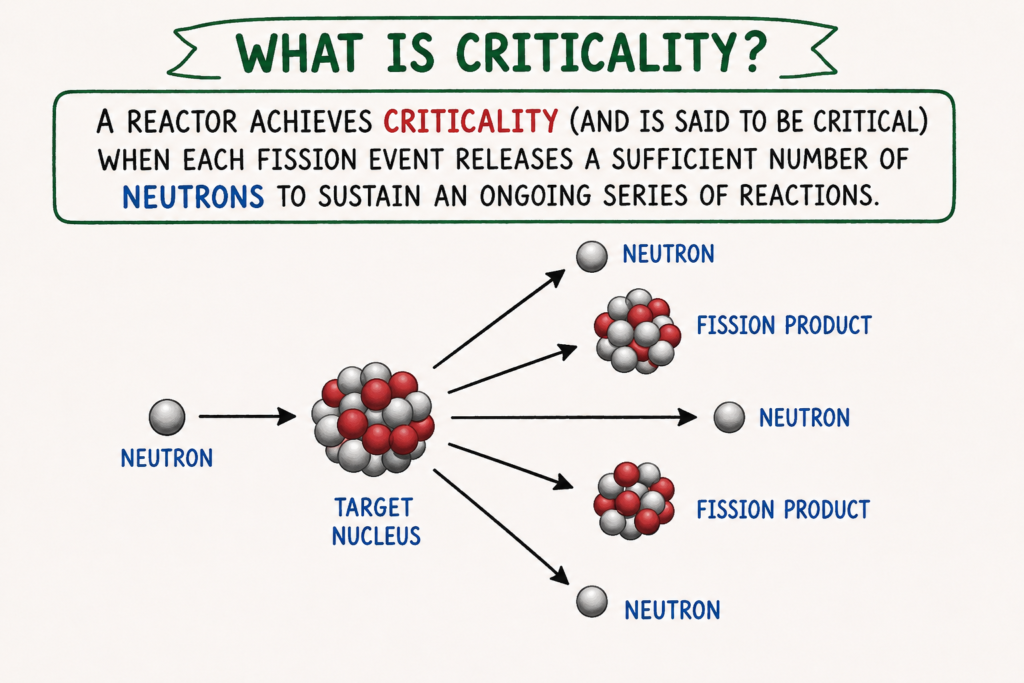
Criticality is the stage at which a nuclear chain reaction becomes self-sustaining—the neutrons produced during one generation of fission are sufficient to sustain the next generation.



India’s 500 MWe Prototype Fast Breeder Reactor (PFBR) at Kalpakkam achieved first criticality on 6 April 2026, marking a major milestone in India’s nuclear programme. It has been designed by IGCAR and built and commissioned by BHAVINI.
3. Importance for India’s Energy Future
- Moving towards Thorium: FBRs can convert fertile material into fissile fuel and therefore provide an important bridge towards India’s third-stage thorium programme and eventual production of U-233.
- Better use of fuel: The breeder technology allows India to extract greater energy from its limited uranium resources and reduce dependence on imported fuel.
- Lower waste burden: A closed fuel cycle allows greater recovery and reuse of nuclear materials and can reduce the volume of waste requiring long-term management.
- Reliable clean power: Unlike intermittent renewable sources, nuclear power can provide dependable low-carbon baseload electricity.
- Energy security: Nuclear expansion can support India’s long-term energy requirements while helping it move towards its Net Zero 2070 goal.
Conclusion
The PFBR’s first criticality is therefore more than a technological achievement. It strengthens India’s energy security, indigenous technological capability and fuel-cycle expertise. As India moves from uranium-based thermal reactors towards breeder technology and ultimately greater use of thorium, FBRs can act as a crucial bridge in India’s three-stage nuclear programme.




 Ravi Raaz
 Hassan Khan
 Shadab Ali