
8. Discuss the aim and goals of Kunming-Montreal global biodiversity framework. Mention India’s commitments and initiatives to achieve the goals and targets of this framework giving suitable examples. (Answer in 150 words)
Introduction
The Kunming-Montreal Global Biodiversity Framework (KMGBF) was adopted at CBD COP-15 in 2022 to guide countries in protecting and restoring biodiversity by 2030 and achieving the broader vision of “Living in Harmony with Nature by 2050.” It contains 4 long-term goals for 2050 and 23 targets for 2030.
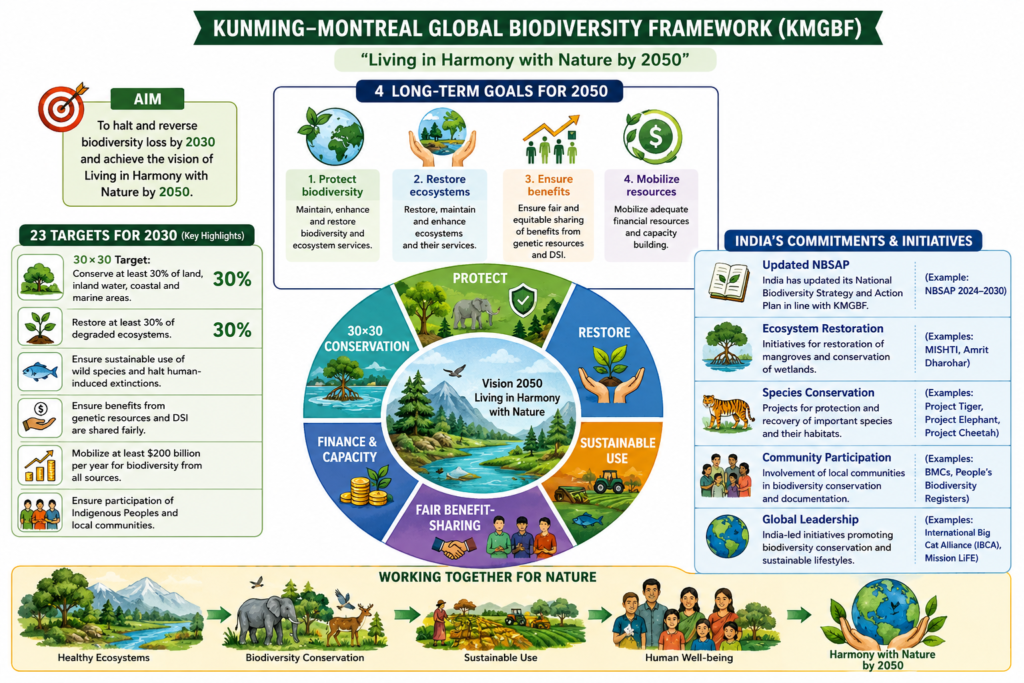
Aim and Key Goals
- Protect nature: Reduce biodiversity loss, prevent species extinction and maintain healthy ecosystems.
- Restore ecosystems: Restore at least 30% of degraded ecosystems by 2030.
- 30×30 target: Effectively conserve at least 30% of terrestrial, inland-water, coastal and marine areas by 2030.
- Sustainable use: Ensure that agriculture, forestry, fisheries and other activities use biodiversity responsibly.
- Fair benefit-sharing: Ensure that communities and countries receive a fair share of benefits from genetic resources and traditional knowledge.
- Finance: Increase financial and technological support for biodiversity conservation, particularly in developing countries.



India’s Initiatives
- Updated NBSAP: India has updated its National Biodiversity Strategy and Action Plan in line with the KMGBF.
- Ecosystem restoration: MISHTI promotes mangrove restoration, while Amrit Dharohar focuses on wetland conservation.
- Species conservation: Project Tiger, Project Elephant and Project Cheetah support the protection and recovery of important species.
- Community participation: Biodiversity Management Committees (BMCs) and People’s Biodiversity Registers (PBRs) involve local communities in documenting and conserving biodiversity.
- Global leadership: The International Big Cat Alliance (IBCA) and Mission LiFE promote biodiversity conservation and sustainable lifestyles.
Conclusion
Thus, the KMGBF provides a common global direction, while India is translating it into action through ecosystem restoration, species conservation and community participation. The key challenge is to balance development needs with long-term ecological security.




 Ravi Raaz
 Hassan Khan
 Shadab Ali