
4. Explain the factors responsible for inefficiency of agri-produce marketing. How e-commerce helps to reduce inefficiency of agri-produce marketing? Explain. (Answer in 150 words)
Introduction
Agricultural marketing inefficiency in India arises when farmers face high transaction costs, limited market choices and weak infrastructure, resulting in a large gap between the price received by farmers and the price paid by consumers.
Factors Responsible for Inefficiency
- Multiple Intermediaries: Several layers of traders and middlemen increase transaction costs and reduce the farmer’s share in the consumer’s rupee.
- Trader Cartelisation: Local trader groups may restrict competition and influence prices, particularly in fragmented markets.
- Poor Infrastructure: Inadequate cold storage, warehouses, transport and processing facilities lead to significant post-harvest losses, especially in perishables.
- Information Asymmetry: Farmers often lack timely information about prices, demand and buyers, encouraging distress sales.
- Fragmented Markets: High mandi charges, regulatory barriers and inadequate quality-assessment facilities restrict wider market access.
How E-Commerce Reduces Inefficiency
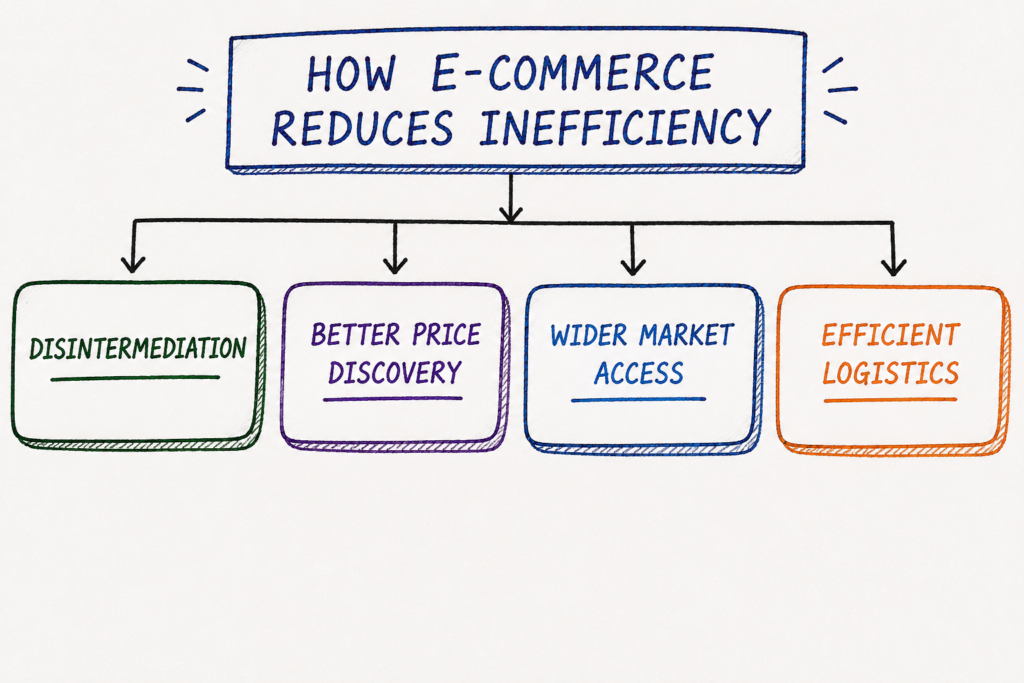
- Disintermediation: Platforms such as e-NAM, ONDC and private agritech platforms can connect farmers and FPOs with buyers more directly.
- Better Price Discovery: Digital bidding and quality-based assaying improve transparency and competition.
- Wider Market Access: Online platforms connect producers with buyers beyond local mandis, expanding their bargaining power.
- Efficient Logistics: Digital aggregation, farm-gate collection and integrated logistics can reduce handling and spoilage.



Conclusion
Thus, e-commerce can make agricultural marketing more transparent, competitive and efficient. However, its full benefits depend on better digital literacy, reliable connectivity, quality assaying and logistics infrastructure




 Ravi Raaz
 Hassan Khan
 Shadab Ali