
3. Describe the various Technology Missions initiated in Indian agriculture and examine their role in food security. (Answer in 150 words)
Introduction
Technology Missions in Indian agriculture follow a mission-mode approach that combines research, improved seeds, farm mechanisation, extension services and post-harvest management to raise productivity and address gaps in the agricultural sector.
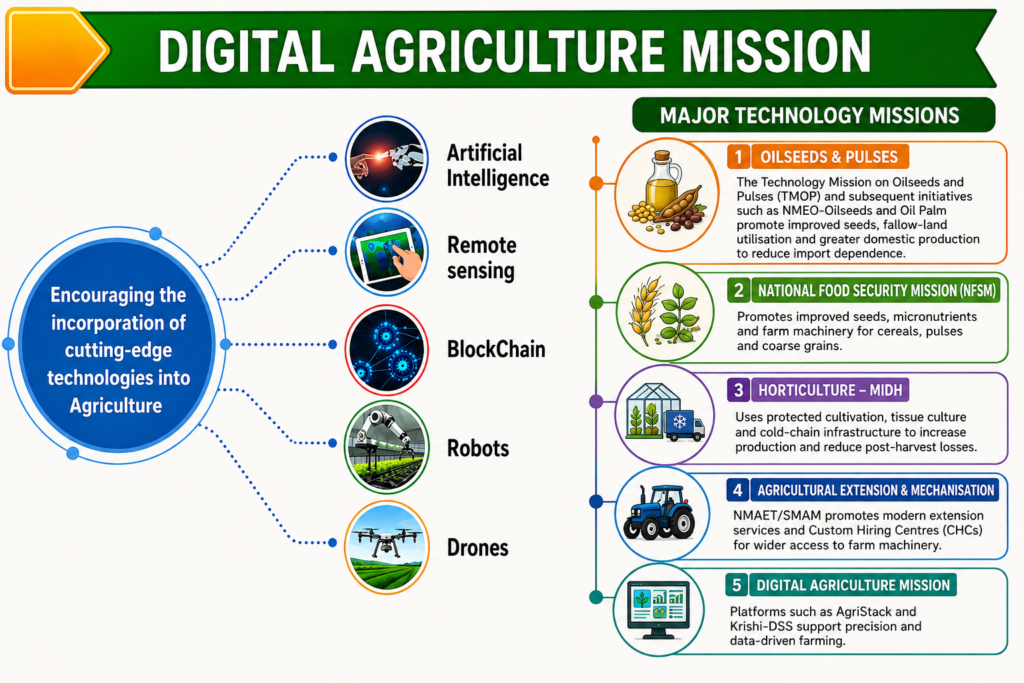
Major Technology Missions
- Oilseeds & Pulses: The Technology Mission on Oilseeds and Pulses (TMOP) and subsequent initiatives such as NMEO-Oilseeds and Oil Palm promote improved seeds, fallow-land utilisation and greater domestic production to reduce import dependence.
- National Food Security Mission (NFSM): Promotes improved seeds, micronutrients and farm machinery for cereals, pulses and coarse grains.
- Horticulture – MIDH: Uses protected cultivation, tissue culture and cold-chain infrastructure to increase production and reduce post-harvest losses.
- Agricultural Extension & Mechanisation: NMAET/SMAM promotes modern extension services and Custom Hiring Centres (CHCs) for wider access to farm machinery.
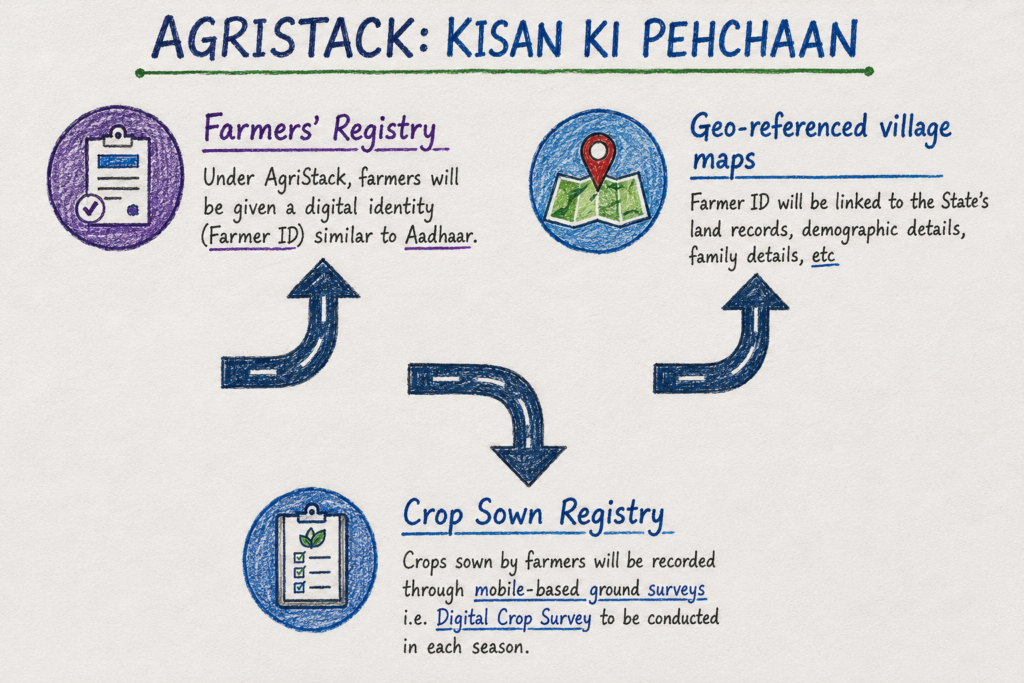
- Digital Agriculture Mission: Platforms such as AgriStack and Krishi-DSS support precision and data-driven farming.



Role in Food Security
- Higher production: Raises agricultural productivity and food availability.
- Nutritional security: Promotes pulses, coarse cereals, fruits and vegetables, diversifying diets.
- Climate resilience: Improved seeds and efficient resource use help withstand droughts and other climate shocks.
Conclusion
Thus, Technology Missions have helped India move beyond mere food availability towards a food system that is productive, diversified, nutritionally secure and climate-resilient.




 Ravi Raaz
 Hassan Khan
 Shadab Ali