
GS-II: Governance | Social Justice | Rural Development | Right to Work | Welfare Schemes
Context
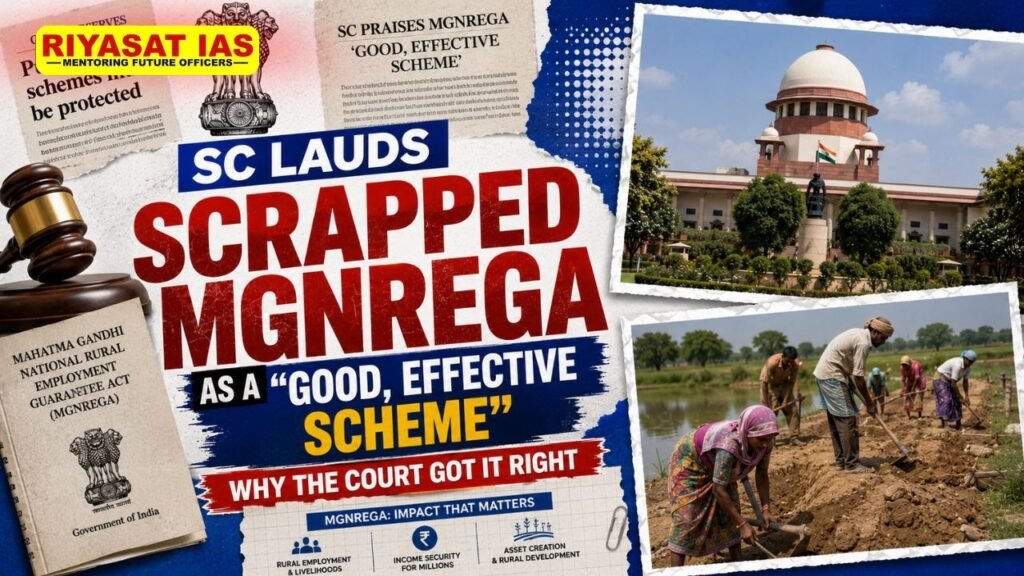
- Supreme Court Observation: The Supreme Court has described the now-repealed MGNREGA as a “good, effective scheme” while hearing a petition concerning delayed wage payments.
- Repeal: The Mahatma Gandhi National Rural Employment Guarantee Act, 2005 ceased to operate from July 1, 2026, following its replacement by the Viksit Bharat–Guarantee for Rozgar and Ajeevika Mission (Gramin) Act, 2025 (VB-GRAM G).
- Significance: The observation brings attention to the importance of rural employment guarantees, timely wage payments and livelihood security.
MGNREGA: Core Features
- Legal Guarantee: MGNREGA provided a legal guarantee of employment to rural households.
- Employment Guarantee: It guaranteed up to 100 days of wage employment to rural households willing to undertake unskilled manual work.
- Demand-Driven Nature: Employment was based on the demand for work, making it a rights-based programme.
- Livelihood Security: It served as an important social safety net during periods of rural unemployment and economic distress.
- Asset Creation: Employment was linked with the creation of productive rural assets.
- Women’s Participation: The programme provided an important source of wage employment for rural women.
- Decentralisation: Gram Panchayats played an important role in identifying and implementing works.
Why MGNREGA Was Considered Effective
- Rural Safety Net: It provided a fallback source of employment when other opportunities were unavailable.
- Income Support: Wage employment helped rural households cope with income insecurity.
- Bargaining Power: Access to guaranteed employment could strengthen the bargaining position of rural workers.
- Social Inclusion: The programme provided employment opportunities to vulnerable sections of rural society.
- Local Asset Creation: Works undertaken under the programme contributed to rural infrastructure and natural-resource management.
- Demand-Driven Character: Workers could seek employment when required, rather than depending entirely on predetermined allocations.



Challenges Under MGNREGA
- Delayed Wages: Delays in wage payments weakened the effectiveness of the employment guarantee.
- Administrative Constraints: Implementation varied significantly across States.
- Technological Barriers: Digital systems such as e-KYC created difficulties for some workers. A 2026 report cited technological hurdles affecting access to employment.
- Underemployment: Households often received fewer than the maximum 100 days of employment.
- Funding Constraints: Adequate and timely funding remained important for ensuring the demand-driven character of the programme.
- Implementation Gaps: Delays, administrative hurdles and uneven implementation could reduce the programme’s effectiveness.
Why the Supreme Court Observation Matters
- Right-Based Welfare: MGNREGA represented a shift from discretionary welfare towards a legal employment guarantee.
- Article 41: The Directive Principles under Article 41 call upon the State to make effective provision for the right to work, within the limits of its economic capacity.
- Rural Distress: Employment guarantees remain important where agricultural employment and rural non-farm opportunities are inadequate.
- Timely Payment: An employment guarantee becomes meaningful only when wages are paid promptly.
- Accountability: Judicial scrutiny of delayed wages reinforces the principle that welfare legislation must translate into effective entitlements on the ground.
MGNREGA and VB-GRAM G: Key Transition
- Replacement: MGNREGA has been replaced by the VB-GRAM G framework from July 2026.
- Policy Question: The transition raises the broader question of how India should balance employment guarantees, fiscal sustainability, decentralisation and rural development.
- Continuity: The effectiveness of the new framework will ultimately depend on whether vulnerable rural households continue to receive accessible and reliable employment opportunities.
- Technology: Digital systems should improve transparency without becoming barriers for workers.
- Federal Dimension: Rural employment programmes require effective coordination between the Union, States and Panchayats.
Way Forward
- Timely Wage Payments: Ensure predictable and prompt payment of wages.
- Accessible Employment: Reduce technological and administrative barriers that prevent workers from accessing employment.
- Demand Responsiveness: Ensure employment programmes remain responsive to actual rural demand.
- Social Audits: Strengthen independent and participatory social audits.
- Panchayat Capacity: Strengthen Gram Panchayats for effective planning and implementation.
- Women-Centric Approach: Continue ensuring meaningful participation of women in rural employment programmes.
- Asset Quality: Link employment generation with durable rural and ecological assets.
- Accountability: Establish effective grievance-redress mechanisms for delayed wages and denial of employment.
Conclusion
The Supreme Court’s description of MGNREGA as a “good, effective scheme” underlines the continuing importance of a reliable rural employment safety net.
The transition to VB-GRAM G should therefore not be assessed merely by the number of employment days promised, but by whether rural workers receive timely wages, accessible employment, effective grievance redressal and genuine livelihood security.
UPSC Mains Practice Question
Q. “The effectiveness of a rural employment programme lies not merely in the number of employment days guaranteed, but in its ability to provide timely wages, accessible employment and livelihood security.” Discuss in the context of MGNREGA and its replacement by VB-GRAM G.





 Ravi Raaz
 Hassan Khan
 Shadab Ali