
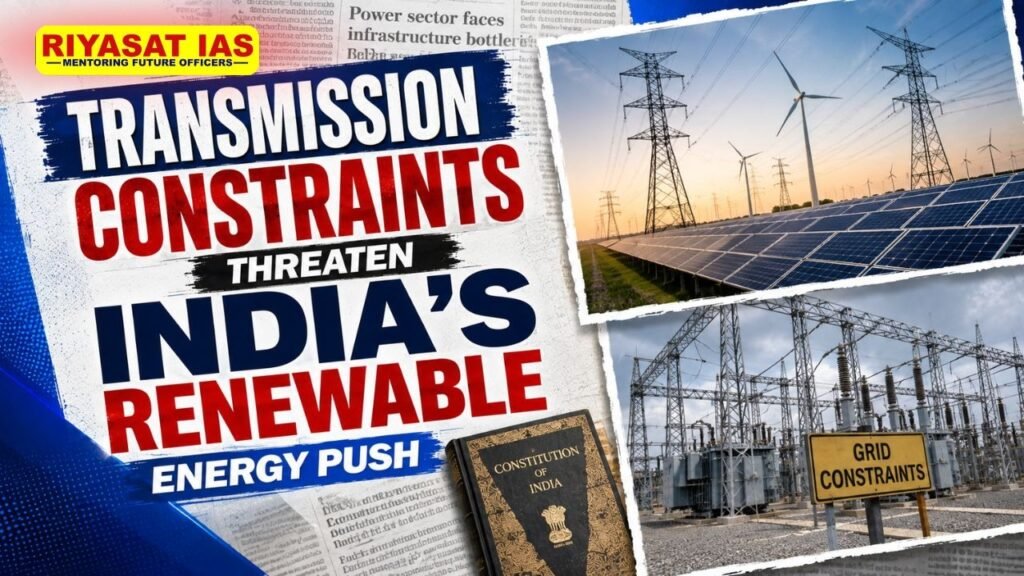
GS-III: Energy | Renewable Energy | Infrastructure | Power Sector | Climate Change
Context
- Transmission bottleneck: Insufficient transmission lines have emerged as a major obstacle to India’s rapid expansion of renewable energy capacity.
- Curtailment: Several solar projects are being curtailed during daylight hours because of oversupply and grid congestion.
- ICRA assessment: Around 37% of renewable capacity at substations affected by curtailment in the northern, western and southern regions operates under Temporary General Network Access (T-GNA).
- Extent of curtailment: This capacity faces around 30%–50% curtailment during the day.
- Peak curtailment: In western India, peak curtailment reached 8,617 MW as of August 6, while the northern region recorded 5,573 MW.
- Core concern: India’s renewable-energy expansion is increasingly constrained not by generation capacity alone, but by grid adequacy and transmission infrastructure.
Temporary General Network Access (T-GNA)
- Meaning: T-GNA is a short-term arrangement allowing renewable-energy projects to use available capacity on the inter-State transmission system.
- Duration: It can range from a single time block to about 11 months.
- Vulnerability: Projects operating under T-GNA are particularly vulnerable to curtailment.
- Financial impact: Prolonged dependence on T-GNA can increase operational costs and affect revenues.
- Affected capacity: Around 37% of renewable capacity at affected substations operates under T-GNA.
Regional Impact
- Western region: About 55% of affected capacity was under T-GNA, with peak curtailment of 8,617 MW.
- Northern region: Peak curtailment reached 5,573 MW.
- Southern region: It is also among the regions experiencing transmission-related curtailment.
- Underlying issue: Renewable generation is growing faster than the transmission network required to evacuate and distribute electricity.



Other Constraints
- Transmission infrastructure: Delays in intra-State and inter-State transmission projects remain a major bottleneck.
- Storage: Insufficient energy-storage capacity limits the ability to absorb surplus renewable generation.
- PPAs: Delays in finalising Power Purchase Agreements slow project development.
- Land acquisition: Difficulty in acquiring land delays infrastructure creation.
- DISCOM finances: Weak financial conditions of distribution companies affect the renewable-energy ecosystem.
- Grid adequacy: Adequate transmission and grid capacity are essential for converting installed renewable capacity into actual electricity generation.
India’s Renewable Energy Pipeline
- Large pipeline: More than 150 GW of renewable-energy projects were under construction as of June 30.
- Generation share: Renewable energy, including large hydro, is estimated to account for more than 35% of electricity generation by FY 2029–30, compared with 22% in FY 2024–25.
- Investment challenge: Such rapid capacity expansion requires transmission infrastructure to grow ahead of or alongside generation capacity.
Decline in Renewable Energy Bidding
- 2024–25: Around 40.6 GW of renewable capacity was awarded.
- 2025–26: Awards declined to 14.7 GW.
- Current year: Only 4.7 GW had been awarded through August 10.
- Unsigned PPAs: Around 40–45 GW of awarded capacity remained without signed PPAs as of April 2026.
- Changing bidding pattern: New bids increasingly focus on Firm and Dispatchable Renewable Energy (FDRE) and Round-the-Clock (RTC) power.
Why FDRE and RTC Matter
- Intermittency: Solar and wind generation varies according to sunlight and weather conditions.
- FDRE: Designed to provide renewable electricity in a more reliable and dispatchable manner.
- RTC power: Seeks to provide electricity throughout the day, rather than only when renewable resources are available.
- Storage integration: Such models encourage integration of battery storage and other energy-storage technologies.
- Grid stability: They can reduce dependence on intermittent generation and improve power-system reliability.
Way Forward
- Transmission expansion: Ensure timely completion of intra-State and inter-State transmission infrastructure.
- Generation-transmission coordination: Plan transmission capacity alongside renewable-energy projects.
- Energy storage: Rapidly expand battery energy storage and other storage systems to manage surplus generation.
- Reduce curtailment: Improve grid management and evacuation infrastructure to minimise renewable-energy wastage.
- PPA reforms: Ensure timely finalisation of Power Purchase Agreements.
- DISCOM reforms: Strengthen the financial health of distribution companies.
- FDRE/RTC projects: Encourage renewable projects capable of providing firm and round-the-clock electricity.
- Integrated planning: Treat generation, transmission, storage and distribution as interconnected components of the energy transition.
Conclusion
India’s renewable-energy challenge is increasingly shifting from “How much renewable capacity can be installed?” to “Can the grid absorb and transmit it?” Without adequate transmission and storage, large investments in renewable generation may remain underutilised and lead to curtailment.
Therefore, India’s clean-energy transition must be supported by “generation + transmission + storage + distribution” as an integrated system.
UPSC Mains Practice Question
Q. “India’s renewable energy transition is increasingly constrained by transmission and grid adequacy rather than generation capacity.” Discuss the challenges and suggest measures to strengthen India’s renewable energy infrastructure.





 Ravi Raaz
 Hassan Khan
 Shadab Ali