
GS-II: International Relations | Multilateral Groupings | Global Governance
GS-III: Environment | Climate Change | International Trade
Context
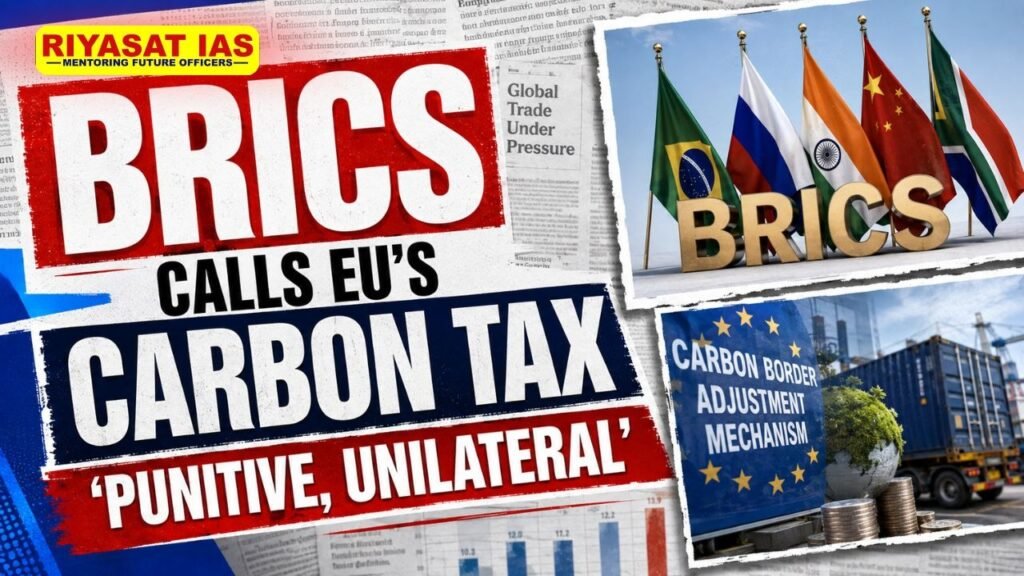
- BRICS criticism: BRICS has described the European Union’s Carbon Border Adjustment Mechanism (CBAM) as “punitive, unilateral”.
- Core concern: BRICS countries argue that such measures can act as trade barriers while being presented as environmental measures.
- Developing countries: The issue is particularly important for developing economies whose exports may face additional carbon-related costs in the EU market.
What is CBAM?
- Carbon border measure: CBAM puts a carbon-related cost on certain carbon-intensive imports entering the European Union.
- Objective: Its stated objective is to prevent carbon leakage, where production shifts to countries with less stringent climate regulations.
- Covered sectors: It covers sectors such as iron and steel, aluminium, cement, fertilisers and electricity.
- Carbon cost: Importers are required to account for the embedded carbon emissions in covered products.
Why BRICS Opposes It
- Unilateral measure: BRICS objects to the EU imposing carbon-related trade measures without a broader multilateral agreement.
- Protectionism: Such measures may act as protectionist barriers for European industries.
- Developing-country burden: Developing countries may face greater difficulty in meeting additional carbon-related requirements.
- Trade competitiveness: Additional carbon costs can affect the competitiveness of exports from developing economies.
- Climate equity: The issue raises concerns regarding fairness and differentiated responsibilities in global climate action.



Concerns for India
- Export competitiveness: Indian exports to the EU could become more expensive due to carbon-related costs.
- Industrial impact: Carbon-intensive sectors such as steel and aluminium may be particularly affected.
- Decarbonisation costs: Indian industries may need additional investment to reduce their carbon intensity.
- Developmental priorities: Developing countries have different financial and technological capacities for achieving rapid decarbonisation.
- Policy space: Unilateral measures may restrict the policy choices available to developing economies.
Core Argument
- Climate objective: Preventing carbon leakage is a legitimate climate objective.
- Trade concern: However, climate measures should not become disguised protectionism.
- Equity: Climate action must recognise the different circumstances and capacities of developed and developing countries.
- Multilateralism: Global climate and trade measures should preferably be developed through multilateral cooperation.
Way Forward
- Multilateral dialogue: Carbon-related trade measures should be discussed through multilateral platforms.
- Climate finance: Developed countries should provide adequate climate finance and technology to developing economies.
- Technology transfer: Greater access to clean technologies can help developing countries reduce the carbon intensity of their exports.
- Capacity building: Developing countries need stronger systems for carbon measurement, reporting and verification.
- Avoid protectionism: Environmental measures should not become tools for protecting domestic industries from foreign competition.
- CBDR-RC: Climate policies should respect Common but Differentiated Responsibilities and Respective Capabilities.
- India’s approach: India should engage with the EU through diplomatic and trade negotiations while strengthening domestic decarbonisation efforts.
Conclusion
The BRICS criticism of CBAM reflects the wider tension between climate action, international trade and developmental needs. Climate policies should reduce carbon emissions without creating disproportionate burdens on developing economies.
UPSC Mains Practice Question
Q. “Climate action should not become a new form of protectionism.” In this context, examine the concerns of BRICS countries regarding the European Union’s Carbon Border Adjustment Mechanism (CBAM).




 Ravi Raaz
 Hassan Khan
 Shadab Ali