
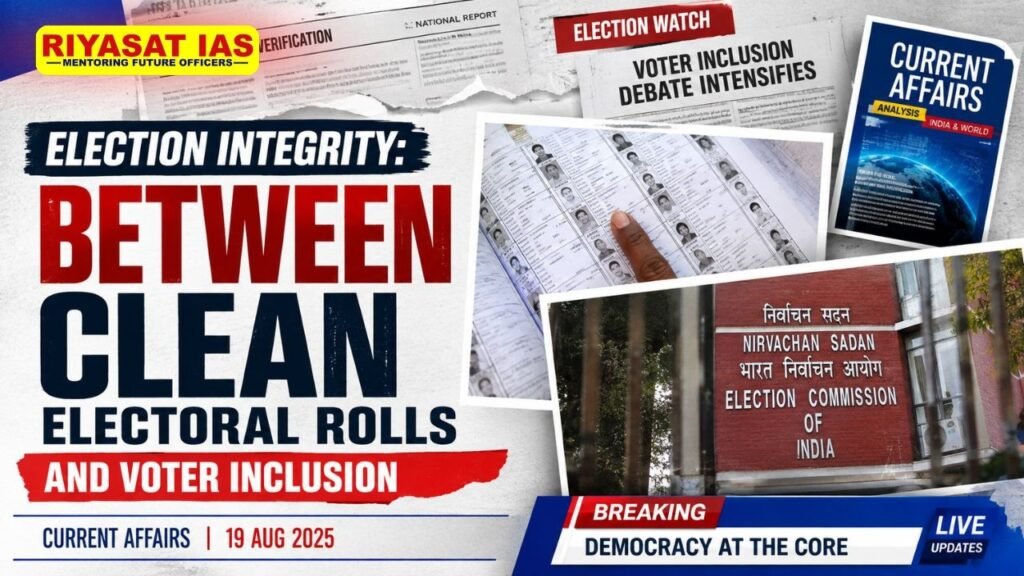
GS-II: Polity | Elections | Electoral Reforms | Constitutional Bodies | Democratic Governance
Context
- Trump’s appreciation: U.S. President Donald Trump’s appreciation of India’s election mechanism has brought the issue of election integrity into focus in both democracies.
- SIR-like exercise in U.S.: Mr. Trump is pushing for an SIR-like exercise in the U.S., but its highly federalised electoral system and fragmented rules make such a move difficult.
- Photo identity debate: Trump’s social media post citing CEC Gyanesh Kumar on the issue of valid photo identity has renewed concerns over election integrity.
- Political mistrust: Partisan politics in both countries has contributed to mistrust, with election losers repeatedly questioning electoral integrity.
- Different approaches: Liberal-progressive and conservative-nativist groups seek to purify electoral rolls and processes, but often through different and contradictory approaches.
- Core issue: Both countries need fair and transparent elections, but electoral-integrity measures should not become instruments of partisan politics.
India’s Election Administration
- Nationalised system: India has a largely nationalised election administration system, which has generally worked well.
- Constitutional body: The Election Commission of India (ECI) is established as a constitutional body under Article 324.
- Crisis of legitimacy: Despite its institutional strengths, the Indian electoral system now faces concerns relating to public trust and legitimacy.
- SIR: The Special Intensive Revision seeks to ensure cleaner electoral rolls but has raised concerns over transparency, consultation and adequate time.
- Frequency: Since SIR is meant to be conducted only once in 20 years, it should be carried out carefully and inclusively.



U.S. Electoral System
- Decentralised structure: The U.S. has a highly federalised electoral process, with States having their own methods and rules.
- Constitutional provision: The Constitution grants States authority over election methods, while Congress may alter such regulations by law.
- Fragmented rules: Decentralisation creates variations and potential loopholes in enrolment and voting.
- SAVE Act: The expanded Safeguard American Voter Eligibility (SAVE) Act was passed in February and is pending in the Senate.
- Proposed requirements: The proposed federal law would require proof of citizenship for voter registration and photo ID for voting.
- Potential lesson: The U.S. could benefit from a more robust national framework similar to India’s ECI.
Common Ground: Electoral Integrity
- Citizenship: Existing law in both countries establishes that only citizens may register and vote.
- Clean electoral rolls: Accurate electoral rolls are an elementary requirement of a fair electoral process.
- Photo ID: Voting with photo identity can strengthen electoral authentication.
- Fairness: The electoral process must be fair and transparent.
- Shared agenda: India and the U.S. could develop a shared democratic agenda on election rules.
The Core Political Conflict
- Ruling establishments: Ruling dispensations in both countries argue that electoral processes may be too permissive and could allow foreigners to obtain voting rights.
- Opposition concerns: Opponents argue that election-integrity measures can become systematic and premeditated attempts to target social groups.
- Partisan weaponisation: Requirements related to citizenship, electoral rolls and voter identification should not be selectively weaponised against those not in power.
- Trust deficit: Electoral reforms cannot succeed without restoring public trust and institutional integrity.
Way Forward
- Clean electoral rolls: Ensure electoral rolls contain only eligible citizens.
- Photo identity: Strengthen voter authentication through photo ID.
- Transparency: Electoral-roll revision should be conducted with transparency and adequate consultation.
- Inclusiveness: Verification processes must not unnecessarily exclude eligible voters.
- Political neutrality: Electoral-integrity measures must not be selectively used against particular social or political groups.
- Institutional trust: Both countries must first restore trust and integrity in their electoral processes.
Conclusion
Electoral integrity is essential to democratic legitimacy, but measures designed to protect elections must themselves remain fair, transparent and politically neutral. India and the U.S. need clean electoral rolls and secure voting processes, while ensuring that such requirements are not used to exclude legitimate voters or serve partisan interests.
UPSC Mains Practice Question
Q. “Clean electoral rolls and secure voter identification are elementary requirements of electoral integrity, but they must not become instruments of political exclusion.” Discuss in the context of India and the U.S.




 Ravi Raaz
 Hassan Khan
 Shadab Ali