
GS-I: Indian Society | GS-II: Polity & Governance | Gender Equality | Democracy
Context
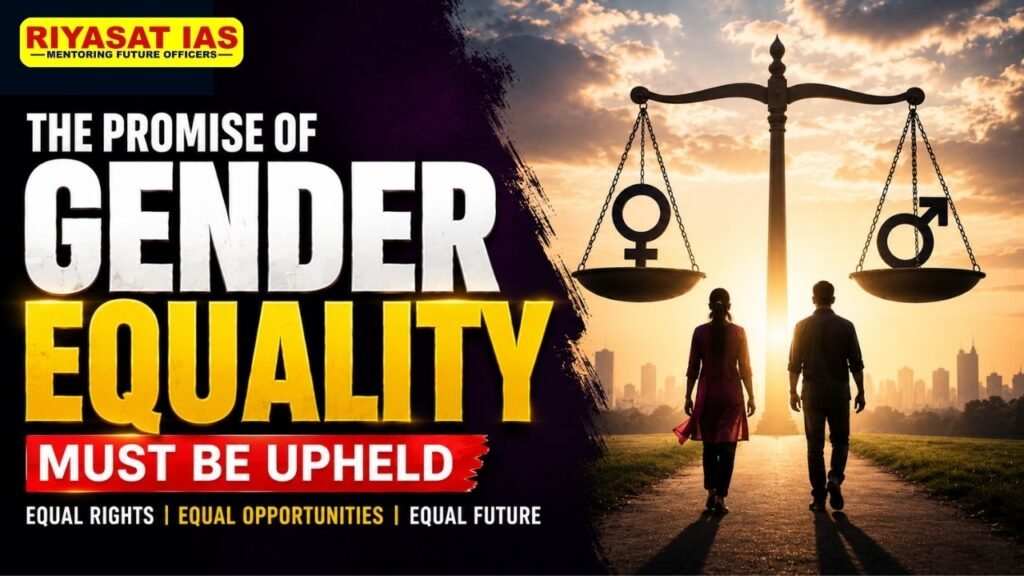
- India’s independence: India’s freedom was based on the promise that freedom would be bestowed on all citizens, regardless of caste, creed, class, political allegiance or gender.
- Equality before law: Overnight, all women and men became equal before the law.
- Contemporary concern: The promise of equality has come under question following the misogynistic response to the Cockroach Janta Party (CJP)-organised protests at Jantar Mantar.
An Old Promise
- Universal franchise: The Constituent Assembly decided to give universal franchise to all Indians above the age of 21.
- First elections: Every woman and man above 21 was eligible to vote in the 1952 elections.
- Women’s registration: The Election Commission faced the challenge of registering around 80 million eligible women.
- Individual identity: Women had to be persuaded to register under their own names, rather than as “the daughter of X” or “the wife of Y”.
- Inclusion: The Election Commission persisted because the promise of equality was more than merely words.
- Exclusion in 1952: Around 2.8 million women were eventually struck off the rolls because they would not identify themselves by name.
- Electoral equality: By 2019, the gender gap in voting had closed.
- Progress: Since 1952, India has made progress in turning electoral equality into lived equality for women and men.



Gendered Expectations
- Doxxing: Several women who participated in the Jantar Mantar protests were reportedly doxxed, with their names, numbers, addresses and other personal details uploaded online.
- Online abuse: They faced vile online abuse following the protests.
- Gendered response: The Prime Minister referred to the women protesters as “misguided daughters” who needed forgiveness.
- Different standards: Women protesters were singled out for their language, while men using the same language were not similarly noticed.
- Gendered expectations: The same protest, demands and aspirations were subjected to different expectations based on gender.
- Paternalism: Women who had been recognised as independent voters were portrayed as “misguided children” requiring counselling.
- Threats: The women protesters also faced threats of rape and murder from online attackers.
The Larger Concern
- Equality: The ownership of one’s own name, which symbolised gender electoral equality, has now been weaponised against women.
- Democratic accountability: A protest over democratic accountability was presented instead through the lens of personal grievance.
- Hope: The protests also reflected the continuing hope that a better future was possible.
- Reality of equality: The experience of women protesters highlights the continuing gap between the promise of equality and its lived reality.
Way Forward
· Protect democratic participation: Ensure that women can participate in political and civic activities without intimidation.
· Strengthen cyber enforcement: Swiftly investigate doxxing, threats, sexual harassment and targeted online abuse.
· Gender-neutral accountability: Apply standards of acceptable political conduct equally to men and women.
· Promote digital responsibility: Platforms and users should discourage the circulation of personal information and abusive content.
· Strengthen constitutional literacy: Citizens should be educated about fundamental rights, duties and democratic forms of dissent.
· Encourage women’s representation: Greater participation of women in political institutions and civil society can deepen democratic inclusion.
· Preserve the spirit of 1947: India’s original commitment to equality should remain the guiding principle of contemporary democratic governance.
Conclusion
India did not fail after independence despite enormous challenges and held on to hope. The promise of equality was central to that journey. The challenge today is to ensure that this hope does not falter and that the principle of equality for all remains meaningful in the lived experience of Indian citizens.
UPSC Mains Practice Question
Q. “India’s independence was founded on the promise of equality for all, but the lived experience of gender equality remains incomplete.” Discuss.




 Ravi Raaz
 Hassan Khan
 Shadab Ali