
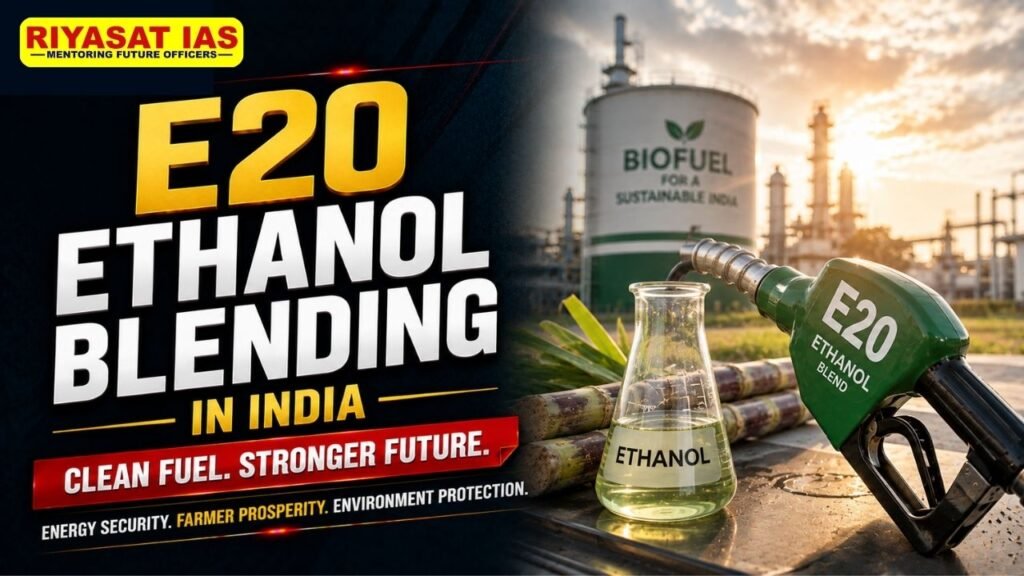
GS-III: Energy | Environment | Agriculture | Food Security | Biofuels
Context
- E20 debate: Opposition leaders such as Rahul Gandhi and Arvind Kejriwal have launched campaigns against E20, arguing that it harms vehicles and that the government is forcing it on consumers.
- Government objective: India aimed to produce 10–11 billion litres of ethanol so that 20% of petrol used in transport could come from domestically produced ethanol.
- Energy security: Ethanol blending is intended to reduce crude oil imports and foreign exchange outgo while supporting the domestic economy.
- Current capacity: India’s distillery capacity has expanded to around 18–20 billion litres across nearly 500 distilleries.
- Procurement: For the current ethanol year, oil companies have contracted to procure around 10.5 billion litres of ethanol.
Status of Ethanol Production
- Expanded capacity: Policy support has significantly increased India’s ethanol production capacity.
- Diversified feedstock: Ethanol for petrol blending is sourced from:
o Maize: 45%
o FCI rice: 22%
o Sugarcane juice: 16%
o B-heavy molasses: 10%
o Damaged foodgrains: 4.5%
o C-heavy molasses: 1.1%
- Maize production: India’s maize output increased by around 45% in three years, reaching about 55 million tonnes in 2025-26.
- Domestic availability: More than 20% of maize production is being used for ethanol, with the assessment that India currently has no need to import maize.
Will E20 Spur Corn Imports from the U.S.?
- No current evidence: Ministry of Commerce statistics do not indicate a surge in ethanol or maize imports.
- Direct ethanol imports: Direct import of ethanol for petroleum blending is banned.
- U.S. pressure: The U.S. corn lobby has nevertheless been pushing for greater Indian maize imports.
- Future vulnerability: A failed monsoon, crop losses or foodgrain shortages could create pressure on domestic feedstock availability.
- Potential consequence: Diversion of FCI rice, sugarcane juice and B-heavy molasses to ethanol could come under stress, increasing the possibility of maize imports.
Impact on Sugar Availability
- Feedstock diversion: Sugarcane juice and B-heavy molasses, which can otherwise contribute to sugar production, are increasingly being diverted towards ethanol.
- Sugar stocks: Closing sugar stocks in September 2025 were around 5 million tonnes, and stocks are expected to remain around the same level.
- Current assessment: The diversion towards ethanol has not so far significantly affected sugar availability or stocks.
- Future risk: A major crop shock could create competing demands between food, sugar and fuel.



Should Consumers Be Worried About E20?
- Post-April 2023 vehicles: Vehicles manufactured after April 2023 under Bharat Stage 6 Phase 2 (Real Driving Emissions) standards were factory-engineered for E20.
- Vehicle compatibility: These vehicles use ethanol-resistant elastomers, fuel lines, upgraded pump seals and recalibrated engine-control systems.
- Legacy vehicles: The major concern relates to older vehicles designed for E5 or E10.
- Potential problems: Ethanol can:
o Degrade older rubber compounds and plastics.
o Harden and crack fuel hoses.
o Absorb atmospheric moisture because it is hygroscopic.
o Contribute to corrosion and fuel-system problems when vehicles remain parked for long periods.
- Fleet exposure: Around 77% of India’s petrol fleet consists of legacy vehicles, according to the figures cited in the article.
Need for a Phased Transition
- Brazilian experience: Brazil transitioned towards high ethanol use alongside vehicle modifications over several decades.
- India’s transition: India reached the 10% blending milestone in 2022 and subsequently moved towards 20% blending within around three years.
- Information gap: The rapid transition was accompanied by relatively limited information and advisories for consumers from manufacturers.
- Consumer confidence: A more transparent and phased rollout could have helped take consumers into confidence.
- Legacy fleet: Special attention is required for older vehicles that were not originally designed for E20.
Has Ethanol Blending Improved Energy Security?
- Foreign exchange savings: The government stated that the ethanol blending programme has so far saved around ₹2 lakh crore in foreign exchange.
- Crude substitution: It has reportedly substituted around 32 million tonnes of crude oil imports.
- Import reduction: Substituting 10 billion litres of petrol with ethanol is equivalent to roughly one month of crude imports.
- Oil-price shock: The government also stated that despite crude oil prices rising by around 70% during the West Asia war, petrol pump prices increased by only around 7–8%.
- Strategic benefit: Ethanol blending can therefore contribute to energy security and reduced import dependence.
Economic and Fiscal Concerns
- Ethanol procurement: Oil marketing companies procure ethanol at around ₹70 per litre for blending.
- Petrol price: The pump price of petrol is around ₹105 per litre.
- Different cost structures: Ethanol and petrol operate under different costing and taxation regimes.
- Caution in comparison: It is therefore difficult to independently conclude that ethanol is necessarily cheaper than petrol solely by comparing these prices.
- Broader benefit: The economic assessment should consider foreign exchange savings, crude import substitution, domestic agricultural demand and fiscal costs.
Implications for India
- Energy security: Greater ethanol blending can reduce dependence on imported crude oil.
- Agricultural diversification: Rising demand for maize and other feedstocks can create additional markets for farmers.
- Food-fuel balance: Diversion of rice, maize and sugarcane products towards ethanol requires careful management of food security.
- Vehicle compatibility: Legacy vehicles require greater attention regarding compatibility, maintenance and consumer awareness.
- Consumer confidence: Transparent information regarding mileage, vehicle compatibility and possible maintenance requirements is essential.
- External trade: Although there is currently no evidence of a surge in U.S. maize imports, future domestic feedstock shortages could create import pressures.
Way Forward
- Phased transition: The E20 rollout should consider the large population of legacy vehicles.
- Consumer awareness: Automobile manufacturers should provide clear information regarding vehicle compatibility, mileage and maintenance.
- Evidence-based policy: Independent studies should assess the long-term effects of E20 on different vehicle categories.
- Food-fuel balance: Ethanol policy should ensure that diversion of agricultural commodities does not compromise foodgrain and sugar availability.
- Feedstock diversification: Greater reliance on multiple domestic feedstocks can reduce vulnerability to any single crop shock.
- Climate resilience: Ethanol procurement should account for monsoon variability and crop losses.
- Transparent communication: The government should clearly communicate the economic, energy-security and environmental benefits as well as the limitations and costs of E20.
- Consumer protection: Mechanisms should be developed to address genuine compatibility or maintenance concerns associated with legacy vehicles.
Conclusion
India’s ethanol-blending programme represents an important effort towards energy security, crude-import substitution and greater domestic use of agricultural resources. However, the transition to E20 also raises legitimate questions regarding legacy vehicles, consumer awareness and the competing demands of food and fuel. The appropriate approach is therefore neither to reject ethanol blending nor to dismiss consumer concerns, but to pursue a transparent, evidence-based and phased transition that balances energy security, agricultural interests, food security and consumer welfare.
UPSC Mains Practice Question
Q. “India’s transition towards E20 ethanol blending offers significant energy-security benefits but also raises concerns relating to food security, agricultural feedstock and legacy vehicles.” Discuss.


 Ravi Raaz
 Hassan Khan
 Shadab Ali