
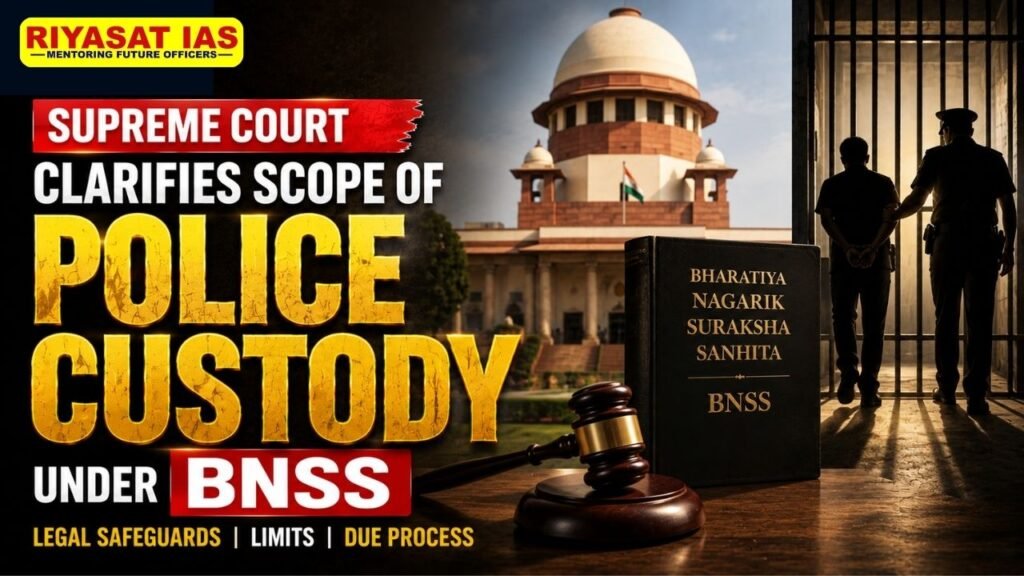
GS-II: Polity & Governance | Criminal Justice System | Fundamental Rights | BNSS
Context
- Supreme Court ruling: In The State of Andhra Pradesh vs Suda Suresh Veera Venkata Naga Raju, the Supreme Court held that Section 187(2) of the BNSS enlarges the window during which police custody may be sought.
- Change under BNSS: Police custody can now be granted in parts, subject to an aggregate maximum of 15 days, during the first 40 or 60 days of the permissible detention period.
- Earlier position: Under the CrPC, police custody was confined to the first 15 days of remand.
- Key issue: The judgment concerns the balance between effective investigation and safeguards against custodial abuse.
Supreme Court’s Ruling on Police Custody
- Investigative requirement: The Supreme Court held that the investigating agency’s concerns were justified in the circumstances of the case.
- Expanded statutory window: Courts must take into account the BNSS provision that enlarges the window for police custody.
- No absolute outer limit: A magistrate or court cannot impose an absolute and non-extendable outer limit that effectively prevents recourse to Section 187(2).
- Additional custody: The Court permitted 7 additional days of police custody, ensuring that the aggregate police remand did not exceed 15 days.
- Purpose: The legislative change is intended to accommodate situations where fresh facts, discoveries or investigative leads emerge later.
Current Law on Police Remand
- 24-hour rule: Under Section 58 BNSS, a person arrested without warrant cannot ordinarily be detained for more than 24 hours, unless authorised by a magistrate under Section 187.
- Section 187(2): Where investigation cannot be completed within 24 hours and the accusation appears well founded, the magistrate may authorise detention.
- Police custody: Police custody of up to 15 days in the whole or in parts may be authorised during:



o First 40 days where the total permissible detention period is 60 days.
o First 60 days where the total permissible detention period is 90 days.
- Section 187(3): Judicial detention may continue beyond 15 days where adequate grounds exist.
- Maximum detention period:
o 90 days: Offences punishable with death, life imprisonment or imprisonment for 10 years or more.
o 60 days: Other offences.
- Default bail: If investigation is not completed within the stipulated period, the accused becomes entitled to default bail, subject to the statutory conditions.
Presence of an Advocate During Interrogation
- Section 38 BNSS: An arrested person is entitled to meet an advocate of their choice during interrogation, but not throughout interrogation.
- Supreme Court interpretation: The provision does not create an unqualified right to continuous physical presence of an advocate throughout every interrogation session.
- Modified safeguard: The advocate may remain present at the interrogation site where the advocate can see the accused.
- Balance: The Court sought to preserve the accused’s access to legal assistance without making the advocate’s continuous presence mandatory.
Audio-Visual Recording
- Earlier condition: The High Court had imposed a requirement concerning uninterrupted videography of the transit of the accused between locations.
- Supreme Court modification: Audio-visual recording of:
o The actual interrogation, and
o Proceedings relating to discovery or recovery
would satisfy the requirement.
- Purpose: Recording provides an evidentiary and accountability mechanism while allowing investigators to conduct the investigation without unnecessary procedural restrictions.
Conclusion
The Suda Suresh judgment clarifies that the BNSS has deliberately expanded the time window for police custody while retaining the 15-day aggregate ceiling. The change seeks to accommodate investigations in which fresh discoveries or leads emerge after the initial period. However, greater investigative flexibility must operate alongside strong safeguards for personal liberty, legal assistance, judicial supervision and accountability. The real challenge is to ensure that the expanded statutory window strengthens investigation without weakening the constitutional protection against arbitrary or coercive detention.
UPSC Mains Practice Question
Q. “The BNSS has expanded the window for police custody while retaining the overall 15-day ceiling.” Discuss the significance of the Supreme Court’s interpretation of Section 187 in balancing investigative needs with individual liberty.





 Ravi Raaz
 Hassan Khan
 Shadab Ali