
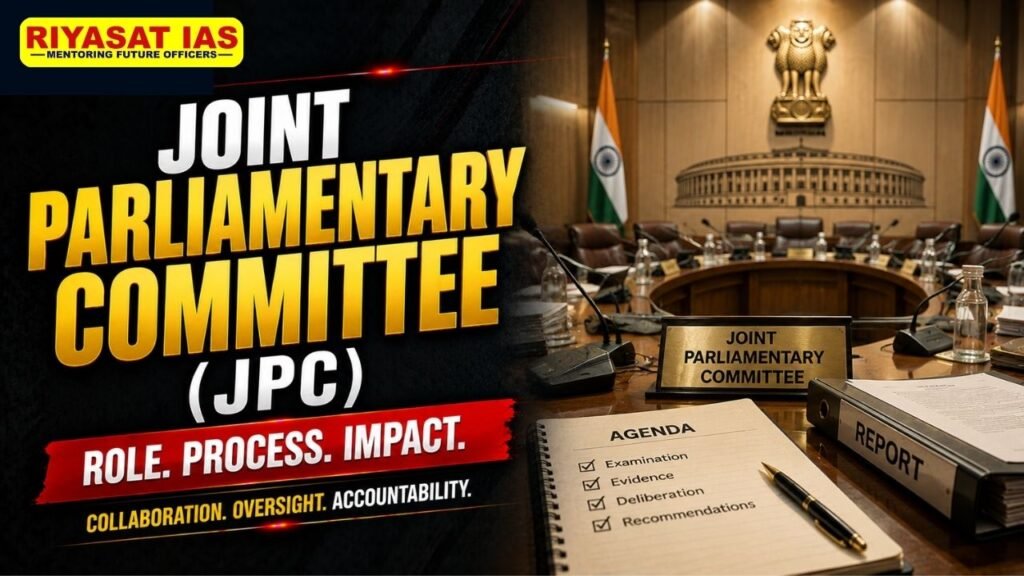
- JPC (Joint Parliamentary Committee) is a temporary/ad hoc committee constituted by Parliament for examining a specific issue, Bill or matter.
- It consists of members from both Lok Sabha and Rajya Sabha.
- Composition: The strength and composition of a JPC are decided by Parliament through the motion/resolution constituting it.
- Chairperson: Generally, the Chairperson is appointed by the Speaker of Lok Sabha.
- Purpose: It conducts detailed examination, collects evidence, hears stakeholders and submits a report to Parliament.
- Powers: A JPC can summon persons, call for documents and examine evidence, subject to the terms of its constitution and parliamentary rules.
- Report: Its recommendations are not legally binding on the government.
- Dissolution: Being an ad hoc committee, it ceases to exist after completing its assigned task and submitting its report.
- Difference from PAC: The Public Accounts Committee (PAC) is a standing financial committee, whereas a JPC is constituted for a specific purpose.
- Difference from Select Committee: A Select Committee generally consists of members from one House, whereas a JPC includes members from both Houses.
- Constitutional basis: JPCs are not directly created by a specific Article of the Constitution; they function under the parliamentary rules and procedures.
- Important: A JPC is a parliamentary investigative mechanism, not a judicial body.



Prelims Questions
With reference to the Joint Parliamentary Committee (JPC), consider the following statements:
- It is a permanent committee of Parliament.
- It can consist of members from both Lok Sabha and Rajya Sabha.
- Its recommendations are legally binding on the government.
- It is generally constituted to examine a specific matter.
Which of the statements given above are correct?
(a) 2 and 4 only
(b) 1 and 3 only
(c) 1, 2 and 4 only
(d) 2, 3 and 4 only
Answer: (a) 2 and 4 only
- Statement 1 — Incorrect: JPC is an ad hoc/temporary committee, not a permanent committee.
- Statement 2 — Correct: It can include members from both Houses of Parliament.
- Statement 3 — Incorrect: Its recommendations are not legally binding on the government.
- Statement 4 — Correct: It is constituted to examine a specific issue or matter.





 Ravi Raaz
 Hassan Khan
 Shadab Ali