
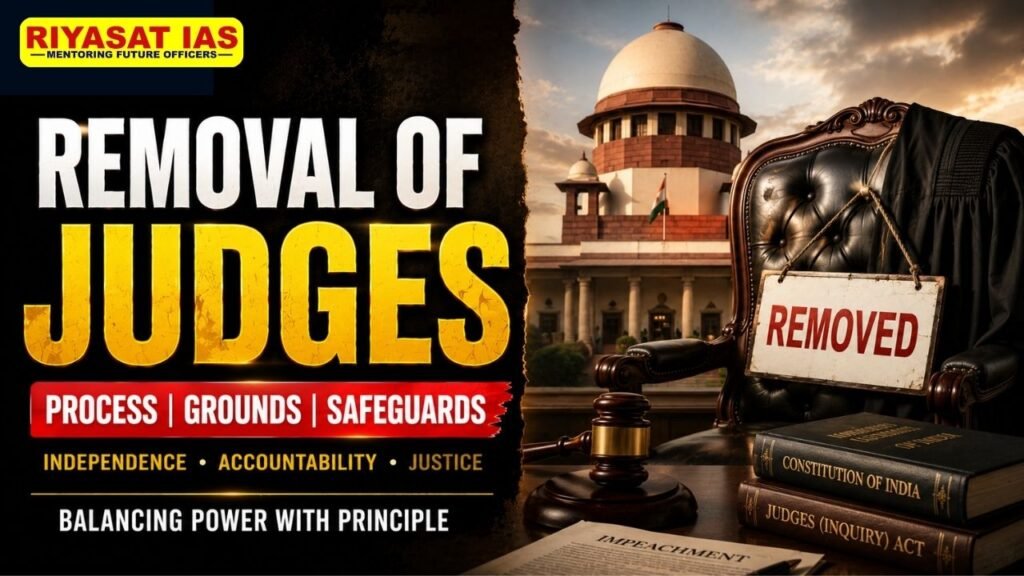
- Constitutional provisions: Removal of Supreme Court and High Court judges is governed primarily by Articles 124(4), 124(5) and 217.
- Grounds for removal: A judge can be removed only on the grounds of:
- Proved misbehaviour, or
- Incapacity.
- Authority: The judge is removed by the President of India.
- Parliamentary requirement: The President can remove the judge only after Parliament presents an address requesting removal.
- Special majority: The address must be passed by each House of Parliament by:
- A majority of the total membership of that House, and
- A majority of not less than two-thirds of members present and voting.
- Constitutional safeguard: This difficult procedure is intended to ensure judicial independence and prevent arbitrary removal.
- Procedure: The detailed procedure is provided under the Judges (Inquiry) Act, 1968.
- Initiation: The removal motion can be initiated in either House:
- 100 members of Lok Sabha, or
- 50 members of Rajya Sabha.
- Speaker/Chairman: The motion is submitted to the Speaker of Lok Sabha or Chairman of Rajya Sabha, who may admit or refuse to admit it.
- Inquiry Committee: If admitted, a three-member inquiry committee investigates the charges.
- Composition of Inquiry Committee:
o A Supreme Court judge;

o A Chief Justice of a High Court;
o A distinguished jurist.
- If charges are proved: The committee submits its report to the concerned House.
- Parliamentary stage: Both Houses must separately pass the removal address with the required special majority.
- Final stage: After Parliament passes the address, it is presented to the President, who issues the order of removal.
- Same procedure: The constitutional removal procedure broadly applies to Supreme Court and High Court judges.
- Important distinction: Transfer of a High Court judge is different from removal. A High Court judge can be transferred by the President after consultation with the Chief Justice of India.
Prelims Questions
With reference to the removal of a Supreme Court judge in India, consider the following statements:
- A Supreme Court judge can be removed only on the grounds of proved misbehaviour or incapacity.
- The President can remove the judge directly without parliamentary approval.
- The removal address must be passed by each House of Parliament by a special majority.
Which of the statements given above are correct?
(a) 1 and 3 only
(b) 2 and 3 only
(c) 1 and 2 only
(d) 1, 2 and 3
Answer: (a) 1 and 3 only
Explanation:
- Statement 1 — Correct: Article 124(4) specifies proved misbehaviour or incapacity.
- Statement 2 — Incorrect: The President cannot remove a judge independently. Parliament must first pass the required address.
- Statement 3 — Correct: Each House must pass the address by:
- Majority of total membership, and
- At least two-thirds of members present and voting.





 Ravi Raaz
 Hassan Khan
 Shadab Ali