
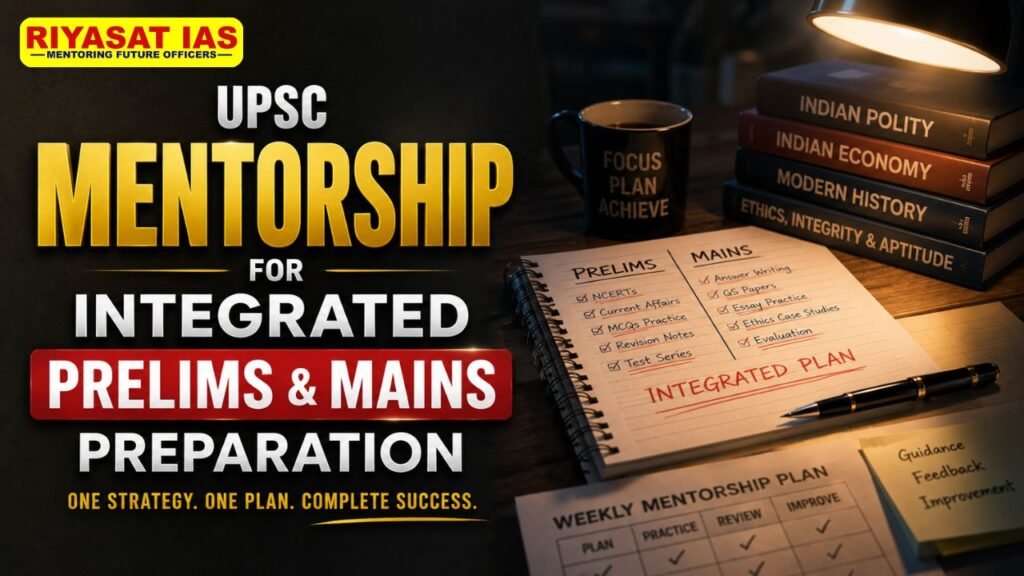
The sequential preparation model — Prelims first, then Mains — is the most widely practised and most consistently suboptimal approach to UPSC preparation. Aspirants who follow this model clear Prelims, then begin Mains preparation in June with 3–5 months available before the examination. In those 3–5 months, they must develop the analytical expression, answer writing quality, Optional Subject depth, Essay practice, and Ethics case study skill that competitive Mains performance requires — skills that take 8–9 months to develop to competitive standard.
The result is predictable: Mains attempts that have strong GS content knowledge but inadequate analytical expression, essays that demonstrate topic familiarity without structured argument, Ethics case studies that state moral conclusions without structured reasoning, and Optional scores that reflect 3 months of intensive but insufficient preparation. The sequential model produces a preparation that is structurally guaranteed to be Mains-inadequate for the 8 months that Prelims absorbed.
How the Integrated Preparation Model Works
Integrated Prelims and Mains preparation does not mean doing Prelims-specific MCQ practice and Mains-specific answer writing simultaneously from Day 1. It means building a preparation architecture where the activities that develop GS depth for Mains also develop the knowledge base for Prelims — so that the same preparation serves both stages rather than one stage serving each in isolation.
| Preparation Activity | How It Serves Prelims | How It Simultaneously Serves Mains |
| Deep primary source reading with PYQ practice | Builds the specific, retrievable knowledge that MCQ recognition requires; PYQ practice calibrates depth to what UPSC actually tests | Builds the analytical knowledge base that Mains answers draw from; deep understanding — not just recognition — is what produces analytical arguments |
| Mains-oriented current affairs (four-part note format) | The GS paper tags and static connections in four-part notes strengthen the static-current affairs linkages that Prelims MCQs test | The analytical GS angle in each note is directly deployable in Mains GS answers as analytical evidence |
| Timed answer writing from Month 3 | Strengthens the deep retrieval of knowledge under pressure that makes Prelims MCQ answers more reliable under time pressure | Builds the analytical expression skill that Mains requires; the output practice deepens the input knowledge as a side effect |
| Spaced revision architecture | Maintains the multi-cycle retention that Prelims accurate recall requires across the full syllabus | Maintains the knowledge base that Mains answers draw from; capsule-level retention is the minimum for exam-day retrieval in both stages |
| Optional Subject development | Optional knowledge overlaps with GS in several subjects (History, Geography, Polity, Public Administration) — this overlap provides dual preparation benefit | Optional papers are assessed only in Mains; every hour of Optional preparation is Mains-specific and exclusively serves Mains performance |



What Integrated UPSC Mentorship Specifically Tracks
A mentorship programme designed for integrated Prelims and Mains preparation must track both stages simultaneously — which requires a weekly session structure that reviews Prelims-specific performance data and Mains-specific output quality in the same session:
- Prelims tracking: mock test error categorisation by subject and error type; PYQ accuracy on recently covered topics; current affairs recall from weekly notes
- Mains tracking: GS answer quality from submitted answers; Optional Subject coverage and answer quality; Essay and Ethics practice completion; current affairs archive organisation and revision-readiness
- Schedule balance: whether the daily time allocation is maintaining both Prelims and Mains preparation activities or drifting toward one at the expense of the other
At Riyasat IAS Mentorship, each weekly session reviews both Prelims and Mains preparation dimensions — ensuring that the preparation does not drift into a de facto sequential model (all attention to Prelims now, Mains deferred) despite the nominal intention to prepare for both.
| Want an integrated Prelims and Mains preparation plan built specifically for you? → Apply for Riyasat IAS Mentorship |
The Prelims Consolidation Phase: Maintaining Mains in the Final 2 Months
The final 2 months before Prelims are the most critical and most dangerous phase of integrated preparation. The natural instinct — and the universal advice from batch coaching — is to abandon Mains-specific activities (answer writing, Optional, Essay) and focus entirely on Prelims revision, mock tests, and current affairs rapid review.
This instinct is correct in degree but wrong in absoluteness. In the final 2 months before Prelims:
- GS answer writing: reduce to 1 answer per day minimum (not stopped — reduced). The habit must remain active or rebuilding it after Prelims takes 2–3 weeks of re-establishment.
- Optional Subject: reduce to 1 hour per day (not stopped). Optional coverage and answer quality built over 8 months will not hold at examination level through 2 months of complete neglect.
- Essay and Ethics: one Ethics case study per week and one Essay outline per fortnight maintain the skill without consuming Prelims preparation time.
The aspirant who maintains these reduced Mains activities through the Prelims phase arrives at Mains results with 9 months of answer writing development, 9 months of Optional preparation, and 6+ months of Essay practice. The aspirant who stops all Mains activities for 2 months during Prelims consolidation arrives with 7 months, 7 months, and 4 months — a significant preparation quality difference.
Frequently Asked Questions
Does integrated preparation mean I cannot focus on Prelims in the final weeks before the examination?
No — in the final 4 weeks before Prelims, Prelims preparation should be the primary focus. The integrated approach does not prevent focused consolidation; it prevents complete abandonment of Mains preparation during the longer preparation period. Specifically, in the final 2 weeks before Prelims, reducing Mains-specific activities to near-zero is reasonable — the skill maintenance that was sustained through the preceding months is sufficient to preserve what was built. What cannot be sustained at near-zero for 8 months (sequential model) can be sustained at near-zero for 2 weeks (integrated model’s final consolidation).
Is integrated preparation more tiring than sequential preparation?
The daily preparation commitment is similar in total hours. What differs is composition: integrated preparation includes answer writing and Optional activities from earlier in the cycle, where sequential preparation does not. In exchange, integrated preparation eliminates the exhausting experience of beginning answer writing and Optional preparation from scratch after Prelims — when the 3–5 months available are insufficient for the skills to develop to competitive standard. The upfront investment in integrated preparation replaces the often-demoralising experience of realising in Mains preparation that key skills are underdeveloped.
How does integrated mentorship handle the different emphases required by Prelims and Mains?
By adjusting the balance across the preparation cycle rather than switching between modes. In the first 6 months, the balance is approximately 60% input/GS depth (which serves both stages) and 40% output/Mains-specific (answer writing, Optional, Essay). In the Prelims consolidation phase (final 2–3 months), the balance shifts to 70% Prelims-focused and 30% Mains-maintenance. After Prelims, the balance returns immediately to full Mains intensity. The mentorship tracks this balance weekly and makes specific adjustments when the preparation drifts from the intended ratio.
Conclusion
Integrated Prelims and Mains preparation is not two preparations running in parallel — it is one preparation architecture designed to serve both stages, with the GS depth and current affairs preparation that both require built once and maintained across the cycle. UPSC mentorship for integrated preparation tracks both stages simultaneously, maintains the Mains-specific activities through the Prelims consolidation phase at reduced but non-zero levels, and ensures that aspirants who clear Prelims arrive at Mains with 9 months of preparation quality rather than 4. This is the structural difference between a first Mains attempt that has a realistic chance and one that is a well-prepared learning experience.
| Riyasat IAS Mentorship — Personal Guidance for UPSC CSE Direct mentorship from Riyasat Ali Sir │ Hindi & English Medium │ 100% Online — Apply Now |


 Ravi Raaz
 Hassan Khan
 Shadab Ali