
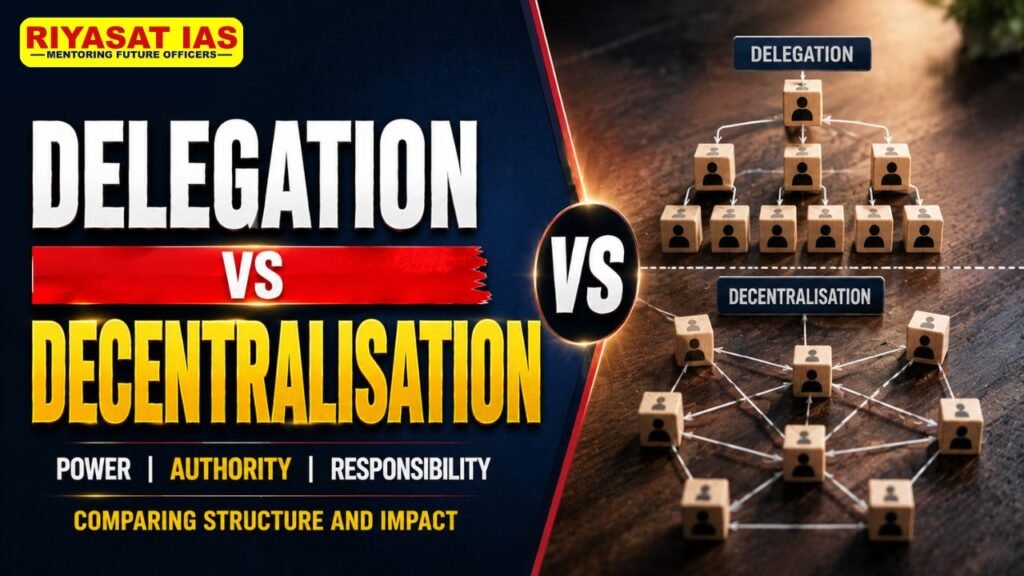
Decentralisation
· Decentralisation is the systematic transfer of decision-making powers, functions, responsibilities and resources from higher levels of government to lower levels, particularly to elected local institutions.
· It brings governance closer to citizens and promotes participation, responsiveness and local accountability.
· Decentralisation means that lower levels of government receive real authority to make and implement decisions within their legally defined domain.
Types of Decentralisation
Political Decentralisation: It transfers political decision-making authority to elected representatives at lower levels.
o Example: The 73rd and 74th Constitutional Amendments strengthened Panchayats and Municipalities.
Administrative Decentralisation: It transfers administrative functions and decision-making authority to lower levels of administration.
It includes:
· Deconcentration: Distribution of functions within the same administrative hierarchy.
· Delegation: Transfer of specified powers to subordinate or semi-autonomous bodies while ultimate authority remains with the higher authority.
· Devolution: Transfer of substantial powers and responsibilities to constitutionally or legally recognised local governments with greater autonomy.
Fiscal Decentralisation: It involves transferring financial resources and revenue-raising powers to lower levels of government.
o Example: State Finance Commissions recommend the distribution of financial resources between States and local bodies.
Economic/Market Decentralisation: Certain functions are transferred from the government to private or community-based actors through mechanisms such as contracting, public-private partnerships and deregulation.
Background of Decentralisation in India
· Ancient and Traditional Roots: Ancient and medieval India had traditions of local self-governance, with institutions such as Vedic Sabhas and Samitis, village Panchayats and the Chola-era assemblies documented in the Uttaramerur inscriptions, particularly Ur and Sabha.
· Balwant Rai Mehta Committee, 1957: It recommended democratic decentralisation and a three-tier Panchayati Raj system consisting of: Gram Panchayat, Panchayat Samiti, Zila Parishad.
· Ashok Mehta Committee, 1978: It recommended a stronger two-tier Panchayati Raj system, with the district as the key level of decentralised administration.
· 73rd Constitutional Amendment Act, 1992: It gave constitutional status to Panchayati Raj Institutions through Part IX and the Eleventh Schedule.
· 74th Constitutional Amendment Act, 1992: It gave constitutional status to Urban Local Bodies through Part IX-A and the Twelfth Schedule.
o The core constitutional idea is to promote democratic decentralisation, strengthen grassroots participation and ensure local accountability.
Delegation
· Delegation is the process by which a superior authority transfers specific powers or functions to a subordinate authority or agency while retaining ultimate responsibility and the power to supervise, review or modify the delegated authority.
o For example, a Union Ministry may delegate certain administrative powers to a subordinate department or officer to enable faster decision-making.
· Transfer of authority without complete transfer of ultimate responsibility.
Advantages of Delegation
· Faster Decision-Making: Subordinates can make routine decisions without referring every matter to higher authorities.
· Administrative Efficiency: Delegation reduces the workload of senior officials and allows them to focus on strategic and policy matters.



· Better Local Responsiveness: Officials closer to citizens may understand local problems and requirements better.
· Capacity Building: Delegation provides subordinate officials with opportunities to develop leadership, decision-making and administrative skills.
· Innovation: Greater operational freedom can encourage officials to experiment with locally appropriate solutions.
· Accountability at the Point of Delivery: When responsibility is clearly assigned to the level actually delivering a service, it becomes easier to identify who is responsible for performance or failure.
Barriers to Effective Delegation
· Fear of Losing Control: Senior officials may hesitate to delegate powers because of concerns about loss of authority or control.
o confidence in subordinate officials can discourage meaningful delegation.
· Unclear Authority: If the boundaries of delegated powers are not clearly defined, it can lead to confusion, duplication and conflict.
Capacity Constraints
o Subordinate institutions may lack adequate:
o Personnel
o Skills
o Financial resources
o Technology
o Institutional capacity
· Excessive Centralisation: Even where powers are formally delegated, senior authorities may continue to interfere in routine decisions.
· Weak Accountability Mechanisms: Delegation without appropriate monitoring can result in misuse of authority, arbitrariness or poor performance.
Delegation vs Decentralisation
| Basis | Delegation | Decentralisation |
| Meaning | Transfer of specific authority to a subordinate | Transfer of decision-making powers to lower levels of governance |
| Nature | Mainly administrative/managerial | Political, administrative and fiscal |
| Authority | Usually remains under the control of the superior authority | Lower-level institution receives greater institutional autonomy |
| Responsibility | Ultimate responsibility remains with the delegating authority | Responsibility is increasingly located at the decentralised level |
| Reversibility | Powers can generally be withdrawn or modified by the superior | Usually requires legal/constitutional or institutional changes |
| Example | Ministry delegating financial powers to a subordinate officer | Panchayats exercising constitutionally recognised local functions |
| Purpose | Efficiency and faster decision-making | Participation, local autonomy and democratic accountability |
How Does Delegated Legislation Impact Transparency and Accountability?
What is Delegated Legislation?
· Delegated legislation refers to rules, regulations, bye-laws, notifications and orders made by the executive or other subordinate authorities under powers delegated to them by the legislature.
· It is necessary because modern governance involves highly technical, detailed and frequently changing matters that cannot all be specified in primary legislation.
Positive Impact on Transparency and Accountability
· Greater Administrative Detail: Delegated legislation can convert broad legislative objectives into specific procedures, standards and operational rules, making administration more predictable.
· Faster Regulatory Response: The executive can modify technical rules more quickly than Parliament can amend a primary law.
· Technical Expertise: Experts and specialised regulators can formulate detailed rules based on technical knowledge and sector-specific requirements.
· Better Service Delivery: Clear rules can reduce administrative discretion and establish standardised procedures, thereby reducing opportunities for arbitrary decisions.
Concerns Regarding Transparency and Accountability
· Excessive Executive Power: If Parliament delegates excessively broad powers, the executive may effectively exercise quasi-legislative authority without adequate legislative scrutiny.
· Reduced Parliamentary Oversight: Large volumes of rules and notifications can make it difficult for Parliament to scrutinise every delegated provision effectively.
· Lack of Public Consultation: Rules framed without adequate consultation may reduce participatory transparency and overlook stakeholder concerns.
· Excessive Discretion: Vague delegated powers can allow officials to exercise excessive discretion, increasing the possibility of arbitrariness and rent-seeking.
· Regulatory Capture: Powerful interest groups may influence specialised rule-making institutions, particularly where consultation and disclosure mechanisms are weak.
· Difficulty for Citizens: Frequent amendments, complex notifications and technical rules can make the regulatory framework difficult for ordinary citizens to understand.
· Accountability Gap: When decisions are made through executive rules rather than primary legislation, determining political responsibility and accountability may become more difficult.
Constitutional Safeguards
Parliament Cannot Delegate Essential Legislative Functions
o The legislature cannot completely surrender its essential legislative function to the executive.
o The Supreme Court established this principle in In re Delhi Laws Act, 1951, holding that Parliament cannot delegate its essential legislative function.
Judicial Review: Courts can examine delegated legislation for:
- Excessive delegation
- Violation of fundamental rights
- Violation of the parent statute
- Constitutional invalidity
- Arbitrariness
Parliamentary Scrutiny
o Delegated legislation can be examined through Parliamentary Committees on Subordinate Legislation.
o Such committees examine whether delegated powers have been properly exercised and whether rules conform to the parent legislation.
How to Improve Delegated Legislation
· Maintain Legislative Control: Parliament should clearly define the policy, principles and limits within which delegated legislation can operate.
· Strengthen Parliamentary Committees: The Committee on Subordinate Legislation should have adequate capacity to examine important rules and regulations.
· Promote Pre-Legislative Consultation: Draft rules should, wherever appropriate, be placed in the public domain and subjected to stakeholder consultation.
· Ensure Transparency: Rules, notifications, amendments and explanatory documents should be easily accessible through official digital platforms.
· Conduct Regulatory Impact Assessment: Major regulations should be assessed for their likely impact on citizens, businesses, vulnerable groups and administrative costs.
· Strengthen Judicial Review: Courts should continue to ensure that delegated legislation remains within the limits of the parent statute and the Constitution.
Conclusion
Delegation and decentralisation are complementary instruments of effective governance: delegation improves administrative efficiency by distributing authority, while decentralisation strengthens local autonomy, participation and democratic accountability. Their success depends on matching authority with resources, responsibility with accountability and discretion with transparency, ensuring that decentralised power remains both effective and answerable to citizens.
FAQs
Q1. What is the key difference between delegation and decentralisation?
Ans: Delegation transfers specific authority to a subordinate, whereas decentralisation transfers decision-making powers and responsibilities to lower levels of governance.
Q2. What is the difference between devolution and delegation?
Ans: Delegation involves transfer of authority with ultimate control retained by the higher authority, whereas devolution provides lower-level institutions with greater autonomy and responsibility.
Q3. What are the major types of decentralisation?
Ans: The major types are political, administrative, fiscal and economic decentralisation.
Q4. Why is delegated legislation necessary?
Ans: Delegated legislation enables the executive to formulate detailed, technical and flexible rules within the framework established by the legislature.
Q5. How is delegated legislation kept accountable?
Ans: It is subject to parliamentary scrutiny, judicial review and the limits imposed by the parent legislation and Constitution.


 Ravi Raaz
 Hassan Khan
 Shadab Ali