
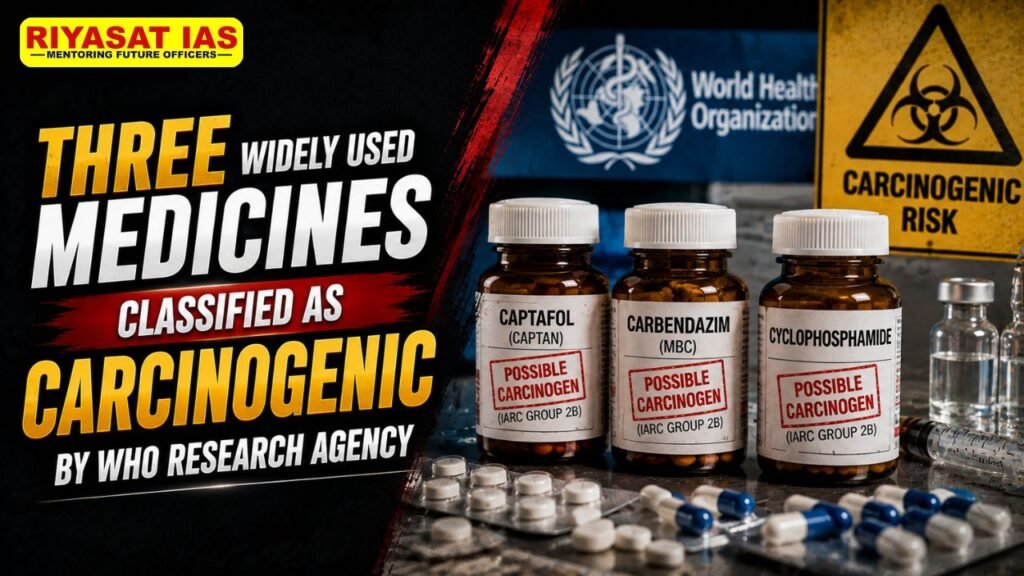
- WHO Research Agency: The International Agency for Research on Cancer (IARC), the cancer research arm of the World Health Organization (WHO), has classified Hydrochlorothiazide, Voriconazole and Tacrolimus as Group 1 – Carcinogenic to Humans.
- Hydrochlorothiazide: A thiazide diuretic widely prescribed for hypertension (high blood pressure) and oedema. It is included in the WHO Model List of Essential Medicines.
- Voriconazole: A broad-spectrum triazole antifungal used to treat serious fungal infections, particularly in transplant recipients and immunocompromised patients.
- Tacrolimus: An immunosuppressant (calcineurin inhibitor) used to prevent organ transplant rejection and graft-versus-host disease; topical formulations are also used for atopic dermatitis and vitiligo.
- IARC Group 1: Indicates sufficient scientific evidence that an agent can cause cancer in humans. It does not measure the magnitude of risk, only the strength of evidence.
- IARC: Established in 1965 and headquartered in Lyon, France. It is the specialized cancer research agency of the WHO.
UPSC Prelims Question (English)



Q. With reference to the International Agency for Research on Cancer (IARC), consider the following statements:
- IARC is the cancer research agency of the World Health Organization (WHO).
- Hydrochlorothiazide, Voriconazole and Tacrolimus have been classified by IARC as Group 1 – Carcinogenic to Humans.
- An IARC Group 1 classification indicates the highest level of cancer risk posed by an agent.
Which of the statements given above is/are correct?
A. 1 and 2 only
B. 2 and 3 only
C. 1 and 3 only
D. 1, 2 and 3
Answer: A
Explanation:
- Statement 1: Correct. IARC is the specialized cancer research agency of the WHO.
- Statement 2: Correct. The three medicines have been classified as Group 1 – Carcinogenic to Humans.
- Statement 3: Incorrect. Group 1 reflects the strength of scientific evidence that an agent can cause cancer, not the magnitude or level of risk.




 Ravi Raaz
 Hassan Khan
 Shadab Ali