
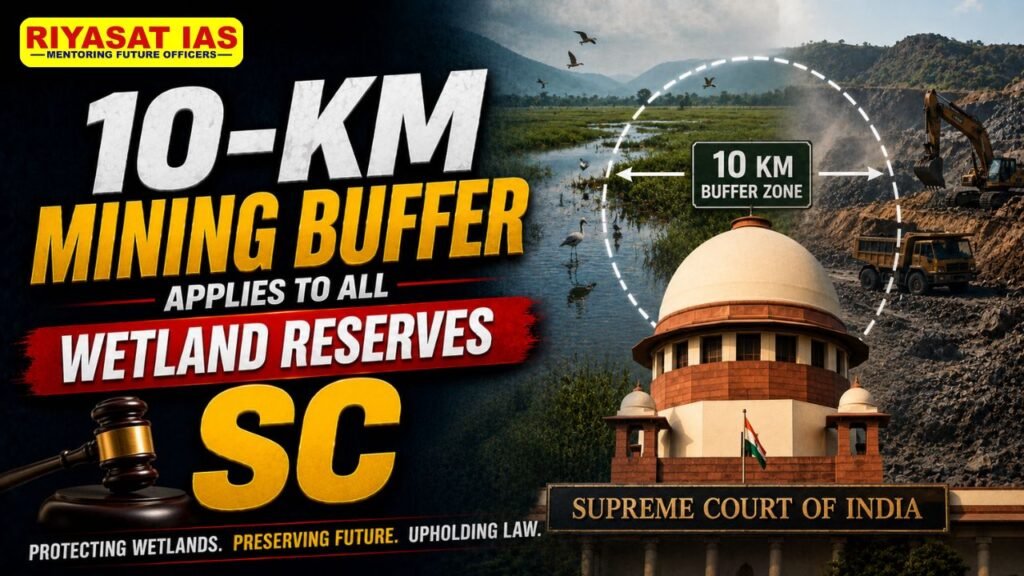
- Supreme Court Ruling: The Supreme Court held that the 10-km mining buffer applies to all notified wetland reserves, even if a specific buffer has not been separately notified.
- Objective: To protect ecologically fragile wetlands from the adverse impacts of mining activities.
- Wetlands: Areas where water is the primary factor controlling the environment and associated plant and animal life; they include natural and man-made, permanent or temporary wetlands.
- Legal Framework: Wetlands in India are regulated under the Wetlands (Conservation and Management) Rules, 2017, framed under the Environment (Protection) Act, 1986.
- Regulatory Authority: The State Wetland Authority (SWA) is responsible for the conservation and management of notified wetlands in each State/UT.
- Ramsar Convention: India is a Contracting Party to the Ramsar Convention on Wetlands (1971), an international treaty for the conservation and wise use of wetlands.
- India’s Ramsar Sites: India has 91 Ramsar Sites (as of 2026), the highest in Asia.
UPSC Prelims Question (English)
Q. With reference to wetlands in India, consider the following statements:
- The Supreme Court has held that the 10-km mining buffer applies to all notified wetland reserves.
- Wetlands in India are regulated under the Wetlands (Conservation and Management) Rules, 2017.
- The State Wetland Authority is responsible for the conservation and management of notified wetlands.



Which of the statements given above is/are correct?
A. 1 and 2 only
B. 2 and 3 only
C. 1 and 3 only
D. 1, 2 and 3
Answer: D
Explanation:
- Statement 1: Correct. The Supreme Court ruled that the 10-km mining buffer applies to all notified wetland reserves.
- Statement 2: Correct. Wetlands are regulated under the Wetlands (Conservation and Management) Rules, 2017.
- Statement 3: Correct. The State Wetland Authority is the designated authority for wetland conservation and management.





 Ravi Raaz
 Hassan Khan
 Shadab Ali