
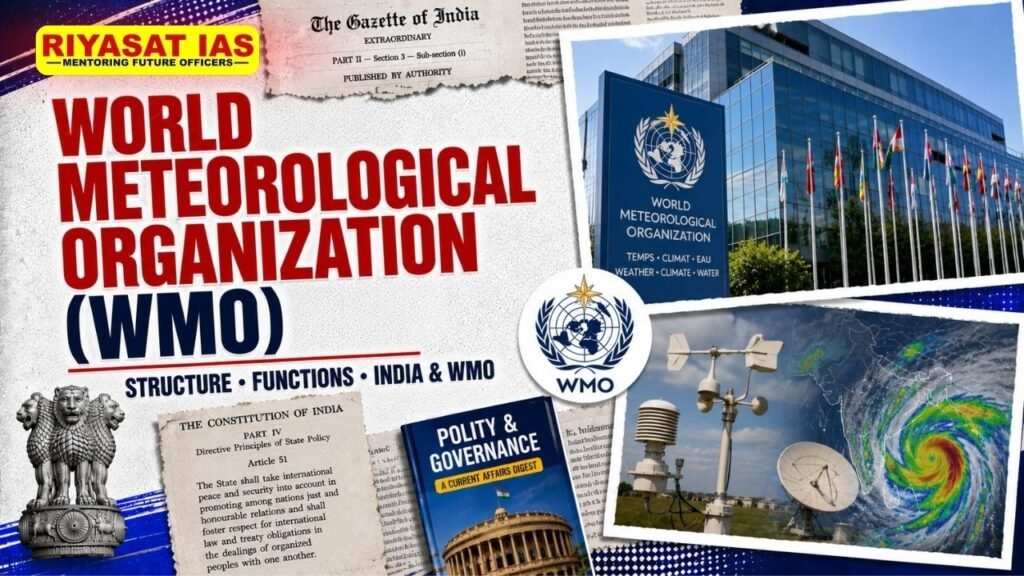
About WMO
· The World Meteorological Organization (WMO) is a specialised agency of the United Nations that promotes international cooperation in meteorology, climatology, hydrology and related Earth sciences. It facilitates the exchange of weather and climate data, development of forecasting systems, scientific research and provision of early-warning services to protect lives, livelihoods and property.
· The WMO currently has 193 Members, comprising 187 Member States and 6 Territories.
Establishment and Headquarters
· The WMO Convention was adopted in 1947, and the organisation formally came into existence on 23 March 1950. It became a UN specialised agency in 1951.
· The headquarters of WMO are located in Geneva, Switzerland.
· 23 March is observed as World Meteorological Day to commemorate the entry into force of the WMO Convention in 1950.
· WMO succeeded the International Meteorological Organization (IMO), which had been established in 1873.
Governance Structure of WMO
· World Meteorological Congress
o The World Meteorological Congress is the supreme body and highest decision-making authority of WMO. It consists of representatives of all WMO Members and normally meets every four years.
o It determines the overall policies and priorities of WMO, adopts the Strategic Plan and budget, elects the President and Vice-Presidents, and establishes the organisation’s technical and administrative framework.
· Executive Council
o The Executive Council is the executive body of WMO and is responsible for implementing the decisions of the Congress and supervising the organisation’s activities between Congress sessions.
o It consists of the President, three Vice-Presidents, six Regional Association Presidents and 27 Directors of National Meteorological or Hydrological Services, making 37 members in total.
· Regional Associations: WMO has six Regional Associations, corresponding to its six geographical regions:
o Africa (Region I)
o Asia (Region II)
o South America (Region III)
o North America, Central America and the Caribbean (Region IV)
o South-West Pacific (Region V)



o Europe (Region VI)
· Technical Commissions
o Technical Commissions provide scientific and technical expertise for WMO programmes and standards.
o They develop technical guidance, methodologies and standards relating to areas such as meteorological observations, climate services, hydrology, atmospheric sciences and weather forecasting.
· Secretariat
o The WMO Secretariat is the permanent administrative and technical body of the organisation and is headed by the Secretary-General.
o It supports the governing bodies, coordinates WMO programmes, facilitates international cooperation and provides technical and administrative support to Members.
Key Functions of WMO
· Weather Observation and Forecasting: WMO coordinates global systems for observing and monitoring the atmosphere, oceans, land and cryosphere and facilitates the exchange of meteorological information among its Members.
· Climate Monitoring: It maintains and analyses long-term climate observations that help assess global warming, climate variability and extreme weather events.
· Early Warning Systems: WMO supports countries in developing multi-hazard early-warning systems for hazards such as cyclones, floods, droughts, heatwaves and storms.
· Hydrological Services: WMO promotes international cooperation in hydrology and water-resource monitoring, which is important for flood forecasting, drought management and sustainable water management.
· Data and Information Exchange: It establishes international frameworks and standards for the collection, exchange and management of meteorological, hydrological and climate data.
· Scientific Research and Capacity Building: WMO facilitates international scientific cooperation and supports developing countries through technical assistance, training and capacity building.
· Climate Services: It promotes the development of climate information and services that help governments and communities make decisions relating to agriculture, water, health, disaster management, energy and infrastructure.
· Coordination of Global Observation Systems: WMO coordinates international observation networks and scientific programmes, including systems for monitoring the atmosphere, oceans, hydrological cycle and cryosphere.
Major WMO Programmes and Initiatives
· Early Warnings for All: The Early Warnings for All initiative was launched by the UN Secretary-General in 2022 and is jointly led by WMO and the UN Office for Disaster Risk Reduction. It seeks to ensure universal access to multi-hazard early-warning systems by the end of 2027.
· Global Framework for Climate Services: The Global Framework for Climate Services (GFCS) promotes the development and use of climate information and services for sectors that are highly sensitive to climate variability and change.
· World Weather Watch: The World Weather Watch provides the foundation for international cooperation in meteorological observation, data exchange and forecasting through a coordinated global system.
· Global Atmosphere Watch: The Global Atmosphere Watch (GAW) monitors the chemical composition of the atmosphere and provides scientific information on greenhouse gases, ozone, aerosols and air quality.
· World Climate Research Programme: WMO co-sponsors the World Climate Research Programme (WCRP), which promotes international research to improve understanding and prediction of the climate system.
Major Reports and Publications of WMO
· State of the Global Climate: The State of the Global Climate is WMO’s flagship annual assessment of the condition of the global climate and examines indicators such as global temperature, ocean heat, sea level, glaciers, sea ice, greenhouse gases and extreme weather.
o The State of the Global Climate 2025, released in March 2026, reported that 2015–2025 were the eleven hottest years on record, while 2025 was approximately 1.43°C above the 1850–1900 average.
· Greenhouse Gas Bulletin: The WMO Greenhouse Gas Bulletin provides observations of globally averaged concentrations of major long-lived greenhouse gases, particularly carbon dioxide, methane and nitrous oxide, and compares them with pre-industrial levels.
· State of Climate Services: The State of Climate Services series assesses countries’ capacity to provide climate information and services needed for adaptation, resilience and climate-sensitive decision-making.
· Global Status of Multi-Hazard Early Warning Systems: This report assesses global progress in establishing multi-hazard early-warning systems and identifies gaps in coverage, capacity and investment.
· El Niño/La Niña Updates: WMO’s El Niño/La Niña Updates provide assessments and forecasts concerning the development of ENSO conditions, which influence weather and climate patterns across different parts of the world.
· Global Seasonal Climate Update: The Global Seasonal Climate Update provides seasonal climate predictions and information on expected temperature and precipitation patterns.
· WMO Global Annual to Decadal Climate Update: This publication provides annual to decadal climate predictions, helping governments and sectors plan for climate-related risks over medium-term timescales.
FAQs
1. When was WMO established?
The WMO Convention was adopted in 1947, and WMO formally came into existence on 23 March 1950.
2. How many members does WMO have?
WMO currently has 193 Members, including 187 States and 6 Territories.
3. Where is WMO headquartered?
The headquarters of WMO are located in Geneva, Switzerland.
4. What is the relationship between WMO and the International Meteorological Organization?
WMO succeeded the International Meteorological Organization (IMO), which had been established in 1873.
5. Which is WMO’s flagship climate report?
The State of the Global Climate is WMO’s flagship annual report on the state of the world’s climate.




 Ravi Raaz
 Hassan Khan
 Shadab Ali