
Historical Background
· Sati refers to the practice in which a widow was burnt or buried alive along with the body of her deceased husband. The modern legal definition is broader: the Commission of Sati (Prevention) Act, 1987 includes the burning or burying alive of a widow or woman along with the body of her husband or relative, whether such an act is claimed to be voluntary or otherwise.
· The practice had a long and uneven history in the Indian subcontinent. It was not uniformly prevalent throughout India, nor was it practised by all Hindu communities. Its occurrence varied considerably across regions, social groups and historical periods.
· Early references to widow immolation are debated by historians. References are found in some ancient and medieval literary traditions, while clearer historical evidence becomes available from later periods. By the medieval and early-modern periods, the practice was particularly associated with some sections of upper-caste and warrior communities, including Rajput groups.
About the Sati System?
- Meaning of Sati: Sati was a practice in which a widow immolated herself on the funeral pyre of her deceased husband.
- After the woman’s death, a memorial stone or shrine was sometimes constructed in her memory, and she could be venerated as a goddess.
- The earliest known epigraphical evidence of sati is generally associated with the Eran Pillar Inscription of Bhanugupta, found at Eran in present-day Madhya Pradesh, and dated to 510 CE.
Steps Taken to Restrict or Abolish Sati
Mughal Empire
- Emperor Akbar took measures against forced sati. In 1582, he instructed his officials to prevent the immolation of a woman when it was evident that she was being forced into it.
- Akbar also encouraged alternatives to sati by providing financial assistance, gifts and support for the rehabilitation of widows who were willing to abandon the practice.
Sikh Tradition: Guru Amar Das strongly condemned sati during the 15th–16th centuries and advocated a more dignified position for widows.
British India
- The most important legal step came under Lord William Bentinck.
- The Bengal Sati Regulation, 1829 (Regulation XVII) declared the practice of sati illegal and punishable by the criminal courts in territories under the Bengal Presidency.
Other Legal Measures for the Improvement of Women’s Position
Female Infanticide
- The Bengal Regulations of 1795 and 1804 treated female infanticide as a criminal offence and equated it with murder.
- The Female Infanticide Prevention Act of 1870 introduced measures such as the registration of births and monitoring of female children in areas where the practice was suspected to continue.
Widow Remarriage
- The campaign led by Ishwar Chandra Vidyasagar played an important role in the enactment of the Hindu Widows’ Remarriage Act, 1856.
- The Act legalised the remarriage of Hindu widows and recognised children born from such marriages as legitimate.
Child Marriage
- The Age of Consent Act, 1891 raised the age of consent for girls to 12 years, thereby restricting certain forms of child marriage and protecting young girls from early sexual relations within marriage.
- The Child Marriage Restraint Act, 1929, popularly known as the Sarda Act, introduced minimum marriage ages and sought to discourage the practice of child marriage.
- The Child Marriage Restraint (Amendment) Act, 1978 further raised the minimum marriageable age to 18 years for women and 21 years for men.
Women’s Education
- The Calcutta Female Juvenile Society, established in 1819, was among the early initiatives that contributed to the development of female education in colonial India.
- Bethune School, established in 1849, became an important centre for the education of girls and represented a major step in the organised promotion of women’s education.
Where Did Mainly Sati Prevail?
Bengal: Bengal became one of the most important regions in the 18th and early 19th centuries in the official records concerning sati. Raja Rammohan Roy’s campaign against the practice was also closely connected with Bengal.
Rajasthan and Rajputana
· Rajputana was one of the strongest centres associated with the practice, particularly among sections of the ruling and warrior elite.



· The important point is that Bentinck’s 1829 Regulation did not automatically abolish sati throughout the princely states of Rajputana. The princely states had their own internal administrations, so prohibition took place separately in different states.
· This is why Rajasthan’s chronology is different from the standard 1829 Bengal Regulation story.
Other Regions
· Cases were also recorded in parts of Bombay Presidency, Madras Presidency, Central India and other regions. The practice was therefore not restricted to Bengal or Rajasthan.
· The colonial government gradually collected information about the practice through district and judicial records, which eventually became an important basis for legislative intervention.
Sati and Raja Rammohan Roy
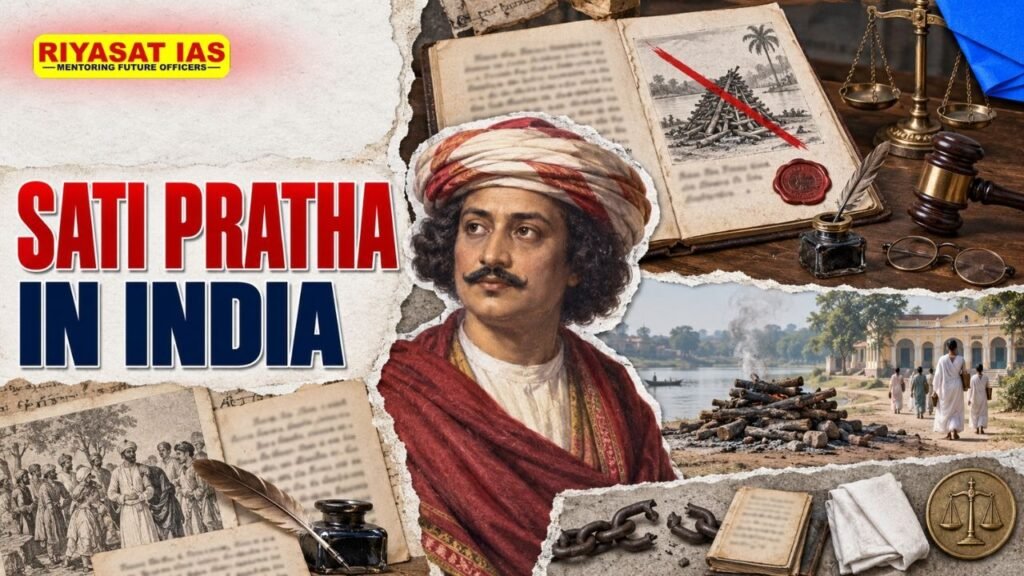
· Raja Rammohan Roy became the most prominent Indian voice against sati in the early nineteenth century.
· His opposition was both humanitarian and scriptural. He argued that sati was not an obligatory requirement of Hindu religious texts and challenged the interpretation that widow immolation was sanctioned by Hinduism.
· The Government of India’s Ministry of Culture records that Rammohan Roy was a lifelong campaigner against sati and that he supported its abolition through his writings and public activity.
· An important personal episode strengthened his opposition. According to a Ministry of Culture account, the death of his sister-in-law, who was forced to commit sati in 1811, became a turning point in his campaign against the practice.
· His Sambad Kaumudi also became an important vehicle for creating public opinion against sati.
Abolition During British Rule
Regulation XVII of 1829
· The decisive legal step came under Lord William Bentinck, Governor-General of Bengal.
· On 4 December 1829, the Bengal Government issued Regulation XVII of 1829, declaring the practice of sati illegal.
· The regulation treated the practice as a criminal offence and provided for its punishment through the criminal courts.
· The NIOS textbook states that the custom was formally abolished in 1829 and specifically highlights Rammohan Roy’s support for Bentinck’s efforts.
· The measure was subsequently extended to other British-controlled territories. The Bombay and Madras Presidencies adopted similar measures in 1830.
Why was 1829 important?
· The significance of Regulation XVII was not merely that one social practice was prohibited.
· It established an important principle: the colonial state was prepared to use law to intervene in a social custom when it considered the practice incompatible with human life and public order.
· At the same time, the abolition generated opposition from orthodox sections who considered it interference in religious affairs. Rammohan Roy and other reformers defended the measure.
When Was Sati Stopped in Rajasthan?
· The practice of Sati was declared illegal for the first time by the princely state of Bundi in 1822 AD.
· Rajasthan did not abolish sati through Bentinck’s 1829 Bengal Regulation. Rajputana consisted largely of princely states, and prohibition developed state by state.
· Jaipur was among the first Rajput states to prohibit the practice. The exact year is given differently in different historical accounts, with 1844 and 1846 both appearing in the literature. The available historical material is more certain about Jaipur’s primacy than about a single universally accepted year.
o Jaipur: The first major prohibition in Rajputana is generally dated to 1844/1846.
o Dungarpur, Banswara and Pratapgarh: Prohibitions followed in 1846.
o Kota and Jodhpur: Sati was prohibited in 1848, with penalties attached.
o Mewar/Udaipur: The practice continued longer and was prohibited in 1860/1861, depending on the source and whether the legal prohibition or last known case is being referred to.
By which king?
· Here one should avoid writing “Sawai Ram Singh II abolished sati in Rajasthan in 1846” as a blanket statement.
· Jaipur’s prohibition took place while Sawai Ram Singh II was a minor, and the state was being administered through a Council of Regency under British political supervision. Historical material records that this council prohibited sati, slavery and infanticide.
· In Mewar, the last phase is associated with Maharana Swarup Singh (1842–1861). The practice was prohibited in his reign, but a recorded case occurred around the time of his death in 1861.
Important Sati and Jauhar Episodes
| Period | Event | Region | Relevance |
| Ancient/early medieval period | References to widow immolation appear in literary and historical traditions. | Different regions | Shows the antiquity of the practice, although its prevalence varied greatly. |
| 1303 | Chittor Jauhar associated with the siege of Alauddin Khalji. | Mewar | Traditionally associated with Rani Padmini; the historical details are debated and should be treated cautiously. |
| 1535 | Second major Jauhar of Chittor. | Mewar | Associated with the siege of Bahadur Shah of Gujarat. |
| 1568 | Third major Jauhar of Chittor. | Mewar | Took place during Akbar’s siege of Chittor. |
| 1811 | Sati of Rammohan Roy’s sister-in-law. | Bengal | Became an important personal turning point in his campaign against sati. |
| 1829 | Regulation XVII abolished sati in Bengal Presidency. | British India | Landmark legislative intervention under William Bentinck. |
| 1838 | Sati was reported after the death of Maharana Jivan Singh. | Mewar | Shows that the practice continued in Rajputana after the 1829 regulation. |
| 1843 | Sati occurred following the death of Maharaja Man Singh. | Jodhpur | Demonstrates continuation of the practice in Rajputana. |
| 1840s–1860s | Rajput states progressively prohibited sati. | Rajputana | Shows the state-by-state nature of abolition. |
| 1861 | A final well-known case was recorded in Mewar after the death of Maharana Swarup Singh. | Udaipur/Mewar | Important for understanding the difference between legal prohibition and actual disappearance of the practice. |
| 1987 | Roop Kanwar case at Deorala. | Sikar, Rajasthan | Led to renewed national debate and stronger legislation against sati and its glorification. |
After Independence
· Although sati had been legally prohibited during the colonial period, the issue reappeared dramatically in independent India.
· The most significant modern case was the Roop Kanwar incident at Deorala in Rajasthan in 1987.
· The incident generated widespread public debate about whether existing criminal law was sufficient to prevent sati and, importantly, its glorification.
· This resulted in the Commission of Sati (Prevention) Act, 1987, which received Presidential assent on 3 January 1988 and came into force on 21 March 1988.
· Main features of the 1987 Act
· The law goes beyond simply prohibiting the act of sati.
· It provides for punishment relating to:
o Attempt to commit sati.
o Abetment of sati.
o Glorification of sati.
o Public ceremonies and processions connected with sati.
o Creation of trusts or collection of funds intended to perpetuate the honour or memory of a person who committed sati.
o Construction of temples or other structures for such glorification.
· The Act also gives powers to the Collector or District Magistrate to take preventive measures and provides for Special Courts for offences under the legislation.
· The statutory definition is particularly important: the Act states that sati is the burning or burying alive of a widow or woman and does not make legality depend upon whether the act was claimed to be voluntary.
Conclusion
The history of sati reflects the interaction between social customs, religious interpretation, reformist thought and state intervention. Rammohan Roy provided an important intellectual challenge to the practice, Bentinck gave it legal force through the 1829 Regulation, and later legislation strengthened prevention. The 1987 law finally addressed both sati and its glorification.
FAQs
1. Who abolished sati in India?
Lord William Bentinck abolished sati in the Bengal Presidency through Regulation XVII of 4 December 1829, following sustained reformist efforts, particularly those of Raja Rammohan Roy.
2. Did the 1829 law abolish sati throughout Rajasthan?
No. The princely states of Rajputana followed their own processes of prohibition. Jaipur moved in the mid-1840s, while Mewar was among the last.
3. Is sati the same as jauhar?
No. Sati concerned a widow after her husband’s death, while jauhar referred to collective self-immolation by women during a situation of imminent defeat and capture.
4. What was the Roop Kanwar case?
Roop Kanwar died in a reported sati incident at Deorala, Rajasthan, in 1987. The incident led to renewed national debate and stronger legislation against sati and its glorification.
5. Which law currently deals specifically with sati?
The Commission of Sati (Prevention) Act, 1987, which came into force in 1988, provides for the prevention of sati and its glorification.



 Ravi Raaz
 Hassan Khan
 Shadab Ali