
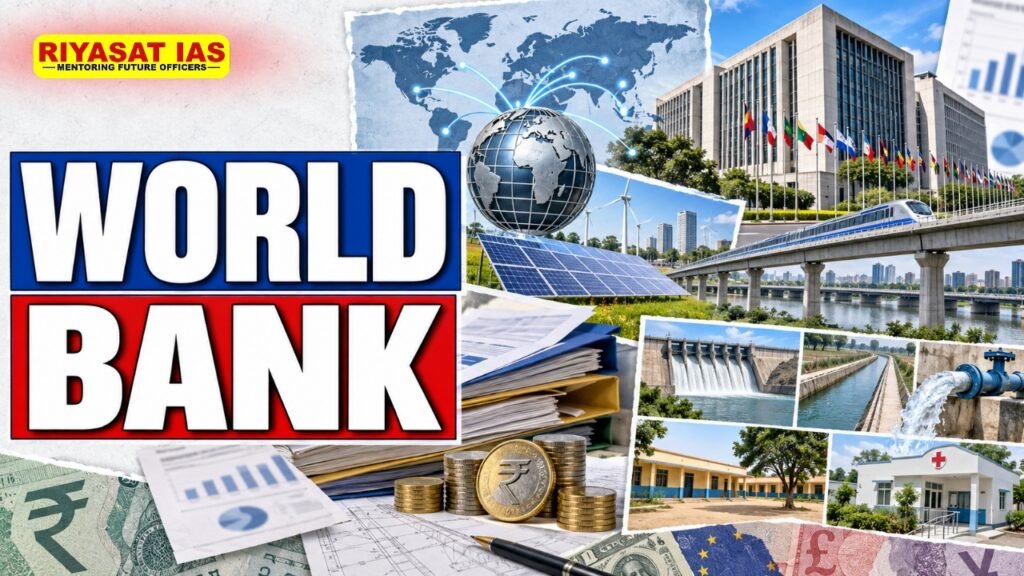
The World Bank is an international financial institution which was founded in 1944, at the Bretton Woods conference in New Hampshire. The World Bank was initially created in order to help the recovery of the economies which were affected by World War II.
The scope of its action included not only the war affected countries but also the developing countries. It supports its 189 member countries in reducing poverty and promoting sustainable economic development. The World Bank is headquartered in Washington, D.C.
World Bank Group
The World Bank is an international financial institution, and a part of the World Bank Group.
| Particulars | Details |
| Organization | World Bank Group |
| Headquarters | Washington, D.C., U.S. |
| Founded | 1944 |
| Members | 189 |
| India | Since 1944 |
| President | Ajay Banga (since June 2023) |
| Flagship publication | World Development Report |
India is one of the founding members of the World Bank. The first ever World Bank loan to India was given in 1949, for the reconstruction of the Indian Railways.
World Bank Objectives
The main objective of the World Bank is to reduce extreme poverty, and to promote sustainable and shared prosperity through sustainable development.
1. End Extreme Poverty
The World Bank aims to reduce the number of people living under the international poverty line, and work towards the end of extreme poverty.
2. Sustainable Development
It promotes sustainable, green, resilient and inclusive growth in developing countries.
3. Climate Change
The World Bank facilitates countries in dealing with climate change through both mitigation and adaptation measures.
4. Human Capital
It focuses on areas such as education, health and social protection, along with other social aspects which impact people’s wellbeing.
5. Institutional Development
The World Bank supports institutional and governance reforms in developing countries in order to strengthen their institutions.
6. Inclusive Growth
Its development programmes aim to promote growth which reaches out to different sections of society, especially the vulnerable groups.
World Bank Activities
The World Bank combines finance and analysis, as well as technical expertise in order to help developing countries in addressing their long-term economic and social needs.
1. Finance
The World Bank provides loans, guarantees and other financial services to governments. With the help of its sister organisations, it also creates opportunities for private companies to invest in developing markets.



2. Technical Assistance
It provides expert advice, guidance and implementation support across a range of areas, from infrastructure to social reforms.
3. Knowledge and Research
The World Bank produces and shares development-related knowledge, such as reports, data and research findings through the Open Knowledge Repository.
4. Capacity Development
The World Bank helps countries to strengthen their administrative and institutional capacities through knowledge-sharing initiatives, training and education programmes, for government officials.
5. Private Sector Development
The World Bank Group supports private-sector-led economic development through entrepreneurship, investment and job creation, especially through IFC and MIGA.
6. Crisis Response
The World Bank also helps countries to respond to major crises, such as health emergencies, climate disasters and conflicts.
Bretton Woods Institutions
Bretton Woods Institutions (BWI) is a common name for the World Bank and the IMF. Both organisations were created at the UN Monetary and Financial Conference, which took place in 1944, in Bretton Woods, New Hampshire.
Bretton Woods Institutions – World Bank vs. IMF
| World Bank | IMF |
| Focuses on long-term development | Focuses on short-term issues |
| Supports development projects | Helps countries deal with balance of payments problems |
| Provides development financing | Provides financing during crises |
| Works in infrastructure, health, education and social sectors | Deals with exchange rates, money and banking issues |
In simple terms, the main difference is that the IMF focusses on monetary and financial issues, while the World Bank focusses on long-term development concerns.
World Bank Group: Five Institutions
The World Bank Group (WBG) is comprised of five institutions. Each has a different role, but they are all involved in achieving broader development-related goals.
| Institution | Activities |
| International Bank for Reconstruction and Development (IBRD) | Provides loans to countries with middle and low incomes, dependent on their creditworthiness. |
| International Development Association (IDA) | Provides interest-free loans, credits and grants to the world’s poorest countries. |
| International Finance Corporation (IFC) | Encourages private investment in developing countries without government guarantees. |
| Multilateral Investment Guarantee Agency (MIGA) | Provides political-risk insurance and credit enhancement to investors. |
| International Centre for Settlement of Investment Disputes (ICSID) | Provides conciliation and arbitration services for investment disputes. |
World Bank Group’s Organizational Structure
The World Bank has a two-tier governance system.
| Governance Body | Description |
| Board of Governors | The Board of Governors is the main governing body of the World Bank. Each member country has one Governor who is usually the Minister of Finance, and one Alternate Governor. |
| Board of Executive Directors | The Board of Executive Directors forms the second level of governance and supervises the day-to-day operations of the World Bank. |
Important Reports of the World Bank
The World Bank publishes reports, the contents of which include data, analysis and recommendations on different aspects of development.
| Report | Description |
| World Development Report (WDR) | Global development issues |
| Global Economic Prospects | Global economic outlook |
| State and Trends of Carbon Pricing | Climate change |
| World Bank Group Annual Report | Annual report of the World Bank Group |
| Regional Economic Analysis | Regional development overview |
The World Development Report (WDR) is the World Bank’s annual flagship publication focusing on development issues.
India and the World Bank
India has had a significant relationship with the World Bank since 1944. Over the years, the relationship has expanded considerably. The support the World Bank has given to India has been in areas ranging from reconstruction and social services to rural development, highways and other development sectors.
1. Founding Member: India is one of the founding members of the World Bank.
2. Strategic Partnership: India’s strategic partnership with the World Bank supports green, resilient and inclusive development.
3. Major Borrower: India has been one of the major recipients of World Bank/IDA support, including concessional lending for roads, rural development and other services.
4. Blend Country: India has been categorised as a blend country, meaning that it has access to financing from both IBRD and IDA.
5. Development Goals: India’s development partnership with the World Bank also contributes to the country’s aim of becoming a developed nation by 2047.
FAQs on the World Bank
Q1: When was the World Bank established?
The World Bank was established in 1944, at the Bretton Woods conference in New Hampshire.
Q2: Where is the World Bank headquartered?
The World Bank’s headquarters is located in Washington, D.C.
Q3: How many institutions does the World Bank Group consist of?
The World Bank Group consists of five institutions: IBRD, IDA, IFC, MIGA and ICSID.
Q4: What is the main goal of the World Bank?
The main objective of the World Bank is to reduce extreme poverty, and to promote sustainable and shared prosperity through sustainable development.
Q5: What is the World Development Report?
The World Development Report (WDR) is the World Bank’s annual flagship publication focusing on global development issues.
Q6: When did India join the World Bank?
India has been a member of the World Bank since 1944 and was one of its founding members.


 Ravi Raaz
 Hassan Khan
 Shadab Ali