
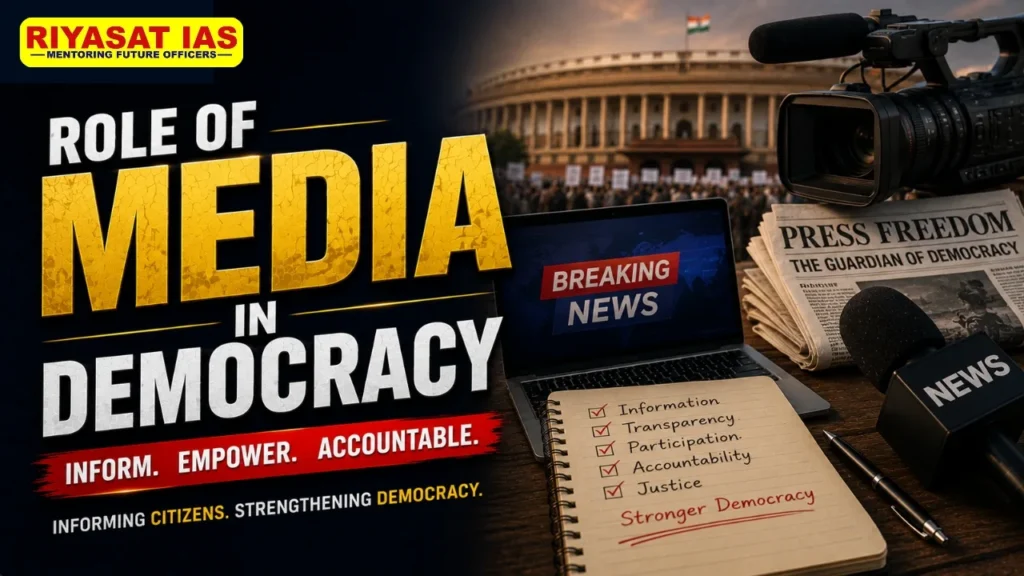
Introduction
Media is often regarded as the “fourth pillar of democracy” because it facilitates the flow of information between the State and citizens and enables public scrutiny of those in power. Although the Constitution does not expressly mention freedom of the press, the Supreme Court has recognised it as an integral part of Article 19(1)(a), which guarantees freedom of speech and expression, subject to reasonable restrictions under Article 19(2).
World Press Freedom Index – Reporters Without Borders (RSF), 2026
India is ranked 157th out of 180 countries, with a score of 31.96/100. RSF assesses press freedom across political, economic, legal, social and security dimensions.
Role of Media in Promoting Democracy
· Ensures Government Accountability: Media investigates and reports corruption, administrative failures, human-rights violations and misuse of public resources, thereby subjecting public institutions to scrutiny.
· Informs Citizens: It provides citizens with information about government policies, laws, elections, public expenditure and important national and international developments, enabling informed decision-making.
· Acts as a Watchdog: Investigative journalism can expose wrongdoing and bring issues that may otherwise remain hidden into the public domain.
· Promotes Public Debate: Media provides a platform for diverse viewpoints and facilitates debate on public policies, social issues and competing political ideas.
· Strengthens Electoral Democracy: During elections, media helps citizens evaluate political parties, candidates, manifestos and government performance, thereby supporting informed electoral choices.
· Gives Voice to Marginalised Groups: Media can bring attention to the concerns of women, tribal communities, minorities, workers and other vulnerable sections, making governance more inclusive.
· Acts as a Link Between Citizens and Government: Media communicates citizens’ grievances and expectations to authorities while explaining government policies and programmes to the public.
· Strengthens Participatory Democracy: Digital and social media have expanded opportunities for citizens to express opinions, organise campaigns and participate in public discourse.
Challenges Facing Media
· Paid News: The practice of presenting paid content as independent news can compromise journalistic integrity and electoral fairness.
· Media Ownership Concentration: Concentration of media ownership among a few corporate groups can reduce plurality of viewpoints and create conflicts of interest.
· Political and Corporate Influence: Dependence on political patronage or corporate advertising can affect the editorial independence of media organisations.



· Fake News and Misinformation: The rapid spread of false information can distort public opinion and undermine trust in democratic institutions. For example Mob Lynching.
· Sensationalism: The pursuit of TRPs, clicks and advertising revenue can encourage sensational reporting rather than substantive public-interest journalism.
· Decline of Investigative Journalism: Financial pressures and limited resources can make long-term investigative journalism difficult.
· Online Harassment and Threats: Journalists, particularly women journalists, may face online abuse, intimidation, trolling and threats, affecting freedom of expression.
· Self-Censorship: Fear of legal action, political pressure, economic consequences or social backlash may encourage journalists to avoid sensitive issues.
· Deepfakes and AI-Generated Content: Artificially generated audio, images and videos can make fabricated information appear authentic, creating new challenges for journalistic verification and electoral integrity.
Media-Regulating Agencies and Mechanisms
| Institution / Mechanism | Role |
| Press Council of India (PCI) | Statutory body that preserves the freedom of the press and maintains and improves standards of newspapers and news agencies.Note: The Press Council of India regulates the print media, while television and digital news largely operate through self-regulatory mechanisms and the broader legal framework. |
| News Broadcasting & Digital Standards Authority (NBDSA) | Independent self-regulatory body for participating private television news and current-affairs broadcasters. |
| National Broadcasting & Digital Standards Authority / industry self-regulation | Addresses complaints relating to ethical and professional standards among participating broadcasters. |
| Ministry of Information & Broadcasting | Administers the legal and policy framework governing broadcasting, films, print-related matters and digital media under applicable laws and rules. |
| Central Board of Film Certification (CBFC) | Statutory body that certifies films for public exhibition under the Cinematograph Act. |
| Election Commission of India (ECI) | Regulates election-related media conduct, including the Model Code of Conduct, paid-news monitoring and political advertising during elections. |
| Information Technology framework | Regulates intermediary due diligence and digital-media obligations through the IT Act and IT Rules. |
| Advertising Standards Council of India (ASCI) | Industry self-regulatory body that addresses misleading and harmful advertising. |
Important Supreme Court Judgements
· Romesh Thappar v. State of Madras (1950): The Supreme Court recognised the importance of freedom of circulation of ideas and political discussion in a democratic society.
· Bennett Coleman & Co. v. Union of India (1973): The Court held that freedom of the press is an important component of Article 19(1)(a) and cannot be indirectly restricted through measures that substantially curtail newspaper circulation.
· Indian Express Newspapers v. Union of India (1985): The Court emphasised the important role of the press in a democratic society and held that laws affecting press freedom must withstand constitutional scrutiny.
· Shreya Singhal v. Union of India (2015): The Supreme Court struck down Section 66A of the IT Act as unconstitutional for violating freedom of speech and expression.
Way Forward
· Strengthen Media Independence: Editorial decisions should remain independent of political and corporate interests, while ownership structures should be more transparent.
· Strengthen Self-Regulation: Media organisations should adopt stronger editorial codes, fact-checking mechanisms and transparent correction policies.
· Ensure Transparency in Media Ownership: Citizens should be able to identify who owns, controls and finances major media organisations.
· Combat Fake News Through Verification: Media organisations should invest in professional fact-checking, source verification and digital forensics, particularly for AI-generated content.
· Protect Journalists: Journalists should be protected from violence, intimidation, arbitrary harassment and online threats, while maintaining accountability under ordinary law.
· Improve Media Literacy: Citizens should be equipped to distinguish between credible journalism, misinformation, propaganda, sponsored content and manipulated media.
· Reduce Financial Vulnerability: Independent journalism requires sustainable business models so that news organisations are not excessively dependent on political patronage or concentrated advertising revenue.
· Strengthen Public-Service Broadcasting: Public broadcasters should maintain editorial independence, credibility and accessibility, particularly for citizens who depend on affordable and regional-language information.
Conclusion
A healthy democracy requires not merely a free media but a responsible, independent, plural and credible media ecosystem. India must therefore balance freedom of expression with accountability, technological innovation with information integrity, and regulation with editorial independence so that the media remains an effective watchdog of democracy rather than becoming an instrument of political or commercial influence.
“A democracy is strengthened when citizens have both the freedom to speak and the reliable information necessary to make informed choices.”
FAQs
Q1. Why is media called the fourth pillar of democracy?
Ans: Media acts as a watchdog over government, informs citizens, facilitates public debate and strengthens democratic accountability.
Q2. How does media strengthen democratic participation?
Ans: Media provides citizens with information, diverse viewpoints and platforms for public debate, enabling informed participation in democratic processes.
Q3. What are the major challenges faced by media in India?
Ans: Media faces challenges such as political and corporate influence, paid news, misinformation, sensationalism, media concentration and declining journalistic independence.
Q4. How does Article 19 protect the freedom of media?
Ans: Although the Constitution does not separately mention freedom of the press, it is protected under Article 19(1)(a), which guarantees freedom of speech and expression.
Q5. How can media contribute to good governance?
Ans: Independent and responsible media can promote good governance through investigative journalism, exposing corruption, informing citizens and holding public institutions accountable.


 Ravi Raaz
 Hassan Khan
 Shadab Ali