
Introduction
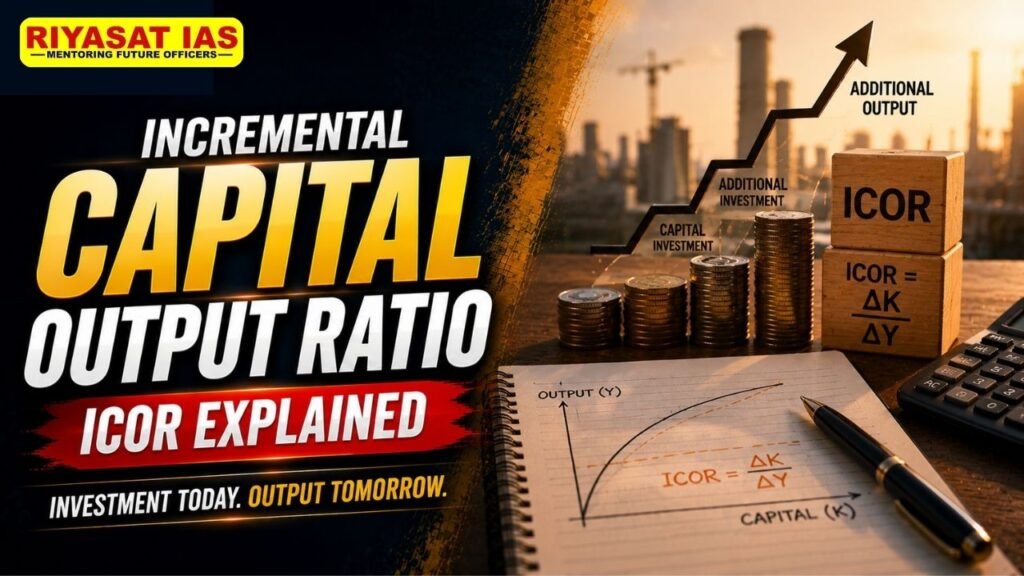
The Incremental Capital Output Ratio (ICOR) is a macroeconomic measure used to understand how efficiently an economy converts new investment into additional output. It is particularly useful in economic planning because it provides an estimate of the investment needed to achieve a specific growth target.
In simple terms, ICOR answers a basic question: How much additional capital is required to generate one additional unit of output? A lower ICOR generally indicates better utilisation of capital, while a higher ICOR suggests lower investment efficiency.
What is Incremental Capital Output Ratio (ICOR)?
- ICOR Meaning: ICOR represents the amount of additional capital required to generate an additional unit of output.
- Capital Efficiency: It provides an indication of how effectively an economy uses newly invested capital to expand production.
- Economic Planning: Governments can use ICOR to estimate the investment required to achieve a desired economic growth rate.
ICOR Formula
The basic formula is:
ICOR = Change in Capital ÷ Change in Output
It can also be expressed as:
ICOR = Investment Rate (% of GDP) ÷ GDP Growth Rate (%)
Therefore:
Investment Rate = ICOR × Growth Rate
For example, if an economy has an ICOR of 4 and aims to achieve 8% growth, the investment requirement would be:
4 × 8 = 32% of GDP
This relationship shows that the investment required for a particular growth target depends not only on the desired growth rate but also on the efficiency of capital utilisation.
What Does ICOR Tell Us?
- Low ICOR: A lower ratio means that the economy can generate additional output with comparatively less capital, indicating higher investment efficiency.
- High ICOR: A higher ratio means that more capital is required to generate additional output, suggesting lower capital productivity.
- Declining ICOR: A fall in ICOR indicates that investment is becoming more productive.
- Rising ICOR: An increase in ICOR may indicate inefficiencies in investment, technology, infrastructure or institutional systems.
ICOR: An Illustrative Example
Suppose an economy has an ICOR of 5 and wants to achieve an annual GDP growth rate of 8%.
Required Investment = ICOR × Growth Rate
= 5 × 8 = 40% of GDP
Now assume improvements in technology, infrastructure and labour productivity reduce the ICOR to 4.
The investment requirement becomes:



= 4 × 8 = 32% of GDP
Thus, improving the efficiency of capital can reduce the amount of investment required to achieve the same growth target.
Why is ICOR Important?
- Investment Planning: ICOR helps policymakers estimate the approximate investment requirement for achieving a particular growth target.
- Measures Capital Efficiency: It indicates how effectively additional investment contributes to additional output.
- Identifies Inefficiencies: A rising ICOR can alert policymakers to problems such as project delays, inefficient infrastructure or poor resource utilisation.
- Supports Policy Decisions: ICOR can help guide decisions relating to infrastructure, technology, investment and productivity.
- Enables Comparisons: Changes in ICOR can be examined across different periods, sectors or economies to understand variations in investment efficiency.
What Factors Affect ICOR?
ICOR varies across economies and over time because capital productivity depends on several structural factors.
- Governance: Efficient administration and timely implementation of projects can reduce wastage and improve investment outcomes.
- Human Capital: Skilled workers can operate machinery and technology more effectively, increasing output generated from existing capital.
- Technology: Modern technology can increase productivity and enable greater output from the same level of investment.
- Infrastructure: Reliable transport, electricity, logistics and communication systems improve the utilisation of productive capital.
- Institutional Efficiency: A predictable regulatory environment and easier business processes can reduce delays and improve investment productivity.
What Does a High ICOR Indicate?
A high ICOR generally suggests that an economy needs a relatively large amount of additional capital to generate extra output.
Possible reasons include:
- Low productivity of investment: Capital may not be generating sufficient additional output.
- Project delays: Delays and cost overruns can reduce the effective productivity of investment.
- Infrastructure bottlenecks: Poor connectivity, unreliable power or weak logistics can prevent productive assets from being fully utilised.
- Skill shortages: Lack of appropriately skilled workers can reduce the productivity of machinery and technology.
- Institutional inefficiency: Regulatory delays and weak governance can reduce the effectiveness of investment.
What Does a Low ICOR Indicate?
A low ICOR generally reflects better utilisation of capital and higher productivity.
It can be supported by:
- Technological improvement: Better technology increases output from existing capital.
- Higher labour productivity: Skilled workers improve the utilisation of machinery and productive assets.
- Better infrastructure: Efficient infrastructure allows investments to operate closer to their potential.
- Effective governance: Faster decision-making and better project management improve investment outcomes.
- Efficient resource allocation: Directing investment towards productive sectors increases the contribution of capital to economic growth.
ICOR and Economic Growth
ICOR establishes an important relationship between investment and economic growth.
Lower ICOR → Higher Capital Efficiency → Less Investment Required for a Given Growth Target
Higher ICOR → Lower Capital Efficiency → More Investment Required for the Same Growth Target
However, ICOR should not be interpreted in isolation. Economic growth also depends on labour productivity, technology, demand conditions, institutional quality, natural resources and the broader investment environment.
How Can Investment Efficiency Be Improved?
- Improve Project Implementation: Reduce delays, cost overruns and administrative bottlenecks in major investment projects.
- Strengthen Infrastructure: Improve transport, electricity, logistics and digital connectivity to maximise the utilisation of productive capital.
- Invest in Skills: Align education and vocational training with industry requirements to improve labour productivity.
- Promote Technology Adoption: Encourage innovation and adoption of technologies that increase output from existing capital.
- Improve Governance: Strengthen transparency, accountability and regulatory efficiency to ensure better utilisation of investment resources.
Conclusion
The Incremental Capital Output Ratio (ICOR) provides a useful way to understand the relationship between investment and additional output. While a lower ICOR generally indicates greater capital efficiency, a higher ICOR suggests that more investment is required to generate the same level of additional output.
For developing economies, the objective should not simply be to increase the volume of investment, but also to improve its productivity. Better infrastructure, skilled human resources, technological progress, efficient governance and effective project implementation can help lower ICOR and make economic growth more investment-efficient.
Frequently Asked Questions (FAQs)
What is ICOR in economics?
ICOR (Incremental Capital Output Ratio) measures the amount of additional capital required to generate an additional unit of output.
What is the formula for ICOR?
ICOR = Change in Capital ÷ Change in Output
It can also be expressed as:
ICOR = Investment Rate ÷ GDP Growth Rate
Is a lower ICOR better?
Generally, yes. A lower ICOR indicates that capital is being used more efficiently to generate additional output.
What does a high ICOR mean?
A high ICOR indicates that a relatively larger amount of investment is required to generate additional output, suggesting lower capital efficiency.
Why is ICOR important in economic planning?
ICOR helps policymakers estimate the investment required to achieve a targeted rate of economic growth.
What factors influence ICOR?
Major factors include technology, labour skills, infrastructure, governance, institutional efficiency and the quality of investment.
How can a country reduce its ICOR?
A country can improve capital efficiency through better infrastructure, technological advancement, skilled labour, efficient governance and improved project implementation.
Is ICOR the only determinant of economic growth?
No. ICOR focuses on the relationship between capital and output. Economic growth also depends on labour, technology, productivity, demand, institutions and other economic factors.


 Ravi Raaz
 Hassan Khan
 Shadab Ali