
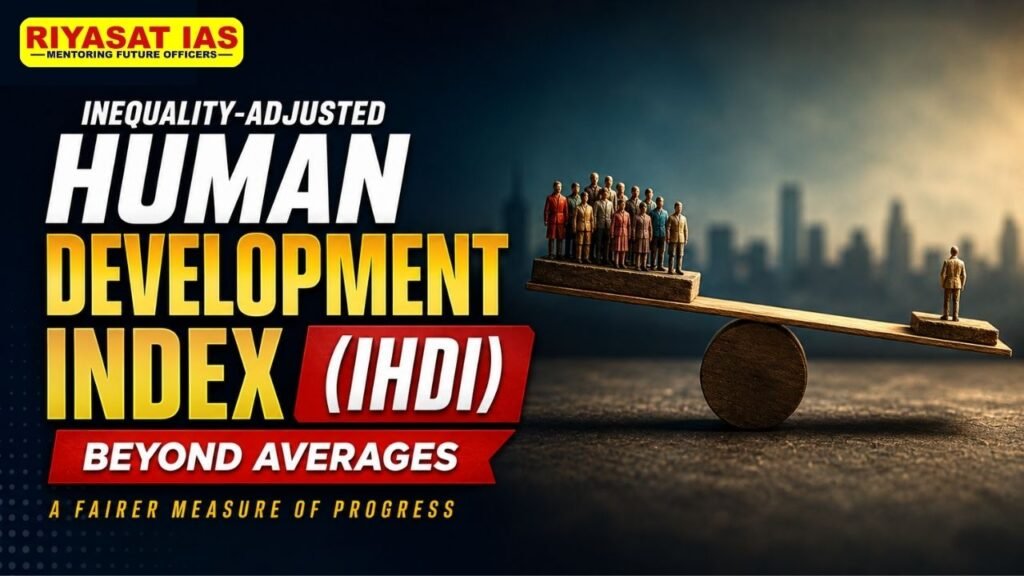
Introduction
The Inequality-adjusted Human Development Index (IHDI) measures human development after accounting for inequality in the distribution of achievements in health, education and income. Published by the United Nations Development Programme (UNDP), it provides a more realistic picture of how evenly the benefits of development are shared across a population.
While the HDI measures average achievements, the IHDI adjusts these achievements downward when significant inequality exists. Therefore, the gap between a country’s HDI and IHDI reflects the loss in human development associated with inequality.
What is IHDI?
The IHDI is an inequality-sensitive version of the Human Development Index.
It adjusts the three dimensions of HDI—health, education and standard of living—according to how equally these achievements are distributed among people.
HDI: Measures the average level of human development.
IHDI: Measures the level of human development after accounting for inequality.
Inequality Penalty: A larger difference between HDI and IHDI indicates greater inequality.
Difference Between HDI and IHDI
| Basis | HDI | IHDI |
| Focus | Average human development | Human development adjusted for inequality |
| Dimensions | Health, education and income | Health, education and income after inequality adjustment |
| Inequality | Not reflected in the basic index | Directly incorporated |
| Nature | Shows potential/average achievement | Shows distribution-adjusted achievement |
| Use | Measures overall human development | Assesses the loss caused by unequal distribution |
| Policy Value | Provides a broad national picture | Helps identify the extent of unequal development |
Why is IHDI Important?
Unmasks National Averages: A high average HDI can sometimes conceal substantial differences between regions, income groups or social groups. IHDI reduces this distortion by accounting for how development achievements are distributed.



Measures Multidimensional Inequality: Unlike measures that focus only on income inequality, IHDI considers disparities in health, education and living standards.
Helps Assess Inclusive Growth: A smaller gap between HDI and IHDI indicates that human development achievements are distributed more equally. A larger gap signals that economic and social progress is not reaching all sections of society equally.
Improves Policy Targeting: IHDI can help policymakers identify areas where inequality is reducing development outcomes and design targeted interventions for disadvantaged communities and regions.
IHDI and Inclusive Growth
The IHDI is particularly relevant to the idea of inclusive growth because economic growth alone does not guarantee equal improvements in human well-being.
For example, rising average income may improve a country’s HDI while persistent disparities in healthcare, education and access to opportunities continue to affect vulnerable groups. IHDI captures this distributional dimension more effectively.
Therefore, India needs to focus not only on improving its HDI but also on reducing the gap between HDI and IHDI.
Significance of IHDI for India
For India, the IHDI highlights the importance of addressing:
Regional disparities in development outcomes
Rural-urban gaps in access to basic services
Income inequality
Gender disparities
Unequal access to quality education and healthcare
Social and economic disadvantages faced by vulnerable groups
Programmes such as the Aspirational Blocks Programme can contribute to reducing localised development gaps by directing greater attention and resources towards relatively underdeveloped areas.
Way Forward
Improve public healthcare: Ensure affordable and quality healthcare across regions.
Strengthen education: Focus on learning outcomes and equal access to quality education.
Promote decent employment: Expand productive employment opportunities for disadvantaged groups.
Reduce regional disparities: Target development interventions towards lagging districts and blocks.
Increase women’s participation: Improve women’s access to education, employment and economic opportunities.
Strengthen social protection: Ensure vulnerable households are protected against economic shocks.
Conclusion
The IHDI provides a deeper understanding of human development by moving beyond national averages and incorporating inequality. While HDI tells us how much progress a country has achieved on average, IHDI indicates how much of that achievement is actually shared across the population.
For India, reducing inequality in income, education, healthcare and access to opportunities is essential for converting economic growth into genuinely inclusive human development.
Frequently Asked Questions (FAQs)
What is the IHDI?
The IHDI is the Human Development Index adjusted for inequality in the distribution of health, education and income achievements.
Who publishes the IHDI?
The Inequality-adjusted Human Development Index is published by the United Nations Development Programme (UNDP).
What does the gap between HDI and IHDI show?
The gap indicates the loss in human development associated with inequality. A larger gap generally indicates greater inequality.
How is IHDI different from HDI?
HDI measures average human development, whereas IHDI adjusts human development outcomes for inequality.
Why is IHDI important for inclusive growth?
It reveals whether improvements in human development are broadly shared or concentrated among particular groups or regions.


 Ravi Raaz
 Hassan Khan
 Shadab Ali