
Introduction
Economic growth alone does not provide a complete picture of a country’s development. A country may have a large economy but still face challenges related to health, education, poverty and living standards. The Human Development Index (HDI) addresses this gap by focusing on people’s well-being and capabilities rather than economic output alone.
The HDI is a composite index developed by the United Nations Development Programme (UNDP) to measure average achievement in three basic dimensions of human development: a long and healthy life, access to knowledge, and a decent standard of living. According to the Human Development Report 2025, India ranked 130th among 193 countries and territories for 2023, with an HDI value of 0.685, placing it in the medium human development category.
What is the Human Development Index?
The Human Development Index (HDI) is a composite measure used to assess a country’s average level of human development.
It was developed to shift the focus of development measurement from economic growth alone towards people’s health, education and living standards.
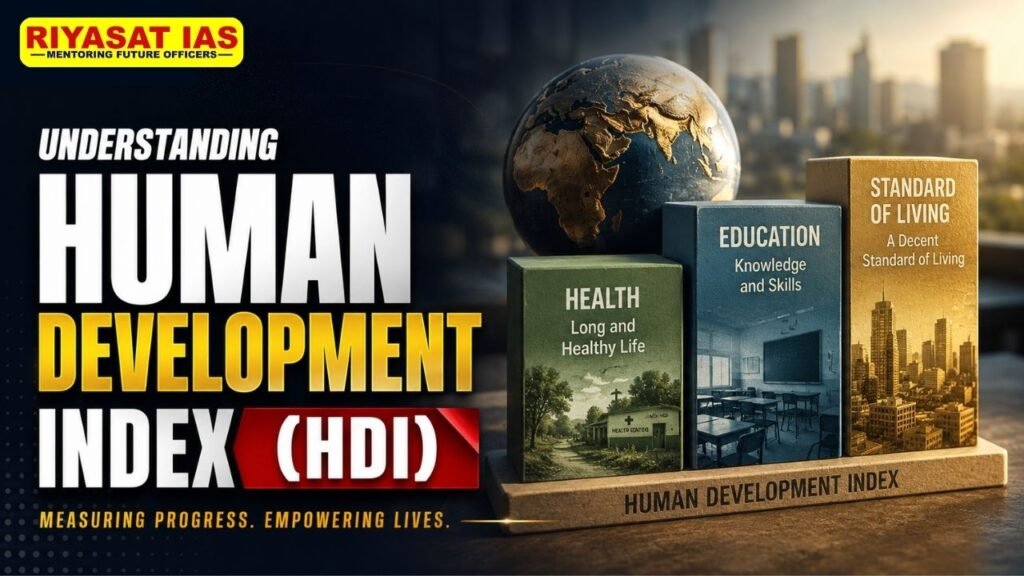
The HDI combines three dimensions:
Health: Life expectancy at birth
Education: Expected years of schooling and mean years of schooling
Standard of living: Gross National Income (GNI) per capita
UNDP calculates the HDI as the geometric mean of normalised indices for these three dimensions.
Who Publishes the HDI?
The United Nations Development Programme (UNDP) publishes the Human Development Index through its annual Human Development Report and Human Development Data Center.
The HDI was introduced in 1990, reflecting the human development approach associated with economists Mahbub ul Haq and Amartya Sen.
The underlying idea is that development should ultimately expand people’s choices and capabilities, rather than being judged only by the growth of national income.
Three Dimensions of Human Development Index
1. Health
The health dimension is measured using life expectancy at birth. It indicates the average number of years a newborn is expected to live under prevailing mortality conditions.
Higher life expectancy generally reflects better health conditions, nutrition, healthcare access and living conditions.
2. Education
The education dimension uses two indicators:
Expected years of schooling: The number of years of schooling a child entering the education system can expect to receive.
Mean years of schooling: The average number of years of education completed by adults aged 25 years and above.
Together, these indicators capture both the expected educational opportunities of the younger generation and the existing educational attainment of adults.
3. Standard of Living
The standard-of-living dimension is measured through Gross National Income (GNI) per capita.
UNDP uses income in purchasing-power-adjusted terms and applies a logarithmic transformation because an additional unit of income generally contributes less to human well-being as income rises.
How is HDI Calculated?
Step 1: Calculate Dimension Indices
Separate indices are calculated for health, education and income. Each indicator is normalised so that countries can be compared.
Step 2: Combine the Indices
The three dimension indices are combined using a geometric mean.
Step 3: Assign the HDI Value
The resulting value lies between 0 and 1. A higher value indicates a higher level of human development.
Human Development Categories
| HDI Value | Human Development Category |
| 0.800 and above | Very High Human Development |
| 0.700–0.799 | High Human Development |
| 0.550–0.699 | Medium Human Development |
| Below 0.550 | Low Human Development |
India’s Human Development Index 2025
The Human Development Report 2025 uses data for 2023. India’s position was:
| Indicator | India, 2023 |
| HDI Rank | 130 |
| HDI Value | 0.685 |
| Human Development Category | Medium |
| Life Expectancy at Birth | 72.0 years |
| Expected Years of Schooling | 13.0 years |
| Mean Years of Schooling | 6.9 years |
| GNI per Capita | $9,047 |



India’s HDI value increased from 0.676 in 2022 to 0.685 in 2023, while its rank improved from 133rd to 130th.
What Does India’s HDI Performance Show?
Improvement in Life Expectancy: India’s life expectancy at birth reached 72 years in 2023, reflecting long-term improvements in health and survival outcomes.
Expansion of Educational Opportunities: Expected years of schooling reached 13 years, indicating an improvement in the educational opportunities available to younger generations. However, mean years of schooling remains considerably lower, highlighting the difference between expected educational attainment and completed education among adults.
Rising Income: India’s GNI per capita increased to approximately $9,047 in 2023 in the measure used by UNDP. However, India’s GNI per capita rank is seven positions below its HDI rank, suggesting that income remains an area where India has considerable scope for improvement relative to its overall human development position.
India and Inequality
A country’s average HDI does not reveal how evenly human development is distributed among its population. This is why UNDP also publishes the Inequality-adjusted Human Development Index (IHDI).
The IHDI adjusts HDI for inequality in the distribution of achievements across the population. When inequality is absent, IHDI equals HDI; as inequality increases, IHDI falls below the country’s HDI.
For India, inequality therefore remains an important factor when assessing the quality and inclusiveness of human development.
This highlights the importance of improving:
Access to quality healthcare
Educational outcomes
Employment opportunities
Women’s economic participation
Social protection
Regional development
Income distribution
India and Multidimensional Poverty
Human development is broader than income poverty. India has also recorded progress in reducing multidimensional poverty. However, improvements in poverty reduction need to be accompanied by better access to health, education, nutrition, sanitation and employment opportunities.
This is important because economic growth translates into meaningful human development only when people can convert higher incomes and public services into better capabilities and living conditions.
Global Human Development Trends
The Human Development Report 2025 highlights a broader global concern: progress in human development has slowed significantly.
The report also points to widening human development gaps and increasing inequality between countries at different levels of development.
This suggests that achieving higher GDP growth alone is not sufficient. Countries also need sustained investment in:
Healthcare
Education
Social protection
Employment
Gender equality
Human capabilities
Why is HDI Important?
Measures Development Beyond GDP: GDP primarily measures economic activity. HDI adds health and education to the assessment, providing a more people-centred perspective on development.
Enables International Comparison: HDI allows countries to compare their progress across common indicators.
Highlights Policy Gaps: A country’s HDI performance can reveal weaknesses in healthcare, education or income even when its economy is growing rapidly.
Focuses on Human Well-being: The index reinforces the idea that people and their capabilities should be at the centre of development policy.
Supports Evidence-Based Policy: HDI and its complementary indices help policymakers identify areas where development outcomes require greater attention.
Limitations of HDI
Does Not Fully Capture Inequality: HDI is based on average achievements. Two countries with similar HDI values may have very different levels of inequality. The IHDI addresses this limitation by adjusting HDI for inequality.
Limited Gender Perspective: HDI does not comprehensively measure gender-based disparities. UNDP therefore publishes separate measures such as the Gender Development Index (GDI) and Gender Inequality Index (GII).
Does Not Capture Poverty Completely: Income and average achievements cannot fully reflect multidimensional poverty.
Quality of Services is Not Fully Reflected: Years of schooling do not necessarily indicate the quality of education. Similarly, life expectancy alone cannot capture the complete quality or accessibility of healthcare.
Environmental Sustainability: Traditional HDI does not fully incorporate environmental pressures. UNDP therefore also provides the Planetary Pressures-adjusted HDI (PHDI).
HDI and Other Human Development Indices
| Index | Main Focus |
| HDI | Overall human development |
| IHDI | Human development adjusted for inequality |
| GDI | Gender differences in human development |
| GII | Gender inequalities |
| PHDI | Human development adjusted for planetary pressures |
| MPI | Multidimensional poverty |
HDI vs GDP
| Basis | HDI | GDP |
| Focus | Human well-being and capabilities | Economic production |
| Health | Included | Not directly included |
| Education | Included | Not directly included |
| Income | GNI per capita included | Measures domestic production |
| Inequality | Not fully captured | Not captured |
| Purpose | Measure human development | Measure economic activity |
Therefore, GDP and HDI should be seen as complementary rather than competing measures.
Way Forward for India
Strengthen Public Healthcare: Improve primary healthcare, preventive care, nutrition and access to quality medical services to further improve health outcomes.
Improve Learning Outcomes: Focus not only on school enrolment but also on learning outcomes, foundational literacy and numeracy, vocational education and employable skills.
Create Quality Employment: Economic growth must generate productive and adequately remunerated employment, particularly for young people and women.
Reduce Inequality: Policies should ensure that improvements in income, education and healthcare reach disadvantaged and vulnerable groups.
Promote Women’s Economic Participation: Greater female labour force participation can improve household incomes, economic productivity and broader human development.
Strengthen Social Protection: Effective social security and welfare systems can protect vulnerable households against economic and social shocks.
Make Growth More Inclusive: India’s development strategy should ensure that economic growth translates into better capabilities and opportunities across regions and social groups.
Conclusion
The Human Development Index provides a broader perspective on development by placing health, education and living standards alongside economic prosperity. India’s improvement to 130th position with an HDI value of 0.685 in the 2025 Human Development Report indicates continued progress, but its classification in the medium human development category also shows that substantial challenges remain.
For India, the next stage of development should focus not merely on increasing national income but on improving the quality, accessibility and distribution of human development outcomes. Strengthening healthcare, education, employment, gender equality and social protection will be crucial for converting economic growth into inclusive and sustainable human development.
Frequently Asked Questions (FAQs)
What is the Human Development Index?
The Human Development Index (HDI) is a composite measure developed by UNDP to assess average achievements in health, education and standard of living.
Who publishes the Human Development Index?
The HDI is published by the United Nations Development Programme (UNDP).
What are the three dimensions of HDI?
The three dimensions are health, education and standard of living.
Which indicators are used to calculate HDI?
HDI uses life expectancy at birth, expected years of schooling, mean years of schooling and GNI per capita.
What is India’s HDI rank in 2025?
According to the Human Development Report 2025, India ranked 130th among 193 countries and territories, based on 2023 data.
What is India’s HDI value?
India’s HDI value for 2023 was 0.685.
Which category does India fall under?
India falls under the medium human development category.
Is HDI better than GDP for measuring development?
HDI and GDP measure different aspects of development. GDP measures economic production, while HDI incorporates health, education and income. Therefore, HDI provides a broader perspective on human development.
What is the Inequality-adjusted HDI?
The IHDI adjusts HDI according to the distribution of achievements across the population. Higher inequality results in a larger reduction from HDI to IHDI.
What are the limitations of HDI?
HDI does not fully capture inequality, gender disparities, multidimensional poverty, environmental sustainability, quality of public services and political freedoms.


 Ravi Raaz
 Hassan Khan
 Shadab Ali