
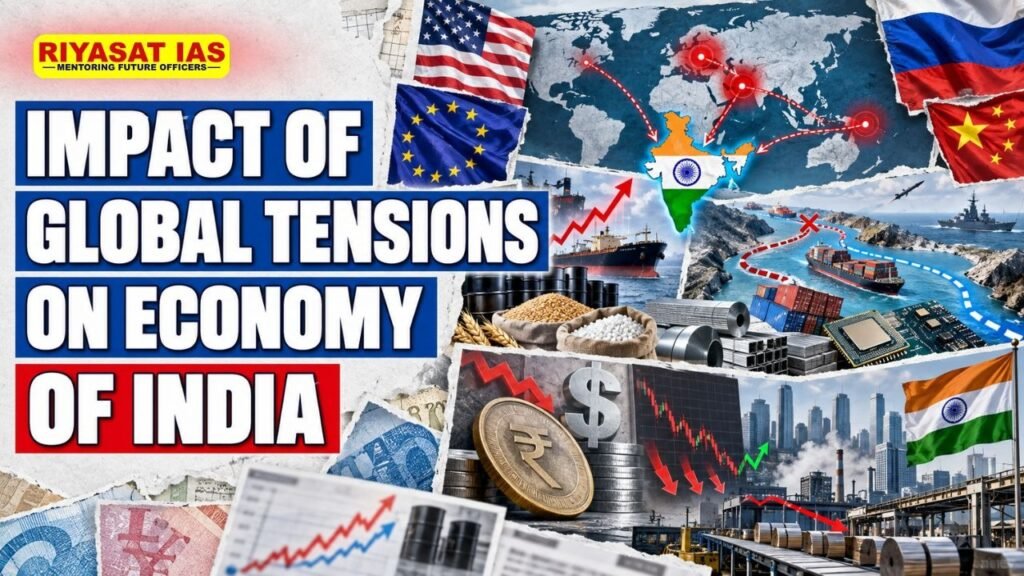
Global tensions can adversely impact the Indian economy. These range from currency and forex pressure, oil price shocks, capital outflows, inflationary pressures and impact on supply chains. India’s heightened dependence on global imports of energy and key inputs make it particularly vulnerable to such impacts.
Key Economic Impact
1. Forex/Currency and Capital Inflows/Outflows
Geopolitical uncertainty can trigger outflows from foreign portfolio investments in India, leading to depreciation of INR. This can lead to higher import bills and imported inflation.
2. Oil Price Shocks
India is highly dependent on imports for crude oil (85%) – an increase in global oil prices will lead to an increase in CAD, inflation, and cost of goods and services.
3. Fiscal Space
Increased cost of energy will lead to fiscal adjustment (tax/subsidy changes) which could reduce space for welfare and capital expenditures.
4. Impact on Households
With higher prices of key items like food and energy, the real value of income will reduce.
5. Sectoral Disparity
India’s growth is capital intensive – so capital intensive sectors will be more resilient compared to informal and labour intensive sectors that are vulnerable to cost-push inflation, and reduction in demand.
India’s Supply Chain Weakness
India is highly reliant on imports for critical raw materials, inputs and components, despite its capacity in downstream manufacturing and processing.
Energy Security
India is highly dependent on imports for crude oil (85%) and gas (more than 50%), according to the source. Disruption in energy markets can lead to cost push inflation, increased logistics costs and fiscal adjustment.
Pharmaceuticals
India is highly dependent on imports for APIs and KSMs – about 65-70% are imported from China, according to the source. Disruption to supply chains can impact domestic pharma production and cost.
Technology and Electronics
India remains highly dependent on imports for semiconductors, displays and high end machines. Transition to EVs and renewables also requires supply of critical minerals like lithium, cobalt, nickel and rare earth elements that have constrained supply chains.



Agriculture
India is highly dependent on imports for edible-oil requirements, and fertilizers like potash and phosphate. Domestic production accounts for around 44% of edible-oil demand, according to the source. There is a need to boost production of oilseeds, pulses etc to reduce dependency.
Export Impact/Traffic Congestion
Tensions in key maritime routes (Red Sea, Hormuz) can increase freight costs and transit time, and impact availability of containers for Indian exports.
Addressing India’s Economic Vulnerability
1. Macro Buffers
Maintaining macroeconomic and forex buffers to absorb shocks.
2. Domestic Supply Chains
Building domestic supply chains for APIs, semiconductors, electronic components, critical machinery, and renewable energy equipment.
3. Logistics
Improving logistics infrastructure (PM GatiShakti, National Logistics Policy).
4. Energy Security
Developing renewable energy and green hydrogen, strengthening strategic petroleum reserves and ensuring supply of critical minerals.
5. Agricultural Diversification
Moving towards domestic production of oilseeds, pulses etc to reduce dependency on imported edible oils.
6. Trade Diversification
Using supply chain diversification, and China +1 strategy to attract FDI and develop alternatives.
7. Alternative Trade Corridors
Developing alternative trade corridors (IMEC, INSTC).
Conclusion
Global tensions can impact India through various channels including energy prices, forex, capital flows, trade and supply chains. India needs to ensure that it reduces over-reliance on critical imports while being able to participate in the global economy.
Focus areas will include diversified supply chains, domestic manufacturing, energy security, improved logistics, agricultural diversification and strategic partnerships.
FAQs on Global Tensions and India’s Economy
How does global tensions impact India’s economy?
These can lead to currency/forex volatility, capital outflows, oil price shock, inflation and impact on supply chains.
Why India is vulnerable to global oil price shock?
India is one of the largest importers of crude oil (85% of its requirement is met through imports).
How global tensions impact Indian Rupee?
Geopolitical tensions can trigger outflows of foreign portfolio investments from India – leading to depreciation of INR.
What are the key vulnerable sectors in terms of supply chains?
Energy, pharmaceuticals, electronics, semiconductor, critical minerals, fertilizers, edible oils
Why is pharmaceutical sector vulnerable?
India is highly dependent on imports of APIs and KSMs – about 65-70% of which are imported from China.
How can India reduce its dependence on imports?
By building domestic manufacturing capability, diversifying sources, promoting renewables and securing critical minerals.
What role does the PLI scheme play?
The Production Linked Incentive (PLI) scheme promotes domestic manufacturing and investment in strategic sectors.
How can India improve its energy security?
By promoting renewable energy and green hydrogen, augmenting strategic petroleum reserves, exploring domestic resources and securing critical minerals.
How can India strengthen its trade resilience?
By diversifying sources and partners, improving logistics, and developing alternate trade corridors.
What is the key challenge for India?
Reducing overdependence on critical imports while participating in the global economy.




 Ravi Raaz
 Hassan Khan
 Shadab Ali