
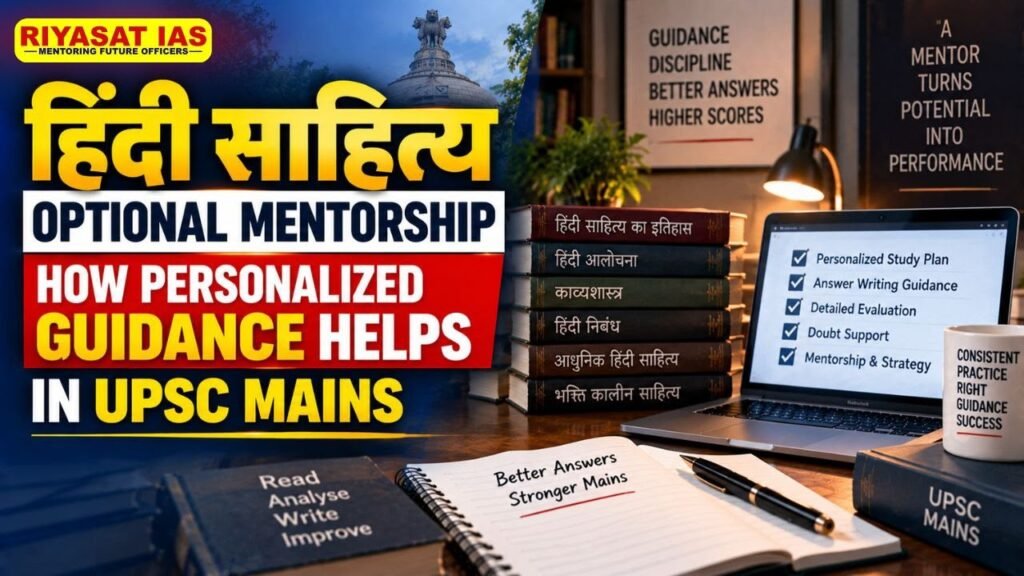
Classes teach you Hindi Literature. Mentorship teaches you how to score in it.
The mentorship model described here is the one followed in the Hindi Sahitya optional course with live mentorship at Riyasat IAS.
Most aspirants who take Hindi Literature (हिंदी साहित्य) as their UPSC optional do not fail because they have not studied. They lose marks because their answers lack structure, because they spent too long on Paper 2 texts and too little on Paper 1 language topics, or because they did not revise in time. These are not knowledge problems. They are planning and feedback problems — and they are exactly what personalised mentorship is designed to solve.
Quick answer: Hindi Literature optional mentorship gives you a planned study path, regular one-to-one or small-group reviews of your answers and progress, and course correction before Mains. It turns 200 hours of classes into marks by showing you what to fix in your own writing.
Classes vs Mentorship: What Is the Difference?
| Classes | Mentorship |
| Teach the syllabus to everyone | Addresses your specific gaps |
| Same pace for the whole batch | Adjusts to your time, background and attempt |
| Explain the text | Explain why your answer on that text lost marks |
| One-way delivery | Two-way conversation |
You need both (read more on how mentorship helps in any optional subject). A mentor without subject teaching has nothing to work on; teaching without mentorship leaves you guessing about your weaknesses.
6 Ways Personalised Guidance Improves Your Mains Score
1. It balances Paper 1 and Paper 2
Many aspirants love the poetry and novels of Paper 2 and neglect Section A of Paper 1 — Apabhramsha and Avahatta, the development of Braj and Avadhi, Khari Boli and the standardisation of Nagari script, Hindi as the official language of the Union, and the grammatical structure of standard Hindi. A mentor notices this imbalance early and corrects it.
2. It fixes your answer structure
A mentor reads your copy and tells you exactly what went wrong: an introduction that is too long, no mention of the literary period, no quotation from the text, a conclusion that repeats the question. These are small changes, but across 20 answers in two papers they add up to a significant difference in marks.



3. It sharpens reference-to-context answers
Paper 2 expects you to explain passages from prescribed texts with context. A mentor teaches you a repeatable method: identify the text and the poet, place the passage in its context, explain the meaning, and then comment on the literary and stylistic features (शिल्प-सौंदर्य). Practising this with feedback is far more effective than reading model answers.
4. It plans your time around GS and Prelims
Hindi Literature is only one part of your preparation. A mentor helps you decide how many hours a week to give the optional in each phase — more in the foundation months, steady but lighter during Prelims, intensive after Prelims.
5. It turns test results into a revision plan
A test score alone tells you very little. Weakness analysis tells you whether you lost marks on content, on structure, on time or on language. The same approach applies to analyse. A mentor converts that into a specific list of units to revise.
6. It keeps you going
Long preparation brings self-doubt, especially after a poor test. Regular conversations with someone who has guided many aspirants through the same stage keep you consistent.
Why Language Accuracy Needs a Mentor’s Eye
Hindi Literature is a language paper. Spelling mistakes, gender and number errors, and loose sentence construction create a poor impression on the examiner, however good the content. Aspirants rarely notice their own errors. A mentor who checks grammar and spelling in every evaluated answer helps you remove these mistakes before the exam.
What Good Hindi Literature Mentorship Looks Like
Use these points to judge any mentorship offer:
- Scheduled sessions, not “contact us anytime” promises that never happen.
- Mentors who teach the subject, so they understand the texts you are writing on.
- Feedback linked to your tests, not generic motivational talks.
- Small batches, so mentors actually know your writing.
- Continuity from the first class to the final full-length test.
Mentorship in the Riyasat IAS Hindi Sahitya Programme
Riyasat IAS is built around personalised mentorship, and the Hindi Sahitya optional course carries the same approach:
- 2 live mentorship sessions every month with Riyasat Ali Sir and Dr. Puneet Chaturvedi Sir.
- Riyasat Ali Sir — founder of Riyasat IAS Mentorship, guiding UPSC aspirants since 2011 and known for clarity of strategy and discipline in answer writing.
- Dr. Puneet Chaturvedi Sir — Ph.D. in Hindi Literature, cleared NET four times, guiding UPSC aspirants since 2015, and known for turning complex literary theory into answer-ready frameworks.
- Weakness analysis after every test, so each mentorship session starts from your actual performance.
- Grammar and spelling checks in every evaluated answer.
- Only 50 seats per batch, so the faculty can give each aspirant real attention.
- 200 hours of classes and 14 evaluated tests that give the mentorship something concrete to work on.
How to Get the Most From Your Mentor
- Bring your test copies. Mentorship without evidence becomes generic advice.
- Prepare two or three specific questions before each session — for example, “How do I compare Chhayavad and Pragativad in 150 words?”
- Track your fixes. Keep a one-page list of the mistakes your mentor points out and check it before every test.
- Be honest about your time. A realistic plan you follow is better than an ambitious one you abandon.
- Act before the next session. Mentorship works only if the next copy shows the correction.
Who Benefits Most From Mentorship?
- First-time aspirants who have never written a literature paper.
- Repeaters whose optional score held back their final result.
- Working aspirants who need a tight, realistic plan.
- Aspirants from non-literature backgrounds who need help with literary vocabulary and critical terms.
Read this also- Best Hindi Literature Optional Coaching in Delhi for UPSC 2027
Read this also- Hindi Literature Optional Coaching vs Self-Study
Frequently Asked Questions
Is mentorship necessary for Hindi Literature optional?
It is not compulsory, but it is the fastest way to find out what is costing you marks. Most aspirants cannot judge their own answers objectively.
How often should I meet my mentor?
Regular, scheduled contact works best. The Riyasat IAS course includes two live mentorship sessions a month, alongside evaluated tests with feedback.
Can mentorship help if I am repeating the exam?
Yes. For repeaters, a mentor’s first job is to diagnose why the previous optional score was low — content gaps, structure, time management or language — and build a plan around that.
Get a Personalised Roadmap
Book a free counselling session and get a roadmap based on your background and target year.
- Course page: Hindi Sahitya Optional with Live Mentorship
- Call or WhatsApp: +91 93196 12575
- Also see: UPSC Mentorship Program for complete GS and Mains mentorship.




 Ravi Raaz
 Hassan Khan
 Shadab Ali