
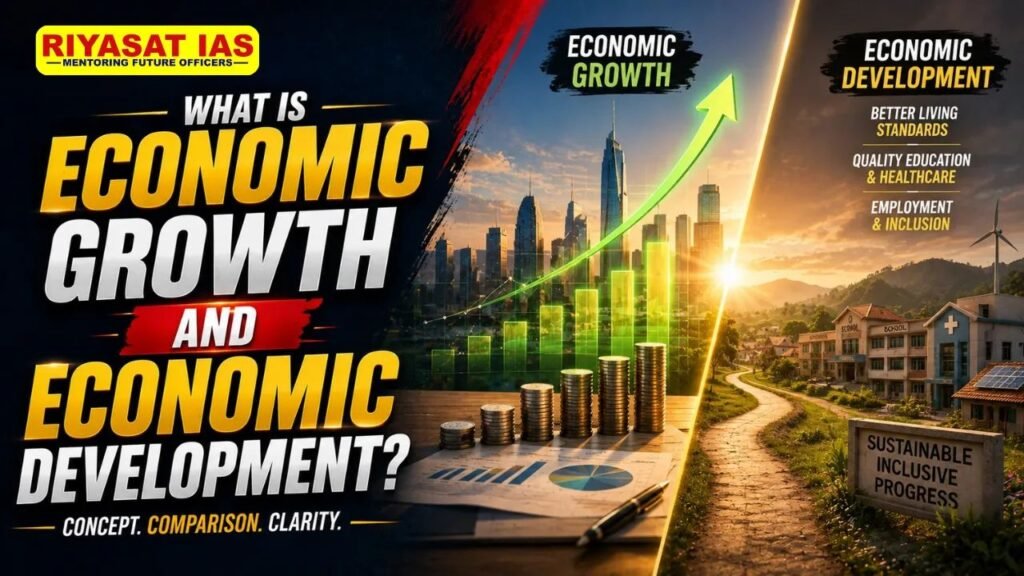
Economic Growth and Economic Development are two fundamental concepts that measure a nation’s economic progress. Although often used interchangeably, they differ in scope, objectives, and outcomes.
Economic Growth refers to an increase in the production of goods and services, resulting in higher national income. It is primarily a quantitative concept, measured through indicators such as Real GDP and Per Capita Income.
Economic Development, on the other hand, is a broader concept that focuses on improving people’s quality of life. It includes better education, healthcare, employment opportunities, infrastructure, environmental sustainability, and social justice. Thus, development combines both quantitative and qualitative improvements.
A country may achieve rapid economic growth without significant improvements in human welfare. Therefore, modern public policy emphasises inclusive, equitable, and sustainable development, where economic gains benefit all sections of society.
Why is this Topic Important?
Economic Growth and Economic Development are among the most important topics in the UPSC Civil Services Examination. Questions are frequently asked in Prelims, GS Paper III, Essay, and Interview because these concepts underpin India’s development strategy.
The topic is directly linked with:
- Inclusive Growth: Ensuring that the benefits of economic progress reach all sections of society.
- Human Development: Improving education, healthcare, nutrition, and living standards.
- Sustainable Development: Balancing economic expansion with environmental conservation.
- Poverty and Unemployment: Evaluating how economic policies improve livelihoods and generate employment.
- Economic Reforms: Assessing the impact of liberalisation, privatisation, and globalisation on India’s economy.
- Government Welfare Programmes: Understanding schemes that promote financial inclusion, social security, and poverty reduction.
- Sustainable Development Goals (SDGs): Measuring India’s progress towards global development targets.
- Viksit Bharat @2047: Examining India’s long-term vision of becoming a developed and self-reliant nation.
Economic Growth
Economic Growth refers to the sustained increase in the production of goods and services in an economy over a period of time. It reflects the expansion of a country’s productive capacity and is generally measured through the growth rate of Real Gross Domestic Product (Real GDP).
In simple terms, when an economy produces more goods and services than before, national income rises, businesses expand, employment opportunities increase, and government revenue improves. However, economic growth measures only the increase in output and does not indicate whether people’s living standards have improved.
Features of Economic Growth
- Increase in Output: Reflects higher production across agriculture, industry, and services.
- Measured in Real Terms: Uses Real GDP to eliminate the effect of inflation.
- Quantitative Concept: Focuses on growth in output, income, investment, and productivity.
- Long-Term Process: Sustainable growth requires continuous expansion of productive capacity.
- Productivity Driven: Technology, infrastructure, capital formation, and skilled labour support economic growth.
- Higher Productive Capacity: Enables the economy to produce more goods and services efficiently.
Indicators of Economic Growth
The following indicators are commonly used to measure economic growth:
- Real Gross Domestic Product (Real GDP): Measures the inflation-adjusted value of goods and services produced in an economy.
- Real Per Capita Income: Indicates the average real income earned per person.
- Gross National Income (GNI): Measures the total income earned by a country’s residents.
- Gross Capital Formation (GCF): Reflects investment in productive assets such as machinery, factories, and infrastructure.
- Industrial Production Index (IIP): Tracks industrial output across mining, manufacturing, and electricity.
- Labour Productivity: Measures output produced per worker or per hour of labour.
Importance of Economic Growth
Economic growth creates the financial resources required for development and improves a country’s productive capacity.
- Generates Employment: Expanding economic activity creates new job opportunities.
- Raises National Income: Higher production increases household income, business profits, and government revenue.
- Encourages Investment: Strong growth attracts domestic and foreign investment.
- Develops Infrastructure: Increased public revenue supports investment in transport, healthcare, education, and digital infrastructure.
- Improves Living Standards: Rising income enhances purchasing power and consumption.
- Strengthens Global Competitiveness: Higher productivity improves exports and economic resilience.
Limitations of Economic Growth
Economic growth alone cannot ensure overall development because it overlooks social and environmental dimensions.
- Ignores Income Distribution: Growth may benefit only a small section of society.
- Does Not Measure Human Development: GDP does not reflect improvements in health, education, or nutrition.
- May Increase Inequality: Unequal access to opportunities can widen income disparities.
- Environmental Degradation: Rapid industrialisation may cause pollution and resource depletion.
- Jobless Growth: High GDP growth may not generate adequate employment opportunities.
Example
Suppose India’s Real GDP increases from ₹300 lakh crore to ₹321 lakh crore in one year, resulting in a 7% growth rate.
If unemployment remains high and access to quality healthcare and education does not improve, India has achieved Economic Growth but not necessarily Economic Development.
Economic Development
Economic Development is the process of improving the economic, social, and institutional conditions of a country to enhance the overall quality of life of its people. Unlike Economic Growth, which focuses mainly on increasing production and income, Economic Development aims to ensure that the benefits of growth are shared equitably across society.
It is a broader concept that includes improvements in education, healthcare, employment, infrastructure, governance, gender equality, and environmental sustainability. Therefore, Economic Development represents both quantitative and qualitative progress, making it the ultimate objective of public policy.
Definition
Economic Development is the process of achieving sustained improvements in income, employment, education, healthcare, infrastructure, and overall human well-being through inclusive and sustainable economic progress.
Features of Economic Development
Economic Development is a multidimensional process that transforms both the economy and society.
- Improves Quality of Life: Enhances education, healthcare, housing, sanitation, and access to basic services.
- Inclusive in Nature: Ensures that the benefits of development reach all sections of society, especially vulnerable groups.
- Reduces Poverty and Unemployment: Expands productive employment and improves income opportunities.
- Promotes Social Justice: Reduces regional, gender, and social inequalities.
- Develops Human Capital: Invests in education, healthcare, nutrition, and skill development.
- Strengthens Institutions: Encourages good governance, transparency, and efficient public administration.
- Supports Environmental Sustainability: Promotes responsible use of natural resources and sustainable development.
- Long-Term Process: Focuses on balanced and continuous improvements in economic and social conditions.
Indicators of Economic Development
Unlike Economic Growth, which is measured mainly through GDP, Economic Development is assessed using both economic and social indicators.
- Human Development Index (HDI): Measures development based on life expectancy, education, and per capita income.
- Multidimensional Poverty Index (MPI): Assesses deprivation in health, education, and living standards.
- Literacy Rate: Indicates educational attainment and human capital development.
- Life Expectancy at Birth: Reflects the overall health status of a population.
- Infant Mortality Rate (IMR): Measures the quality of child healthcare.
- Maternal Mortality Ratio (MMR): Indicates the effectiveness of maternal healthcare services.
- Gender Inequality Index (GII): Measures disparities between men and women in health, education, and economic participation.
- Gini Coefficient: Measures income inequality within a country.
- Access to Basic Services: Availability of clean water, sanitation, electricity, healthcare, education, and digital connectivity.
- Poverty Ratio: A lower poverty ratio reflects higher levels of development.
Importance of Economic Development
Economic Development improves not only the size of an economy but also the well-being of its people. It ensures that economic progress leads to inclusive and sustainable growth.
- Raises Living Standards: Better income, education, healthcare, and housing improve quality of life.
- Reduces Poverty: Creates employment opportunities and expands access to productive resources.
- Promotes Inclusive Growth: Ensures equitable distribution of income and opportunities.
- Strengthens Human Capital: Investment in education and healthcare improves productivity and innovation.
- Reduces Regional Disparities: Encourages balanced development across states and regions.
- Enhances Social Justice: Promotes gender equality, social inclusion, and equal opportunities.
- Supports Sustainable Development: Balances economic progress with environmental conservation.
- Strengthens National Competitiveness: A skilled and healthy workforce enhances productivity and global competitiveness.
Limitations of Economic Development
Although Economic Development provides a comprehensive measure of progress, achieving and measuring it presents several challenges.
- Difficult to Measure: Many aspects such as governance, social justice, and quality of life cannot be measured precisely.
- Long-Term Process: Development requires sustained policy efforts over several years.
- Regional Imbalances: Development often remains uneven across different states and regions.
- Resource Constraints: Developing countries may face financial, technological, and institutional limitations.
- Environmental Challenges: Unsustainable development can lead to pollution, climate change, and resource depletion.
- Persistent Inequality: Income, gender, and regional disparities may continue despite economic progress.
Example
Suppose a state records 8% GDP growth for five consecutive years. During the same period, literacy rates improve, poverty declines, employment opportunities increase, healthcare facilities expand, and access to clean drinking water becomes widespread.
In this case, the state has achieved Economic Development, as economic growth has translated into measurable improvements in the quality of life and overall human well-being.
Economic Growth vs Development
Growth and Economic Development are closely related but differ in their objectives and outcomes. Economic Growth focuses on increasing a country’s output and income, whereas Economic Development emphasises improving people’s quality of life through social, economic, and institutional progress.
Economic Growth is generally considered the means, while Economic Development is the ultimate goal of public policy.
| Basis | Economic Growth | Economic Development |
| Meaning | Increase in the production of goods and services. | Overall improvement in economic and social well-being. |
| Nature | Quantitative concept. | Quantitative and qualitative concept. |
| Focus | Expansion of output and national income. | Improvement in quality of life and human welfare. |
| Measurement | Real GDP, Per Capita Income, GNI, IIP. | HDI, MPI, Literacy Rate, Life Expectancy, Gini Coefficient, etc. |
| Objective | Increase production and income. | Achieve inclusive and sustainable development. |
| Scope | Narrow and income-oriented. | Broad and multidimensional. |
| Income Distribution | Does not consider income distribution. | Promotes equitable distribution of income and opportunities. |
| Employment | Employment generation is not guaranteed. | Focuses on productive and inclusive employment. |
| Environment | May overlook environmental costs. | Encourages sustainable use of natural resources. |
| Outcome | Creates a larger economy. | Creates a healthier, educated, and more prosperous society. |



Relationship between Economic Growth and Economic Development
Economic Growth and Economic Development are complementary and mutually reinforcing. Growth provides the financial resources needed for development, while development strengthens the factors that sustain long-term growth.
The relationship can be understood as follows:
- Growth Generates Resources: Higher production increases income, savings, tax revenue, and investment, enabling governments to spend more on education, healthcare, and infrastructure.
- Development Improves Productivity: Better education, healthcare, and skill development enhance human capital, leading to higher productivity and sustained economic growth.
- Inclusive Growth Promotes Development: Equitable distribution of economic gains reduces poverty, unemployment, and inequality while improving social welfare.
- Development Supports Sustainable Growth: Strong institutions, quality infrastructure, and environmental conservation create a stable foundation for long-term economic expansion.
- Human Capital Drives Innovation: A skilled and healthy workforce encourages entrepreneurship, technological advancement, and global competitiveness.
Thus, Economic Growth provides the means, while Economic Development ensures that growth improves people’s lives in a sustainable and inclusive manner.
Factors Affecting Economic Growth
Economic Growth depends on the efficient use of resources and continuous expansion of productive capacity. Several economic and institutional factors influence the pace of growth.
Human Capital
A productive workforce is essential for long-term growth.
- Education and Skills: Improve productivity, innovation, and employability.
- Healthcare: Healthy workers contribute more effectively to economic activities.
Physical Capital
Investment increases the economy’s productive capacity.
- Capital Formation: Investment in machinery, factories, and technology boosts production.
- Infrastructure: Roads, railways, ports, power supply, and digital networks reduce production costs and improve efficiency.
Natural Resources
Availability and efficient use of natural resources support economic activities.
- Resource Availability: Land, minerals, water, forests, and energy are essential inputs for production.
- Sustainable Utilisation: Efficient use ensures long-term growth without resource depletion.
Technology and Innovation
Technological progress is a major driver of economic growth.
- Innovation: Improves productivity and product quality.
- Research and Development (R&D): Promotes industrial competitiveness and diversification.
Governance and Institutions
A stable policy environment encourages investment and economic expansion.
- Good Governance: Transparency, accountability, and the rule of law improve investor confidence.
- Policy Stability: Predictable economic policies support long-term investment.
Savings, Investment, and Trade
Capital accumulation and global integration accelerate growth.
- Higher Savings: Provide funds for investment.
- Foreign Direct Investment (FDI): Brings capital, technology, and managerial expertise.
- International Trade: Expands markets, increases exports, and facilitates technology transfer.
Factors Affecting Economic Development
Economic Development depends not only on economic progress but also on improvements in social, institutional, and environmental conditions.
Quality Education: Education enhances knowledge, skills, innovation, and employability, making it a key driver of development.
Healthcare: A healthy population improves labour productivity, life expectancy, and overall quality of life.
Employment Opportunities: Productive employment increases income, reduces poverty, and promotes inclusive growth.
Equitable Income Distribution: Balanced distribution of income reduces inequality and strengthens social stability.
Good Governance: Transparent institutions, effective public service delivery, and accountable administration create an enabling environment for development.
Infrastructure Development: Reliable transport, electricity, sanitation, housing, and digital connectivity improve living standards and economic efficiency.
Gender Equality: Greater participation of women in education, employment, entrepreneurship, and decision-making accelerates economic and social development.
Financial Inclusion: Access to banking, credit, insurance, and digital financial services promotes entrepreneurship and reduces poverty.
Environmental Sustainability: Sustainable use of natural resources ensures that development benefits both present and future generations.
Technological Progress: Digital technologies improve governance, education, healthcare, financial inclusion, and productivity, making development more inclusive and efficient.
Economic Growth and Development in India
Since Independence, India has made significant progress in economic growth and development. The country has transformed from an agrarian economy into one of the world’s fastest-growing major economies. While economic reforms have accelerated growth, challenges such as unemployment, inequality, and regional disparities continue to affect the pace of development.
India’s development journey can be understood through four major phases.
1. Planned Development (1950–1991)
After Independence, India adopted a planned economic model with the objective of achieving self-reliance, industrialisation, and balanced regional development.
Key Features
- Establishment of the Planning Commission and Five-Year Plans.
- Expansion of the public sector in strategic industries.
- Development of heavy industries and basic infrastructure.
- Green Revolution improved agricultural production and food security.
Major Achievements
- Growth of industrial and agricultural capacity.
- Improved food grain production.
- Expansion of educational and scientific institutions.
Challenges
- Slow GDP growth, often referred to as the “Hindu Rate of Growth.”
- High poverty and unemployment.
- Excessive government control and low private investment.
2. Economic Reforms (1991 onwards)
The Balance of Payments Crisis of 1991 led India to adopt the Liberalisation, Privatisation, and Globalisation (LPG) reforms.
These reforms reduced government controls, encouraged private investment, and integrated India with the global economy.
Major Outcomes
- Higher GDP growth.
- Rapid expansion of the services sector.
- Increased Foreign Direct Investment (FDI).
- Growth in exports and foreign exchange reserves.
- Greater competition and technological advancement.
However, the benefits of growth were not evenly distributed across regions and social groups.
3. Inclusive Growth Phase
Recognising that economic growth alone was insufficient, the government shifted its focus towards inclusive development.
Major initiatives included:
- Mahatma Gandhi National Rural Employment Guarantee Act (MGNREGA)
- National Food Security Act (NFSA)
- Ayushman Bharat
- Pradhan Mantri Jan Dhan Yojana (PMJDY)
- Skill India Mission
These programmes aimed to reduce poverty, improve human development, and expand financial inclusion.
4. Towards Viksit Bharat @2047
India now seeks to become a developed nation by 2047 through sustained high growth and inclusive development.
The strategy focuses on:
- Manufacturing-led growth
- Digital transformation
- Infrastructure development
- Green and sustainable growth
- Human capital development
- Innovation and entrepreneurship
The objective is not merely to increase GDP but to improve the quality of life of all citizens.
Present Scenario of India’s Economic Growth and Development
India is among the fastest-growing major economies and is steadily strengthening its position in the global economy. Rising investment, digitalisation, infrastructure development, and policy reforms have supported economic expansion. At the same time, improving human development and ensuring equitable growth remain key policy priorities.
Major Trends
- High Economic Growth: India continues to record one of the highest GDP growth rates among major economies.
- Expanding Digital Economy: Digital payments, e-commerce, and Digital Public Infrastructure have accelerated financial inclusion and business growth.
- Infrastructure Push: Large investments in roads, railways, ports, airports, and logistics are improving connectivity and productivity.
- Manufacturing Promotion: Programmes such as Make in India and the Production Linked Incentive (PLI) Scheme aim to strengthen domestic manufacturing.
- Improving Human Development: Government initiatives in healthcare, education, sanitation, and financial inclusion have improved social indicators, although significant gaps remain.
Despite these achievements, India continues to face structural challenges that affect inclusive and sustainable development.
Challenges to Economic Growth and Economic Development in India
India’s rapid economic growth has not always translated into broad-based development. Several structural and institutional challenges continue to hinder inclusive progress.
Poverty: Although poverty has declined considerably, many people still face inadequate income and limited access to quality education, healthcare, nutrition, and housing.
Unemployment
- Jobless Growth: Employment generation has not kept pace with GDP growth.
- Youth Unemployment: Many educated young people struggle to find suitable jobs due to skill mismatches.
Income Inequality: The benefits of economic growth remain unevenly distributed across regions and income groups, leading to widening disparities.
Low Human Capital: Gaps in education quality, healthcare infrastructure, and skill development reduce labour productivity and long-term growth potential.
Infrastructure Deficit: Although infrastructure has improved significantly, deficiencies in logistics, urban transport, power supply, and rural connectivity continue to increase the cost of doing business.
Agricultural Challenges
Small and fragmented landholdings.
Dependence on monsoon rainfall.Ø Low productivity.
Disguised unemployment in agriculture.
These factors continue to limit rural incomes.
Environmental Degradation: Rapid industrialisation and urbanisation have increased pollution, resource depletion, and climate-related risks, making sustainable development a major policy priority.
Informal Economy: A large share of India’s workforce remains employed in the informal sector, limiting productivity, social security, and tax mobilisation.
Governance Challenges: Administrative delays, regulatory bottlenecks, and implementation gaps often reduce the effectiveness of development programmes.
Global Economic Uncertainty: External shocks such as geopolitical conflicts, supply chain disruptions, commodity price fluctuations, and global recessions can adversely affect India’s economic growth.
Government Initiatives for Promoting Economic Growth and Development
To achieve faster, inclusive, and sustainable development, the Government of India has introduced several reforms and flagship programmes. These initiatives aim to boost investment, improve infrastructure, generate employment, strengthen human capital, and enhance India’s global competitiveness.
Infrastructure Development
Strong infrastructure is the foundation of long-term economic growth as it reduces logistics costs, improves connectivity, and enhances productivity.
- PM Gati Shakti National Master Plan: Integrates transport infrastructure to improve multimodal connectivity and logistics efficiency.
- National Infrastructure Pipeline (NIP): Promotes large-scale investment in roads, railways, airports, ports, urban infrastructure, and energy.
Manufacturing and Industrial Growth
Manufacturing plays a vital role in employment generation and economic diversification.
- Make in India: Encourages domestic manufacturing, investment, innovation, and job creation.
- Production Linked Incentive (PLI) Scheme: Provides financial incentives to boost manufacturing in strategic sectors and strengthen global competitiveness.
Ease of Doing Business
Improving the business environment attracts investment and promotes entrepreneurship.
- Business Reforms: Simplification of regulations, digitisation of government services, and reduction in compliance burden encourage business growth.
- Goods and Services Tax (GST): Creates a unified national market and improves tax efficiency.
Financial Inclusion
Financial inclusion ensures that economic growth benefits all sections of society.
- Pradhan Mantri Jan Dhan Yojana (PMJDY): Expands access to banking and financial services.
- Digital Public Infrastructure (DPI): Platforms such as UPI, Aadhaar, and DigiLocker have transformed digital payments and service delivery.
Skill Development
A skilled workforce is essential for improving productivity and employment.
- Skill India Mission: Enhances employability through vocational training and skill development.
- Pradhan Mantri Kaushal Vikas Yojana (PMKVY): Provides industry-oriented training to improve workforce capabilities.
Agricultural Development
Agriculture remains a major source of livelihood for a large section of the population.
- PM-KISAN: Provides income support to eligible farmer families.
- Digital Agriculture Mission: Promotes technology-driven farming and better agricultural productivity.
Human Development
Improving education and healthcare is essential for sustainable development.
- Ayushman Bharat: Expands access to affordable healthcare through health insurance and Health & Wellness Centres.
- National Education Policy (NEP) 2020: Aims to improve the quality, accessibility, and flexibility of education.
Sustainable Development
India is increasingly focusing on green growth to achieve long-term economic sustainability.
- National Green Hydrogen Mission: Promotes clean energy and supports India’s transition to a low-carbon economy.
- Mission LiFE (Lifestyle for Environment): Encourages sustainable consumption and environmentally responsible behaviour.
Conclusion
Economic Growth and Economic Development are complementary dimensions of national progress. While Economic Growth increases production and income, Economic Development ensures that these gains improve people’s quality of life through better education, healthcare, employment, and social justice.
For India, achieving high GDP growth alone is not enough. The focus must remain on inclusive, equitable, and sustainable development so that the benefits of growth reach every section of society. As India moves towards the vision of Viksit Bharat @2047, strengthening human capital, promoting innovation, improving governance, and ensuring environmental sustainability will be crucial for achieving long-term prosperity.
Frequently Asked Questions (FAQs)
1. What is GDP?
Gross Domestic Product (GDP) is the total market value of all final goods and services produced within a country’s geographical boundaries during a specific period, usually a financial year.
2. Who calculates GDP in India?
In India, Gross Domestic Product (GDP) and National Income estimates are prepared by the Ministry of Statistics and Programme Implementation (MoSPI) following the United Nations System of National Accounts (SNA 2008).
3. What are the three methods of GDP estimation?
GDP is estimated using three internationally accepted methods:
- Production (Value Added) Method
- Expenditure Method
- Income Method
All three methods measure the same economic activity from different perspectives.
4. What is the difference between GDP and GVA?
GDP measures the total value of final goods and services produced in an economy, whereas Gross Value Added (GVA) measures the value added by producers before adjusting for taxes and subsidies.
Formula:
GDP = GVA + Product Taxes − Product Subsidies
5. What is the difference between Nominal GDP and Real GDP?
Nominal GDP is calculated using current market prices and includes the effect of inflation.
Real GDP is calculated using constant prices, eliminating the impact of inflation to reflect actual economic growth.
6. What is the GDP Deflator?
The GDP Deflator is an indicator of economy-wide inflation. It measures the change in prices of all final goods and services produced within a country.
Formula:
GDP Deflator = (Nominal GDP ÷ Real GDP) × 100
7. What is National Income?
National Income is the total income earned by the residents of a country from the production of goods and services during a financial year.
8. What is the difference between GDP and GNP?
GDP (Gross Domestic Product) measures production within a country’s geographical boundaries.
GNP (Gross National Product) measures the total income earned by a country’s residents, including income from abroad.
Formula:
GNP = GDP + Net Factor Income from Abroad (NFIA)
9. Why is GDP important?
GDP is important because it:
- Measures economic growth.
- Helps formulate fiscal and monetary policies.
- Supports investment decisions.
- Enables international economic comparisons.
- Assesses sectoral performance.
10. What are the limitations of GDP?
GDP does not fully reflect a country’s overall development because it:
- Ignores income inequality.
- Excludes unpaid household work.
- Does not measure environmental degradation.
- Cannot accurately capture all informal sector activities.
- Does not assess quality of life or human well-being.
11. Why is the GDP base year revised periodically?
The GDP base year is revised to:
- Reflect structural changes in the economy.
- Improve the accuracy of GDP estimates.
- Incorporate updated databases and surveys.
- Align India’s national accounts with international standards.
12. What is the difference between GDP and National Income?
GDP measures the value of production within a country’s borders, whereas National Income measures the total income earned by the country’s residents, including income received from abroad.
13. Which sector contributes the most to India’s GDP?
The services sector is the largest contributor to India’s GDP, followed by industry and agriculture.
14. Why is GDP alone not a sufficient measure of development?
GDP measures the size of an economy but does not account for income distribution, education, healthcare, environmental sustainability, or overall quality of life. Therefore, indicators such as HDI, Green GDP, and GNI are also used to assess development.
15. Which indicators complement GDP in measuring economic performance?
Some important complementary indicators include:
- Gross National Income (GNI)
- Purchasing Power Parity (PPP)
- Human Development Index (HDI)
- Green GDP
- Inclusive Wealth Index (IWI)
Economic Growth and Development UPSC PYQs
Question 1: Faster economic growth requires increased share of the manufacturing sector in GDP, particularly of MSMEs. Comment on the present policies of the government in this regard. (UPSC Mains 2023)
Practice Questions
1. Differentiate between Economic Growth and Economic Development. Explain why high economic growth does not always lead to inclusive development. (10 Marks)
2. Discuss the major challenges that prevent India from converting rapid economic growth into sustainable economic development. Suggest suitable policy measures. (15 Marks)
Prelims PYQ
Question 1: Increase in absolute and per capita real GNP do not connote a higher level of economic development, if: (UPSC Prelims 2018)
(a) industrial output fails to keep pace with agricultural output.
(b) agricultural output fails to keep pace with industrial output.
(c) poverty and unemployment increase.
(d) imports grow faster than exports.
Answer: (c)
Question 2: A decrease in tax to GDP ratio of a country indicates which of the following? (UPSC Prelims 2015)
1. Slowing economic growth rate
2. Less equitable distribution of national income
Select the correct answer using the code given below.
(a) 1 only
(b) 2 only
(c) Both 1 and 2
(d) Neither 1 nor 2
Answer: (a)
Question 3: Consider the following specific stages of demographic transition associated with economic development: (UPSC Prelims 2012)
1. Low birthrate with low death rate
2. High birthrate with high death rate
3. High birthrate with low death rate
Select the correct order of the above stages using the codes given below:
(a) 1, 2, 3
(b) 2, 1, 3
(c) 2, 3, 1
(d) 3, 2, 1
Answer: (c)
Question 4: Economic growth is usually coupled with? (UPSC Prelims 2011)
(a) Deflation
(b) Inflation
(c) Stagflation
(d) Hyperinflation
Answer: (b)


 Ravi Raaz
 Hassan Khan
 Shadab Ali