
1. What do you mean by Digital Rupee? In this context, explain the working and progress of India’s Central Bank Digital Currency (CBDC). (Answer in 150 words)
Introduction
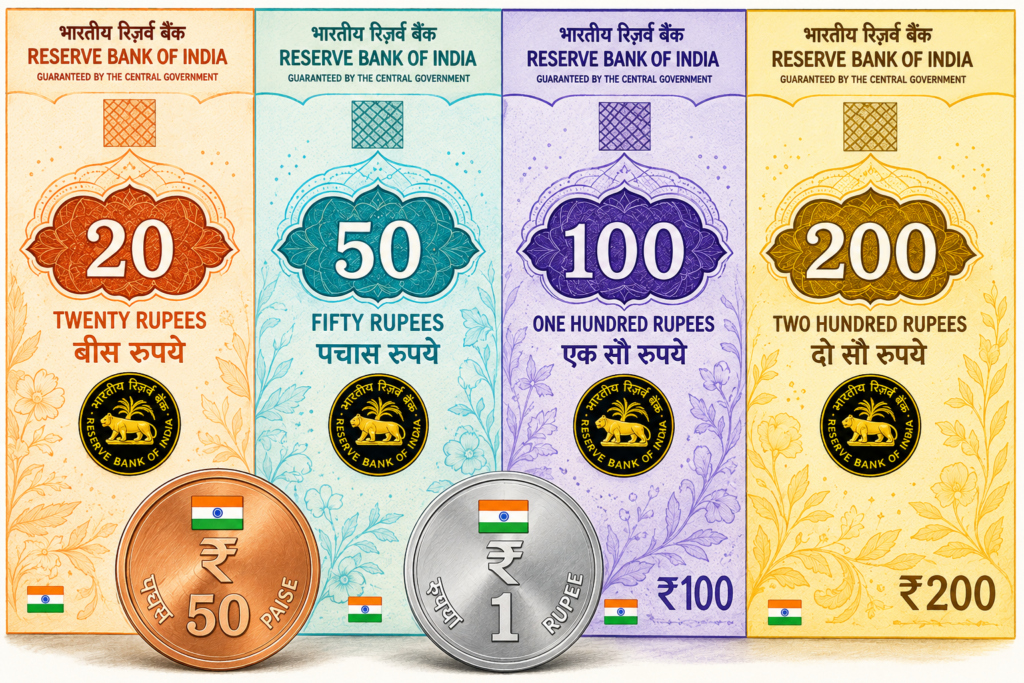
The Digital Rupee (e₹) is India’s Central Bank Digital Currency (CBDC) issued by the Reserve Bank of India (RBI). It is the digital form of the rupee, is legal tender, and represents a direct liability of the RBI. Its legal framework was enabled through amendments to the RBI Act, 1934 in 2022.
Working of Digital Rupee
- Two variants: e₹-R serves retail users and merchants, while e₹-W caters to wholesale financial transactions.
- Two-tier model: RBI issues and redeems e₹, while participating banks and select non-bank entities provide distribution and wallet services.
- Payments: e₹ enables P2P and P2M transactions and can utilise existing UPI QR infrastructure.
- Programmability: It enables purpose-specific payments such as welfare transfers, lending and allowances.
- Offline capability: RBI is testing offline solutions for areas with limited connectivity.



Progress
Since its retail launch in December 2022, pilots have expanded across banks and locations, including programmability, offline payments and non-bank distribution. The wholesale pilot is being explored for Government Securities settlement and inter-bank transactions, alongside emerging cross-border CBDC applications.
Conclusion
Thus, UPI is a payment mechanism, whereas e₹ is sovereign digital money. Its significance lies in programmability, efficient settlement, financial inclusion and potentially smoother cross-border payments, subject to wider adoption, privacy, cybersecurity and technological scalability.




 Ravi Raaz
 Hassan Khan
 Shadab Ali