
GS-II : International Relations
Context
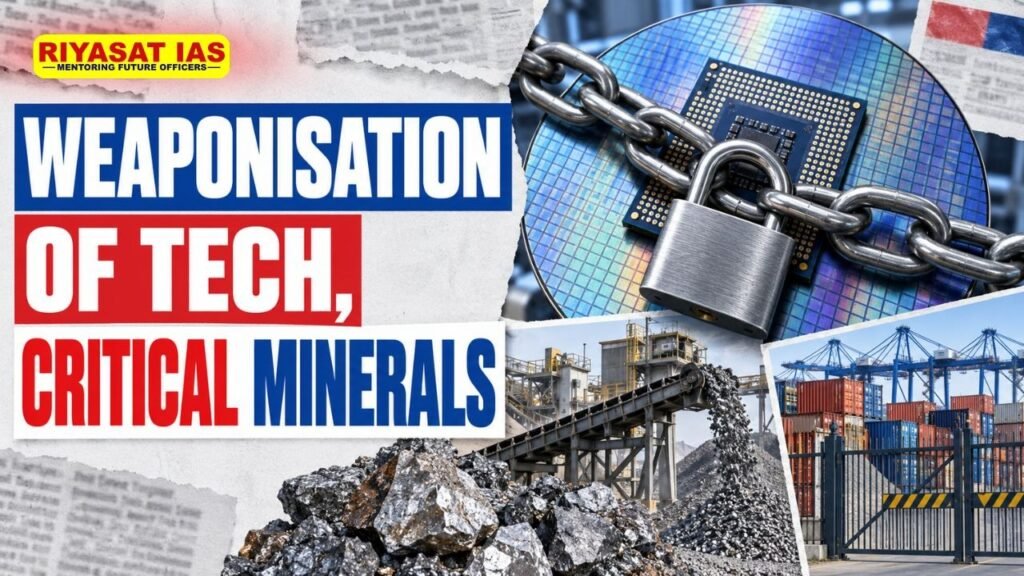
- Modi highlights the risk of factoring in global development with weaponising technology and access to critical minerals at the BRICS Summit.
- Global wars, pandemics, climate disasters and supply-chain shocks reassure us of the weakness of the world economic system.
- As BRICS stands on the cusp of its third decade, Tarun Sharma argued that it was time for ideas and commitments to move past the talking narrative.
Weaponisation of technology and critical minerals
- Technology as a mean of strategy : Limiting the reach and delivery on high tech or technology driven on high innovation bites may at best stand in way to led impact economic growth inequitable prosperity, national security and overall efficient developmental goals.
- Strategic Minerals: Minerals are critical for devices, renewable energies, batteries, semiconductors and military technologies
- Concentration of Supply: Too much reliance on a few countries for key technology or minerals could be a weakness in potential geopolitical friction.
- Technology like drones could lead to asymmetric dependence on the Global South by great powers using them geopolitically
Need for Resilient Supply Chains
- Wide spread Disruptions: COVID-19, geopolitical wars, climate catastrophes and trade circuit breaks have exposed fragility in global supply chains.
- In response, BRICS plans to build more diversified, reliable and resilient supply chains.
- Strategic Objective: Decrease excessive dependence on a single source and foster cooperative action among developing nations.
- Critical Minerals: With increasing cooperation, BRICS countries will converge on essential minerals for the green transition as well as future critical technologies.



Technology for Inclusive Development
- Equal Access to Technology: The fundamental basis of technology adoption — India has stated that progress in technology must ensure the progress of developing countries to not deepen existing inequalities.
- Digital Divide: When countries are not on par in providing access to technology to their citizens, the latest infrastructure and necessary skills, the gap will only widen.
- Global South: BRICS desires tech developed “with them, not for them.”
- Responsible Use of AI and Digital Technologies: Technology Governance — BRICS can be a significant contributor in discussions pertaining to the responsible use of these emerging technologies.
BRICS and the Global South
- Increased Confidence: BRICS is also recognised by developing countries as a platform where their experiences are heard.
- Participatory Approach: The focus is moving away from solutions enforced in developing nations to tenable solutions together created.
- 11-Member Grouping: The reach of BRICS has widened both in geographic and economic terms, and also advanced its Global South identity.
- India: India can use BRICS to champion inclusive tech, resilient supply chains and equitable access to critical resources.
Challenges
- Geopolitical Conflicts: Great power competitions can hinder coordinated BRICS efforts.
- Asymmetry of Resources: Inequality exists among BRICS member states regarding technological, financial and mineral capabilities.
- Conflicting National Interests: States might choose to pursue national strategic interests at the expense of collective efforts.
- Implementation Gap: BRICS will find effectiveness or not depending on institution-building and project orientation of declarations into tangible projects.
Significance for India
- Supply-Chain Security: Expansive BRICS supply chains can limit India’s reliance on outside disruptions.
- Critical Minerals: Cooperation could help meet India’s needs in clean energy & energy transition, electric mobility, electronics & strategic technologies.
- Technology Access: With an inclusive technology cooperation, India can advance towards its digital and technological economy.
- Global South Leadership: New Delhi can reinforce its position as a mediator between the important economies and the developing world.
Conclusion
- The changes in the weaponisation of technology and critical minerals have made economic interdependence into an instrument of potential geopolitical power.
- Some ways that BRICS can take action are by taking necessary measures to create resilient supply chains, equitable access and availability of technology, as well as enhanced cooperation among Global South countries.
- Yet this credibility will rest not just on promises but also implementation and results tangible by way of measure.
UPSC Mains Practice Question
Q. The Global South is gradually recognizing that weaponising technology and critical minerals directly affects their resilience and development. In this context, review the role of the BRICS in sustainable supply chains and inclusive technology development.


 Ravi Raaz
 Hassan Khan
 Shadab Ali