
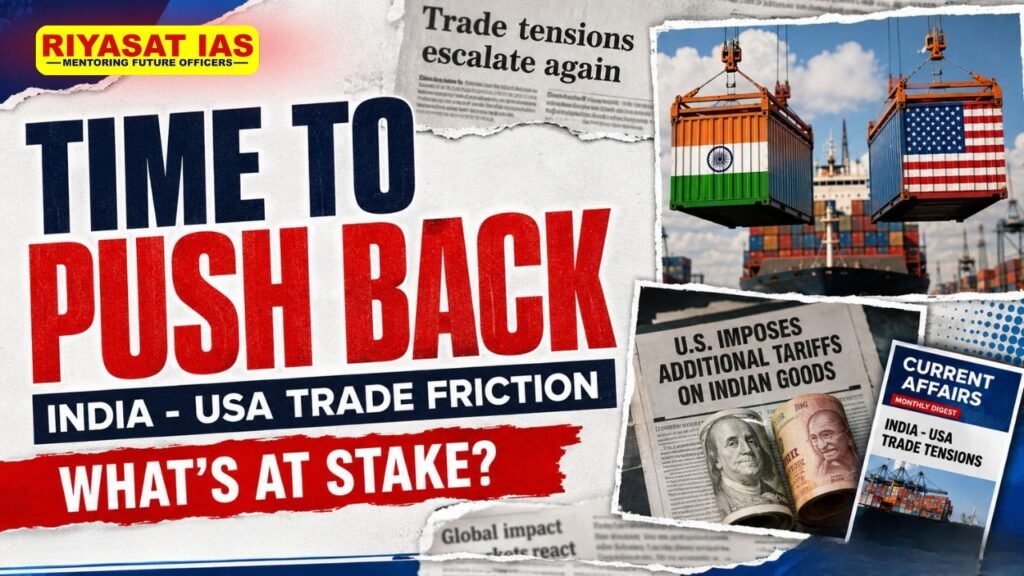
GS-II: International Relations | India–U.S. Relations | Trade Diplomacy
GS-III: Indian Economy | Manufacturing | Foreign Trade | Make in India
Context
- U.S. accusation: A recent White House report, naming around 40 countries, has said that India ranks among the top ‘enablers’ of China’s evasion of U.S. tariffs.
- Allegation: India and other countries are accused of importing Chinese goods, making minor modifications, and then exporting them to the U.S. at lower tariffs than Chinese goods would have faced.
- Changing nature of imports: India is gradually moving away from importing finished products and making cosmetic changes before selling them.
- Intermediate goods: The share of intermediate goods in Indian imports from China has been steadily rising.
- Domestic manufacturing: India is increasingly undertaking its own assembly and manufacturing in several sectors while relying on China and other countries for parts.
- Manufacturing transition: This shift is an important step towards full-scale manufacturing in India.
Why Chinese Imports Matter for Make in India
- Manufacturing pillar: Chinese imports form a significant pillar of Indian manufacturing.
- Intermediate inputs: India is increasingly using Chinese goods as parts and inputs rather than simply selling finished products.
- Domestic assembly: Indian manufacturing is increasingly undertaking assembly and production within the country.
- Make in India: Chinese imports are currently an important part of the Make in India story.
- Future manufacturing: The increasing use of intermediate goods represents an important step towards full-scale manufacturing in India.



Potential U.S. Pressure
- Punitive action: The U.S. has not yet announced punitive actions based on its assessment of apparent Chinese tariff evasion, though such an eventuality is conceivable.
- Need to resist: If punitive action is taken, India must resist bowing to U.S. pressure on this issue.
- Economic impact: Pressure to restrict Chinese imports could affect an important pillar of Indian manufacturing.
Precedent of Indian Concessions
- High-end motorcycles: Donald Trump, during his first term, criticised India’s tariffs on high-end motorcycles.
- Tariff reduction: In 2018, India reduced these tariffs to 50% from 60–75%.
- Further reduction: In February 2025, tariffs were reduced further to 40%, even before trade deal talks had started.
- Shrimp feed: India reduced import duties on shrimp feed and its components in the February 2024 Budget, a key U.S. demand.
- Frozen duck and turkey: India also reduced tariffs on frozen duck and turkey.
Pressure on India’s Energy Choices
- Russian oil: The pressure of 50% punitive tariffs pushed India to diversify away from Russian oil, despite its claims of energy sovereignty and the discount it was receiving.
- Declining Russian share: Russia’s share in India’s oil imports fell to below 20% in January 2026, from nearly double that when the 50% tariffs were imposed six months earlier.
- Venezuelan oil: A similar situation had occurred with Venezuelan oil in 2019.
- Return to Russian oil: The West Asia crisis and the U.S.’s temporary reprieve led India to turn back towards Russian oil.
E-commerce Policy
- FDI: India recently allowed FDI in the e-commerce inventory model.
- Long-standing demand: This was something Amazon had been lobbying for for a decade.
- Policy dilution: The decision represented a dilution of India’s long-held stance.
Core Argument
- U.S. leverage: The U.S. can wield immense pressure, and therefore concessions are understandable.
- Growing demands: However, such concessions have emboldened it to make increasing demands.
- Need to push back: India needs to start pushing back and protect its economic and policy space.
Conclusion
India needs to balance its relationship with the U.S. with its manufacturing interests and policy autonomy. While concessions under economic pressure may sometimes be understandable, repeated concessions can encourage further demands. India must therefore protect the role of Chinese intermediate goods in its manufacturing transition while firmly defending its policy choices.
UPSC Mains Practice Question
Q. “Economic dependence can gradually translate into policy dependence.” In the context of growing U.S. pressure on India’s trade and economic policies, discuss the need for India to balance economic interests with strategic autonomy.



 Ravi Raaz
 Hassan Khan
 Shadab Ali