
GS-II – Polity | Election Commission of India | Electoral Rolls | Right to Vote | Electoral Reforms
Why in News?
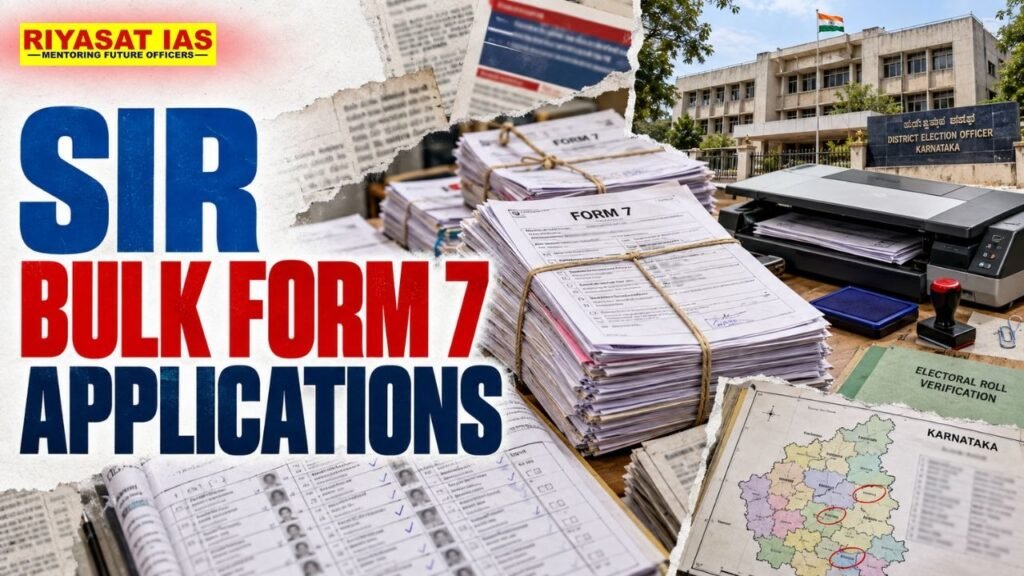
- As Phase 3 of the Special Intensive Revision (SIR) of electoral rolls unfolds, a surge in Form 7 applications, used for seeking deletion of names, has raised concerns.
- Karnataka:
- More than 4,000 Form 7 applications were filed.
- 1,363 applications in Babaleshwar came from just 10 electors.
- Many deletions were reportedly targeting Muslim names.
- Uttarakhand:
- Form 7 objections were filed in the name of an Electoral Registration Officer (ERO) without his knowledge.
- West Bengal:
- Nearly 90% of Form 7 applications were accepted.
- Similar cases have been reported from Rajasthan and Gujarat.
What is Form 7?
- Form 7 is typically used to object to the entry of a person in the electoral roll and seek deletion of the name.
Legal Framework – Registration of Electors Rules, 1960
- The Registration of Electors Rules, 1960 prescribe the procedure for registration, deletion and amendment of electoral-roll entries.
- When a Form 7 application is received:
- The objection should first be displayed on the notice board so that the public knows that an objection has been received.
- A specific notice should be given to the person against whom the complaint has been made.
- If an inquiry is demanded, the ERO/designated officer cannot take a decision on his own without conducting a formal inquiry.
- The officer can summon:
- The complainant.
- The person against whom the complaint has been received.
- The complainant can be asked to testify under oath that the particulars and documents submitted are true.
- The complainant is informed that giving false information can attract a penalty under Section 31 of the Representation of the People Act (RPA), including imprisonment.
- The underlying principle is that no name should be deleted without giving adequate opportunity to the person against whom the complaint has been received.
Need for Investigation and Accountability
- An ERO cannot file objections in the manner alleged.
- Although the Rules provide for the ERO to make certain corrections on his own, this does not amount to filing thousands of objections.
- The Chief Electoral Officer of the State and the Election Commission have responsibility to thoroughly investigate such cases.
- Merely because applications have been filed, the entire system should not be condemned.
- The focus should be on holding the system accountable.
- Claims regarding centralisation of data or centrally generated objections remain speculative in the absence of evidence.
- However, an Election Commissioner has red-flagged the possibility of manipulation at the central level.



Enforcement and Deterrence
- Safeguards exist, but the key issue is whether they are being effectively enforced.
- The EC generally files FIRs but does not systematically follow them up, as the matter is presumed to fall within the responsibility of the concerned law-enforcement machinery.
- There is a need for a strong monitoring mechanism within the EC.
- A separate dataset on election-related crimes has been suggested under the National Crime Records Bureau.
- Such crimes should be reported separately and placed in the public domain.
- Publicly available data would allow people to analyse and flag irregularities.
EC’s Internal Scrutiny Mechanism
- The EC has certain internal norms for scrutiny.
- If a polling booth records more than 2% additions or deletions, that booth is taken up for greater scrutiny.
- In cases involving 2,000 or more applications, the key questions are:
- Whether the system is accepting such applications.
- Whether they are resulting in unjustified removal or addition.
- Whether the system is taking note of the possibility of misuse.
Institutional Accountability
- If an institution responsible for upholding and administering the law has even a section within it violating the law, the entire system can break down.
- Therefore, electoral-roll revision requires:
- Effective institutional accountability.
- Proper investigation.
- Enforcement of existing safeguards.
- Deterrence against misuse.
Need for Legal Reforms
- Electoral laws, the RPA Act and electoral Forms were framed largely during the 1950s and 1960s.
- At that time, the electoral process operated in a non-digital era.
- Today, electoral processes involve:
- Digital databases.
- Online submission of Forms.
- Automated processes.
- The legal framework has therefore become out of sync with the way the process is being conducted today.
- There is a need for legal reforms to address the challenges created by digitalisation and online submission.
Way Forward
- Ensure strict enforcement of the safeguards under the Registration of Electors Rules, 1960.
- Ensure that persons facing deletion receive specific notice and adequate opportunity to respond.
- Thoroughly investigate bulk and unusual Form 7 applications.
- Strengthen monitoring of cases involving unusually high additions or deletions.
- Ensure systematic follow-up of FIRs relating to electoral offences.
- Create a strong EC monitoring mechanism rather than leaving enforcement entirely to law-enforcement machinery.
- Maintain separate and publicly available data on election-related crimes.
- Ensure greater transparency in the disclosure of aggregated Forms 6, 7 and 8 data.
- Examine whether digital and automated systems are facilitating unjustified deletions or additions.
- Bring electoral laws and procedures in line with the realities of digital databases and online submissions.
- Undertake necessary legal reforms to prevent misuse while protecting genuine electors.
Conclusion
- Electoral-roll revision must ensure that the mechanism for removing ineligible entries does not become a means of unjustified exclusion of genuine electors.
- The concerns surrounding bulk Form 7 applications highlight the need for due process, institutional accountability, effective deterrence, transparency and legal reforms.
- The credibility of electoral administration depends not only on the existence of safeguards but also on their effective enforcement.
UPSC Mains Practice Question
Q.“The recent concerns over bulk Form 7 applications during the Special Intensive Revision of electoral rolls highlight challenges of due process, institutional accountability and digital electoral administration. Discuss the legal safeguards, implementation concerns and need for reforms.”




 Ravi Raaz
 Hassan Khan
 Shadab Ali