
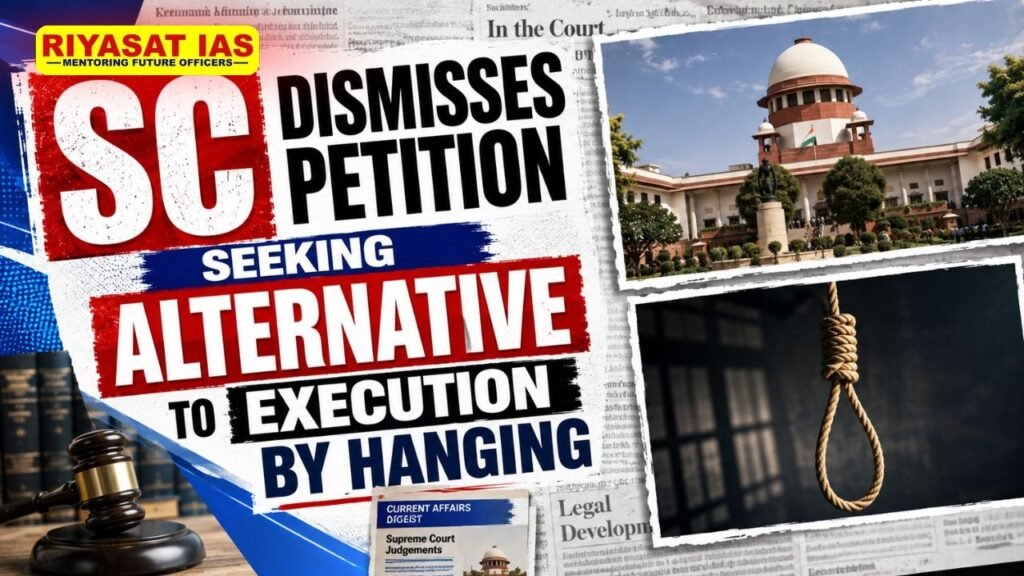
- Supreme Court: The Supreme Court dismissed a petition seeking an alternative method of execution instead of hanging.
- Constitutional context: The issue is linked to Article 21, which guarantees the Right to Life and Personal Liberty.
- Death penalty: India permits the death penalty for certain offences, subject to constitutional and legal safeguards.
- Current method: Execution by hanging is the method prescribed under Section 354(5) of the Code of Criminal Procedure (CrPC).
- Bharatiya Nagarik Suraksha Sanhita (BNSS): The corresponding provision is Section 393(5).
- “Rarest of rare”: The Supreme Court has held that the death penalty should be imposed only in the “rarest of rare” cases.
- Article 72: The President has the power to grant pardon, reprieve, respite or remission of punishment, or to suspend, remit or commute a sentence in specified cases.
- Article 161: The Governor has similar powers in matters within the State’s executive sphere.
- Judicial review: The exercise of constitutional clemency powers is subject to limited judicial review.



Prelims Question — English
Q. With reference to the death penalty in India, consider the following statements:
- Article 21 provides the constitutional basis for protection of life and personal liberty.
- The President has the power to grant pardon under Article 72.
- The death penalty has been completely abolished in India.
Which of the statements given above is/are correct?
A. 1 only
B. 1 and 2 only
C. 2 and 3 only
D. 1, 2 and 3
Answer: B. 1 and 2 only
Explanation: Article 21 protects life and personal liberty, while Article 72 gives the President specified powers of pardon and related clemency. India has not abolished the death penalty.





 Ravi Raaz
 Hassan Khan
 Shadab Ali