
GS-II – Polity and Governance | Fundamental Rights
Why in News?
- Election Commission Rift: On September 23, an Indian Express investigation revealed an unprecedented rift within the three-member Election Commission of India (EC), with Election Commissioners Sukhbir Singh Sandhu and Vivek Joshi recording 14 objections over 10 months against Chief Election Commissioner Gyanesh Kumar.
- Allegations: The objections concerned alleged unilateral changes to rules, voter additions/deletions, and centralised data access, without the Commission’s full approval.
- Goa Electoral Rolls: 97 eligible voters from Goa were excluded from the electoral roll after the centralised ECINet software prevented ground-level Electoral Registration Officers (EROs) from reversing decisions.
- Wider Consequences: Several State schemes use electoral rolls to establish eligibility, including the Goa Mediclaim Scheme, which covers super-speciality treatments unavailable in government hospitals.
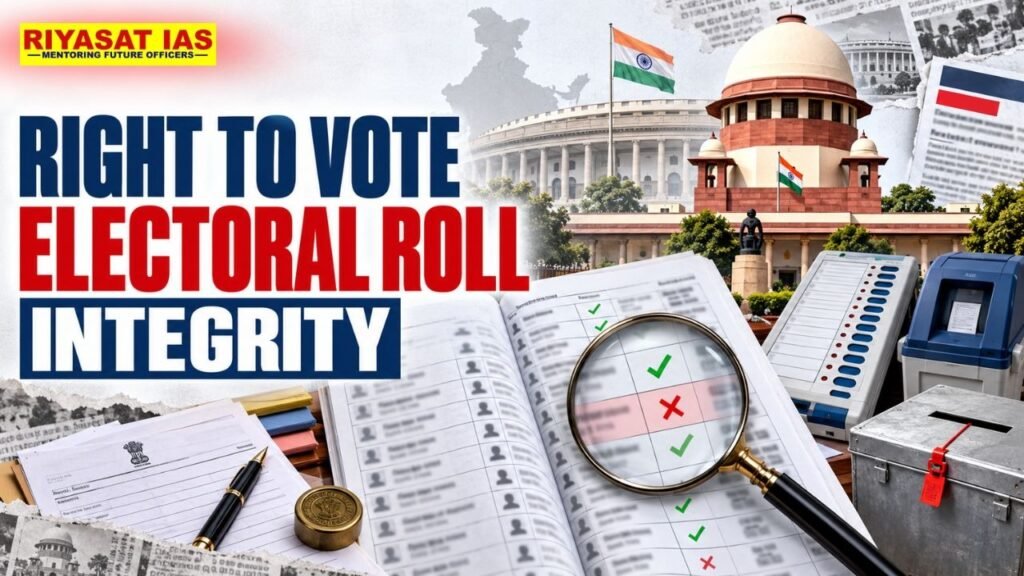
- Key Issue: The issue has once again cast a spotlight on the ‘right to vote’, the foundational processes of India’s electoral machinery, and the genesis of India’s ‘universal adult suffrage’ (UAS).
What Shaped Adult Suffrage in India?
- Western Democracies: Countries like the U.K. initially restricted the franchise to male property owners, reflecting the belief that voting should be reserved for the “enlightened”.
- U.K.: Universal male suffrage emerged only in 1918, while women were granted the ‘right to vote’ in 1928.
- U.S.: Although the 15th and 19th Amendments extended voting rights to African Americans in 1870 and women in 1920, systemic barriers such as poll taxes and literacy tests continued to disenfranchise many for decades.
- India: India’s choice of immediate, universal inclusion ensured ‘democratic equality’ from the outset.
- Article 326: Every adult citizen was granted the ‘right to vote’, regardless of gender, caste, religion, education, or property.
- Kesavananda Bharati v. State of Kerala (1973): Democracy was established as part of the ‘basic structure’ doctrine.
- Representation of the People Act, 1950: Governs the preparation and revision of electoral rolls.
- Representation of the People Act, 1951: Regulates election conduct, candidature, and electoral offences.
- Sukumar Sen: Faced with enrolling 173 million largely illiterate voters, the then Chief Election Commissioner introduced election symbols, making UAS practically accessible.
- Election Commission: The EC has the responsibility to reach the last citizen, wherever they may be, to actualise their ‘right to elect’.



What is the Legal Status of the Right to Vote?
- Constituent Assembly: Dr. B.R. Ambedkar and K.T. Shah proposed including the right to vote in the Constitution’s fundamental rights part, but the Constituent Assembly’s Advisory Committee rejected the idea.
- Kuldip Nayar v. Union of India (2006): The Constitution Bench held that the ‘right to elect’ is a statutory right under Section 62 of the RPA, 1951, and not a fundamental or constitutional right.
- Rajbala v. State of Haryana (2015): A two-judge Bench described the ‘right to vote’ as a constitutional right.
- Kuldip Nayar Prevails: The larger Bench ruling in Kuldip Nayar continues to prevail.
- Anoop Baranwal v. Union of India (2023): The Supreme Court declined to pronounce on the issue, noting that it had already been settled by the five-judge Bench in Kuldip Nayar.
- Justice Ajay Rastogi’s Dissent: Justice Rastogi asserted that the ‘right to vote’ is an expression of Article 19(1)(a) and reflects the essence of Article 21.
- Present Position: As this view remains a minority opinion, the ‘right to elect’ continues to be recognised as a statutory right.
- Democratic Imperative: Courts have nevertheless regarded the ‘right to vote’ as an inseparable part of democracy, enabling citizens to shape governance and making it a “democratic imperative” vital to the Indian republic’s survival.
Why Do We Need Accurate Electoral Rolls?
- Free and Fair Elections: Free and fair elections rest on accurate electoral rolls under the RPA, 1950.
- Inaccuracies: Mass omissions, ineligible inclusions, duplicates, or incorrect entries can undermine the “one person, one vote” principle by enabling impersonation, disenfranchisement, or dilution of votes.
- Section 21, RPA 1950: The EC is empowered to prepare and revise electoral rolls to ensure integrity.
- Article 324: The EC serves as the constitutional guardian of elections, with powers of superintendence, direction, and control.
- Section 19, RPA 1950: Any citizen aged 18 or above, “ordinarily resident” in a constituency and not disqualified, is entitled to be registered.
- Ordinary Resident: “Ordinary resident” implies a genuine, continuous presence, not a temporary stay.
EC Decision-Making and Electoral Rolls
- Chief Election Commissioner and Other Election Commissioners Act, 2023: Lays down how the EC must transact its business.
- Section 17: Requires the Commission’s business to be conducted in accordance with the Act.
- Section 18: Provides that its procedure and allocation of business may be regulated by unanimous decision.
- Majority: Business is to be transacted as far as possible unanimously, but where the CEC and other Commissioners differ, the matter is decided by majority.
Goa Electoral Roll Issue
- 97 Eligible Voters: The Indian Express report revealed that 97 eligible voters were dropped from the rolls.
- ECINet Software: The exclusion occurred because the software architecture itself denied EROs the authority to reverse erroneous deletions.
- ERO Concerns: The EROs reportedly flagged the anomalies to the Commission by email, yet the corrections were not restored.
- Systemic Failure: The episode raises the issue of a systemic failure built into the software’s design, compounded by administrative inertia.
- Substantial vs Isolated Errors: Courts have consistently held that only substantial and systemic errors that demonstrably “materially affected” the election outcome can compromise the sanctity of the electoral roll.
- Lakshmi Charan Sen v. A.K.M. Hassan Uzzaman (1985): The court observed that in a largely illiterate and politically unaware electorate, parties should take steps to ensure eligible voters are included and ineligible ones are removed.
- Electoral Integrity: Given India’s party-based Parliamentary system, such vigilance will help in preserving ‘electoral integrity’.
What Lies Ahead?
- Fundamental Status: The revelations against the EC lend fresh urgency to the argument that the ‘right to vote’ ought to be elevated from a statutory guarantee to a fundamental one.
- Article 326: Many scholars argue that the ‘right to vote’ cannot be regarded as merely a statutory right, as it flows from Article 326.
- Articles 325 and 326: Any legislation regulating it must conform to the parameters prescribed by Articles 325 and 326.
- Reasonable Restrictions: It is necessary to ensure that the legislature does not impose irrational or unreasonable restrictions on the ‘right to vote’.
- Basic Features: “Free and fair elections” and “democracy” are basic features of the Constitution.
- Justice Rastogi’s Dissent: The dissent in Anoop Baranwal offers doctrinal ground for a larger Bench to revisit the question that the majority in Kuldip Nayar considered settled.
- Judicial Review: Elevating the ‘right to vote’ to fundamental status would subject the EC’s authority to the heightened standard of judicial review reserved for fundamental rights.
- Centralisation: The drive to centralise electoral administration should always be weighed against, rather than allowed to override, the citizen’s claim to be counted.
- Software and Voting: In a democracy where software now mediates the relationship between the voter and the ballot, the constitutional status of the ‘right to vote’ can no longer remain a matter of legislative grace.
Conclusion
- Universal Adult Suffrage: India’s choice of immediate, universal inclusion ensured ‘democratic equality’ from the outset.
- Right to Vote: Though the ‘right to elect’ continues to be recognised as a statutory right, courts have regarded the ‘right to vote’ as an inseparable part of democracy.
- Electoral Rolls: Accurate electoral rolls are essential to preserve the “one person, one vote” principle and electoral integrity.
- Constitutional Question: The constitutional status of the ‘right to vote’ remains a question that Justice Rastogi’s dissent in Anoop Baranwal offers doctrinal ground to revisit.
UPSC Mains Practice Question
Q. The accuracy of electoral rolls is central to the principle of “one person, one vote”. Discuss the legal status of the ‘right to vote’ in India and the issues arising from centralised electoral administration.




 Ravi Raaz
 Hassan Khan
 Shadab Ali