
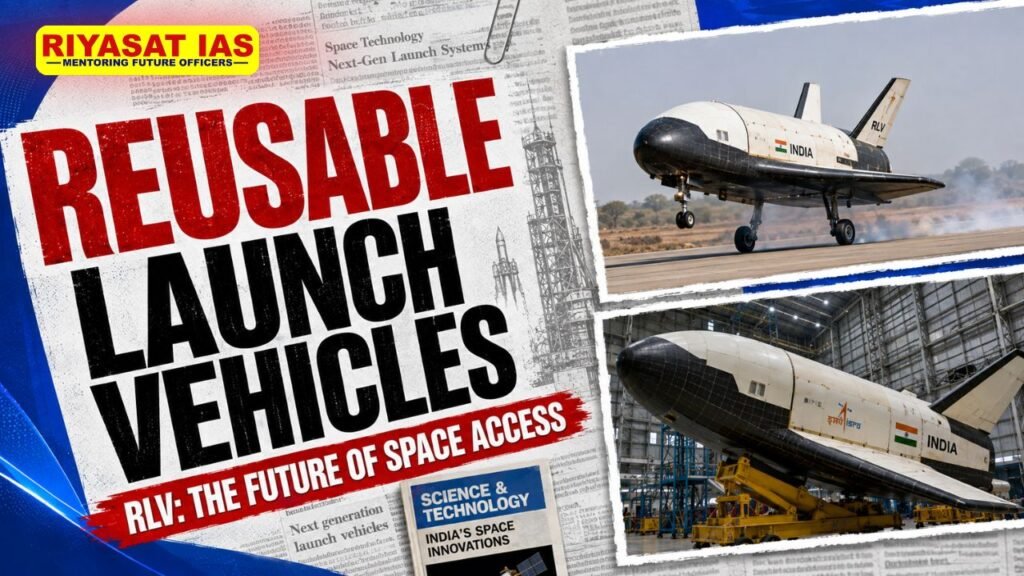
What is RLV?
- Reusable Launch Vehicle (RLV) is a space vehicle designed to recover and reuse major parts of a launch system for multiple missions.
- Conventional rockets are generally expendable, meaning they are discarded after a launch.
- Main aim: Reduce the cost of access to space and increase the frequency of launches.
How does RLV work?
- Launch: The vehicle carries a satellite or other payload into space.
- Separation: After completing its assigned function, the reusable component separates.
- Re-entry: It returns to Earth through the atmosphere at very high speed and temperature.
- Thermal protection: Special materials protect it from intense re-entry heating.
- Controlled descent: Aerodynamic surfaces and onboard systems control its trajectory.
- Landing: It performs a controlled/autonomous landing for recovery.
- Reuse: After inspection and refurbishment, the vehicle/component can be used again.
India’s RLV Programme
- Agency: ISRO
- RLV-TD: Reusable Launch Vehicle–Technology Demonstrator is an experimental vehicle developed to test technologies required for reusable launch systems.
- RLV-LEX: Reusable Launch Vehicle–Landing Experiment focuses particularly on landing and recovery technologies.
- RLV-LEX-01: Demonstrated autonomous landing capability.
- The vehicle was released from a helicopter and subsequently landed autonomously on a runway.
- The experiments are important steps towards developing a future reusable space transportation system.



Important Technologies
- Autonomous landing: Vehicle lands using onboard navigation and control systems without direct manual piloting.
- Aerodynamic control: Helps control the vehicle during atmospheric flight.
- Thermal protection system: Protects the vehicle against extreme heating during re-entry.
- Guidance and navigation: Ensures the vehicle follows the required trajectory.
- Controlled re-entry: Allows safe return to a predetermined landing location.
Why is RLV Important?
- Cost reduction: Expensive rocket hardware does not have to be manufactured for every launch.
- Higher launch frequency: Reusable components can support rapid turnaround.
- Commercial space: Lower launch costs can improve the competitiveness of the space-launch industry.
- Resource efficiency: Reduces wastage of launch hardware.
Prelims MCQ — English
Q. With reference to Reusable Launch Vehicles (RLVs), consider the following statements:
- They are designed to recover and reuse major components of a launch system.
- Thermal protection is important because of intense heating during atmospheric re-entry.
- ISRO’s RLV-LEX programme is associated with reusable launch vehicle technology.
- RLV technology necessarily requires complete reuse of every stage of a rocket.
Which of the statements given above are correct?
(a) 1, 2 and 3 only
(b) 1 and 4 only
(c) 2, 3 and 4 only
(d) 1, 2, 3 and 4
Answer: (a) 1, 2 and 3 only
Explanation:
RLVs are designed to recover and reuse major components, but complete reuse of every stage is not mandatory. Thermal protection is essential during atmospheric re-entry, and RLV-LEX is part of ISRO’s reusable launch vehicle technology programme.





 Ravi Raaz
 Hassan Khan
 Shadab Ali