
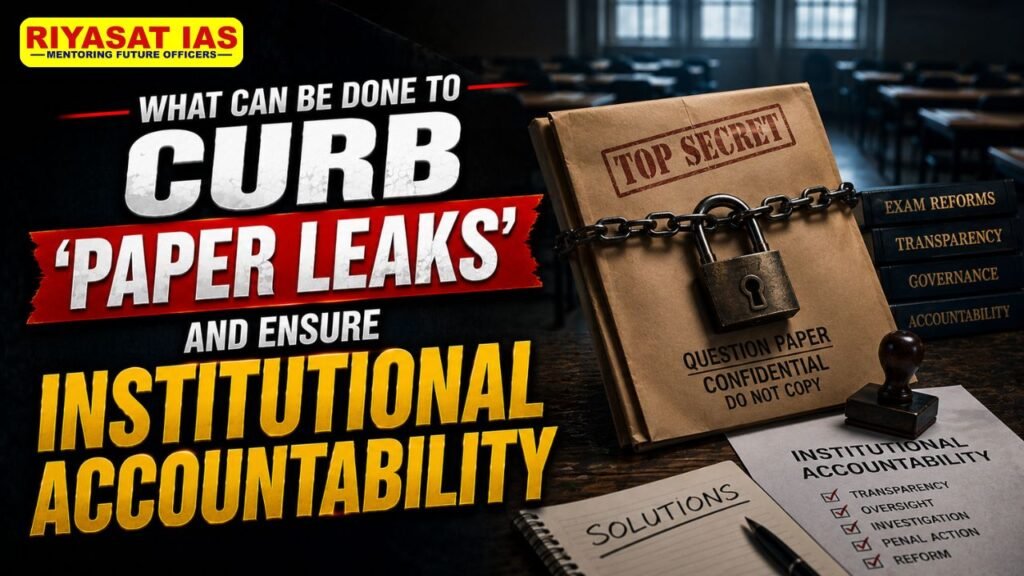
GS-II: Governance | Education | Public Examinations | Institutional Reforms
Context
- Recurring examination irregularities: High-stakes examinations such as NEET, UGC-NET and other national recruitment and admission tests have witnessed repeated controversies involving alleged paper leaks and examination irregularities.
- Editorial’s argument: The focus should move beyond the narrow definition of a “paper leak” towards securing the entire examination lifecycle through stronger institutional accountability, cybersecurity and preventive mechanisms.
Background
- Major examination controversies: NEET-2024, UGC-NET 2024 and NEET-2026 generated nationwide concern.
- Re-conduct of examinations: UGC-NET 2024 was cancelled and conducted again, while NEET-2026 was also re-conducted. All three examinations were conducted by the National Testing Agency (NTA), which attributed the decisions to specific external or intelligence inputs.
- CBI investigations: The CBI investigated NEET-2024 and UGC-NET 2024 but reportedly submitted closure reports, finding no prosecutable evidence of a conventional paper leak under the Bharatiya Nyaya Sanhita (BNS), 2023 or the Public Examinations Act (PEA), 2024. The NEET-2026 investigation remains ongoing with a chargesheet already filed.
Defining a ‘Paper Leak’
- Traditional definition: A paper leak generally refers to the unauthorised disclosure of a printed question paper before the examination, usually during printing, packaging, storage or transportation.
- Limitations of the conventional approach: Modern examinations involve multiple stages such as question-setting, moderation, translation, digitisation and final compilation, where confidential information may be compromised without any printed paper being leaked.
- Broader forms of compromise: Examination breaches may involve disclosure of selected questions, question banks, recurring themes, high-probability question pools, examiner identities, confidential instructions, digital data or administrative information through insider access, cyber intrusions or coaching networks.
- Need for broader interpretation: Restricting the definition of a paper leak to printed question papers overlooks significant vulnerabilities affecting examination integrity.



Other Examination Breaches
- Operational irregularities: NEET-2024 witnessed reported issues such as distribution of an incorrect question paper, delayed collection or replacement of OMR sheets, exceptional grace marks, tie-breaking disputes, clustering of near-perfect scores and unusually high scores from certain centres.
- Cybersecurity and administrative failures: Other vulnerabilities include cybersecurity failures, manipulation of examination data, disclosure of confidential information, compromised examination centres, impersonation, organised unfair means and insider access to privileged information.
- Need for end-to-end security: Protecting public examinations requires securing the complete examination lifecycle from question development to result processing.
Institutional Vulnerabilities
- Beyond logistics: Securing transportation of printed question papers alone cannot prevent examination compromises.
- Critical stages: Question selection, paper allocation, examination-centre management, OMR handling, grace marks, result processing, cybersecurity and confidential data management remain vulnerable.
- Insider risks: Repeated expert engagement, conflicts of interest and links with coaching ecosystems require closer scrutiny while ensuring protection of confidential information and institutional processes.
Primary Accountability
- Responsibility of examination authorities: Preventing examination breaches primarily rests with the examination authority rather than investigative agencies acting after a crisis.
- Institutional oversight: The examination authority should be supported by the Ministry of Education, intelligence agencies, cybersecurity agencies and independent oversight mechanisms.
- Lifecycle accountability: Accountability should extend across question setter selection, translation, examination centres, digital systems, evaluation and result processing through antecedent verification, conflict-of-interest scrutiny, periodic rotation of experts, cybersecurity audits, intelligence monitoring and audit trails.
Official Narrative and Unanswered Questions
- Official position: The NTA attributed the cancellation and re-conduct of NEET-2026 to specific intelligence inputs, while the High-Powered Steering Committee emphasised compliance with its recommendations and SOPs.
- CBI findings: Closure reports in NEET-2024 and UGC-NET 2024 reportedly found no prosecutable evidence of a conventional paper leak and no basis for prosecuting NTA officials, while the NEET-2026 investigation continues.
- Contrasting ground reality: Examination cancellations, arrests, circulation of “guided papers”, cybersecurity incidents, operational lapses and disruptions affecting millions of candidates raise questions about institutional safeguards.
- Need for transparency: The editorial questions why examinations were cancelled if no credible abnormality existed, or why institutional safeguards failed if credible intelligence inputs were available.
Editorial’s Suggestions
- Prepare a White Paper: The committee headed by former UIDAI Chairman Nandan Nilekani should prepare a comprehensive White Paper documenting breaches in NEET-2024, UGC-NET 2024 and NEET-2026.
- Establish a Public Examination Integrity Framework (PEIF): Develop a common framework for all major examination bodies.
- Standardise examination processes: Prescribe end-to-end SOPs covering the complete examination lifecycle.
- Strengthen governance: Emphasise conflict-of-interest management, expert selection, cybersecurity, examination administration, auditing and institutional accountability.
- Shift to preventive governance: Focus on early risk detection and prevention instead of post-crisis investigations.
Way Forward
- Secure the entire examination lifecycle from question development to result declaration.
- Implement a comprehensive Public Examination Integrity Framework (PEIF).
- Strengthen cybersecurity, audit systems and intelligence-based monitoring.
- Ensure transparent institutional accountability through standardised SOPs and conflict-of-interest safeguards.
- Prioritise prevention over post-crisis response to restore public confidence.
Conclusion
- Beyond paper leaks: Protecting the integrity of public examinations requires moving beyond the conventional concept of paper leaks to securing every stage of the examination process. Sustainable public confidence will depend on robust institutional safeguards, preventive governance and accountability across the entire examination lifecycle.
UPSC Mains Practice Question
Q. Repeated controversies surrounding public examinations highlight that threats to examination integrity extend beyond conventional paper leaks. Discuss the institutional vulnerabilities in India’s examination system and suggest measures to strengthen transparency, accountability and public confidence.




 Ravi Raaz
 Hassan Khan
 Shadab Ali