
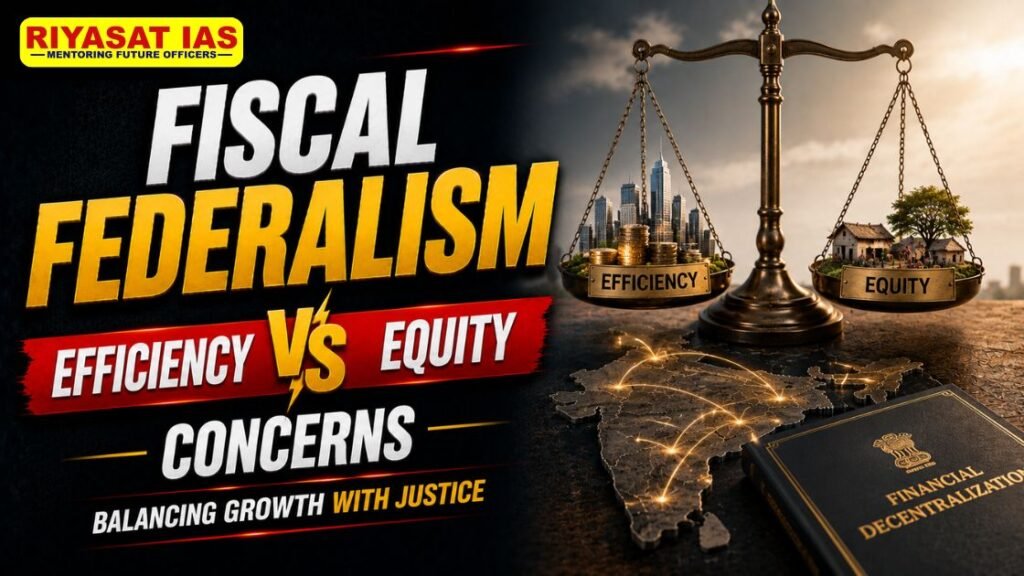
GS-II: Polity & Governance | Fiscal Federalism | Finance Commission | Centre–State Relations
Context
- FC-16 retains 41% tax devolution but fundamentally restructures grants-in-aid: The 16th Finance Commission (FC-16), chaired by Arvind Panagariya, retains the States’ share in the divisible pool at 41% while significantly altering the structure of fiscal transfers.
- Editorial argues that efficiency is being prioritised over constitutional equalisation: According to the editorial, the Commission moves away from its traditional role of reducing fiscal disparities among States and raises concerns about protecting the Union’s fiscal primacy.
Finance Commission was created to reduce fiscal imbalances between the Union and States
- It was envisaged as a constitutional institution to balance India’s fiscal federalism: The Finance Commission was designed to address the asymmetry between a fiscally dominant Union and financially constrained States while reducing horizontal inequalities.
- Its primary mandate was to safeguard State interests and preserve a strong Union: In a country with uneven development, protecting State interests was considered essential for sustaining the federal compact.
- Successive Finance Commissions adapted this mandate to changing circumstances: Each Commission interpreted its constitutional responsibility according to the historical context while contributing to India’s fiscal federal system.
Grants-in-aid were introduced because tax devolution alone cannot address diverse State needs
- Article 275 provides the constitutional basis for grants-in-aid: Grants-in-aid were conceived as instruments of equalisation where formula-based tax devolution falls short.
- Kerala’s development model illustrates the fiscal cost of national contributions: Kerala’s export-oriented human capital strategy accounted for nearly 23% of India’s total remittances, but required borrowing to finance investments in education.
- Punjab’s contribution to food security involved fiscal sacrifice: Punjab strengthened national food security through wheat and rice production while bearing the burden of being a border State.
- Several States continue to face structural disadvantages: Hill States face high infrastructure costs, north-eastern States face connectivity constraints and fiscally stressed States continue to bear demographic and social sector pressures.
- FC-14 and FC-15 recognised these disparities through targeted grants: Revenue Deficit Grants (RDGs), sector-specific grants and State-specific grants were retained to address State-specific needs.



FC-16 significantly restructures the architecture of grants-in-aid
- Overall grants-in-aid have been reduced from ₹10.1 lakh crore to ₹9.47 lakh crore: The total allocation for grants has declined under FC-16.
- The share of grants in total Finance Commission transfers has fallen sharply from 19.4% to 8.3%: Grants now constitute a much smaller component of fiscal transfers.
- Only local body and disaster management grants have been retained: Other categories of grants have been discontinued.
- Revenue Deficit Grants, sector-specific grants and State-specific grants have been removed: FC-16 departs significantly from the approach adopted by earlier Finance Commissions.
- States’ share in the divisible pool remains unchanged at 41% despite demands for 50%: The Commission did not accept the demand raised by 18 States.
Removal of Revenue Deficit Grants is justified on the grounds of fiscal discipline
- FC-16 argues that RDGs create moral hazard: The Commission believes such grants may discourage revenue mobilisation and encourage excessive expenditure by States.
- The Commission assumes improved fiscal discipline can replace gap-filling transfers: It argues that States should be capable of managing their finances without Revenue Deficit Grants.
- Aggregate fiscal indicators are cited to justify the decision: FC-16 contends that States collectively are not under severe fiscal distress.
Editorial argues that aggregate data overlooks significant inter-State disparities
- Fiscal conditions vary considerably across States: Some States remain fiscally stressed despite contributing significantly to national development.
- Revenue Deficit Grants recognised State-level fiscal heterogeneity: Fiscal surpluses in one State cannot compensate for fiscal deficits in another.
- Removal of RDGs weakens the equalisation function of the Finance Commission: The editorial argues that the constitutional objective of reducing disparities may be undermined.
Different treatment of cesses and surcharges creates an asymmetry in fiscal federalism
- Fiscal discipline is imposed on States but not equally on the Union: While RDGs have been withdrawn, no binding rollback of non-shareable cesses and surcharges has been recommended.
- FC-16 proposes a ‘grand bargain’ instead of mandatory reforms: The Centre would gradually merge cesses into the divisible pool in exchange for States accepting a lower devolution share.
- Editorial considers this a dual shift favouring the Union: Fiscal flexibility is preserved for the Union while fiscal support for States is reduced.
Changes in the devolution formula may adversely affect structurally disadvantaged States
- Eight States are expected to receive lower shares in both tax devolution and grants: These include most north-eastern States and fiscally stressed West Bengal.
- Another six States witness a decline in grant allocations: The reduction further affects their fiscal position.
- Weight assigned to Income Distance has been reduced from 45% to 42.5%: Income Distance receives relatively lower importance in the devolution formula.
- A new 10% weight has been assigned to contribution to GDP: Economic contribution becomes an additional criterion.
- Removal of RDGs creates a double burden on affected States: Lower tax devolution combined with the absence of compensatory grants may widen regional disparities.
Performance-based grants become the central feature of FC-16
- Nearly ₹7.2 lakh crore has been allocated to local governments: The Commission significantly strengthens financial support for the third tier.
- Release of grants is linked to strict performance conditions: Water and sanitation targets, revenue mobilisation and audited accounts determine fund release.
- Editorial argues that grants have shifted from equalisation to incentivisation: Need-based fiscal support has increasingly been replaced by compliance-based transfers.
Significance
- FC-16 retains the existing framework of vertical tax devolution: States continue to receive 41% of the divisible pool.
- Fiscal transfers become increasingly performance-oriented: Greater emphasis is placed on efficiency and accountability.
- Local governments receive substantial financial support: Higher allocations strengthen the third tier of governance.
Challenges
- Removal of equalisation grants may widen regional disparities: Structurally disadvantaged States may face greater fiscal stress.
- Lower importance to Income Distance may weaken redistributive objectives: Poorer States may receive relatively lower support.
- Continued reliance on cesses and surcharges preserves Union’s fiscal advantage: Vertical fiscal imbalance remains a concern.
- Performance-linked grants may reduce State autonomy: Strict conditionalities limit flexibility in fund utilisation.
Way Forward
- Future Finance Commissions should balance efficiency with equity: Performance incentives should coexist with support for structurally disadvantaged States.
- Equalisation should remain the guiding principle of fiscal federalism: Fiscal discipline should complement rather than replace constitutional fairness.
- Fiscal federalism should continue strengthening cooperative federalism: The Finance Commission should preserve its historic role as an equalising institution.
Conclusion
- Fiscal federalism cannot be sustained on performance alone: According to the editorial, India’s federal structure requires balancing efficiency with fairness so that the Finance Commission continues to reduce regional disparities while promoting fiscal responsibility.
UPSC Mains Practice Question
Q. The 16th Finance Commission marks a shift from need-based equalisation towards performance-oriented fiscal transfers. Critically examine its recommendations and discuss their implications for India’s fiscal federalism and Centre–State relations.





 Ravi Raaz
 Hassan Khan
 Shadab Ali