
GS-II: International Relations | West Asia | Regional Security | India’s Foreign Policy
Context
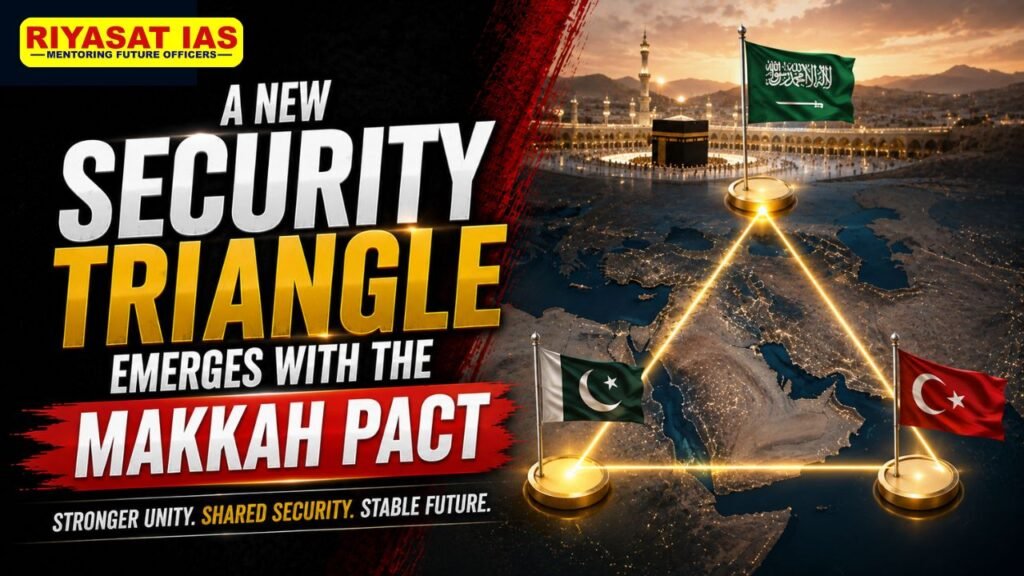
- MJDA signed: Saudi Arabia, Türkiye and Pakistan signed the Makkah Joint Defence Agreement on August 7, 2026.
- Collective defence: The agreement states that an armed attack on one member would be regarded as an attack on all three.
- NATO comparison: This resembles Article 5 of NATO, prompting speculation about a possible “Muslim NATO”.
- Part of Saudi security diversification: It follows Saudi Arabia’s Strategic Mutual Defence Agreement (SMDA) with Pakistan and the Multinational Maritime Defence Alliance (MMDA).
Why a “Muslim NATO” Remains Uncertain
- No military axis: Saudi Arabia has clarified that the MJDA is not intended to create a military axis or sectarian bloc.
- No clear adversary: The agreement does not identify the specific threats it seeks to counter.
- Existing regional divisions: Differences among Arab-Muslim states make the emergence of a unified anti-Iran or anti-Israel bloc unlikely.
- No institutional linkage: The MJDA has not been explicitly linked with the Arab League, OIC or GCC.
Strategic Constraints
- Saudi-Türkiye differences: Historical memories of Ottoman rule and competing leadership ambitions remain important constraints.
- Türkiye’s regional policies: Ankara’s earlier support for groups such as the Muslim Brotherhood and Hamas created concerns among Gulf states.
- Saudi-Pakistan differences: Previous Pakistani deployments in Saudi Arabia witnessed chain-of-command disputes and differences over Iran and Yemen.
- Iran factor: Both Türkiye and Pakistan share borders with Iran, limiting their willingness to confront Tehran militarily.
- Pakistan’s constraints: Its 900-km border with Iran, Shia population and internal security challenges constrain its strategic choices.



Saudi Arabia’s Security Needs
- Complex threats: Saudi Arabia faces threats to its oil and civilian infrastructure, including attacks by Iran and its proxies.
- Strategic chokepoints: Disruptions involving the Strait of Hormuz and Bab al-Mandeb pose major security and economic risks.
- Limited utility of foreign forces: It remains uncertain whether Turkish and Pakistani forces can address challenges that the U.S. Central Command has struggled with.
- Domestic security: Excessive dependence on foreign forces for internal security could create political complications.
Potential Strategic Benefits
- Defence complementarity: Saudi Arabia provides financial resources, Türkiye a growing defence-industrial base, and Pakistan significant military manpower.
- Military cooperation: The three could benefit from joint exercises, interoperability, co-production and defence technology cooperation.
- Political influence: Türkiye and Pakistan could gain greater political and economic influence in Saudi Arabia.
Uncertain Future
- Conflict scenario: A prolonged low-intensity conflict could strengthen the relevance of the MJDA.
- Full-scale war: Türkiye and Pakistan may hesitate to fight Iran because of their geographical and economic interests.
- Peace scenario: If regional tensions decline, the MJDA could become less significant.
- Saudi diversification: The pact reflects Riyadh’s effort to diversify security partnerships rather than depend exclusively on the U.S.
Implications for India
- Strategic vigilance: India should monitor Pakistan’s efforts to use the MJDA to expand its influence against India, without overreacting.
- Energy security: Instability in West Asia could affect oil supplies, prices and maritime chokepoints, directly impacting India.
- Importance of Saudi Arabia: Saudi Arabia is a major Indian energy, trade and strategic partner.
- India as a stable partner: Riyadh views India as a relatively moderate and dependable partner with strong economic complementarity.
- Limited Saudi alignment with Pakistan against India: Saudi Arabia’s broader strategic and economic interests make it unlikely to support Pakistani adventurism against India.
- Need for balanced diplomacy: India should deepen engagement with Saudi Arabia and the wider Gulf while maintaining strategic autonomy.
Conclusion
The MJDA represents an emerging experiment in West Asian security cooperation, but its transformation into a “Muslim NATO” remains uncertain due to divergent interests among its members. For India, the priority should be strategic vigilance, energy-security preparedness and deeper engagement with Saudi Arabia and the Gulf, without treating the pact as an immediate anti-India alignment.
UPSC Mains Practice Question
Q. The Makkah Joint Defence Agreement reflects the emergence of new security alignments in West Asia. Discuss its significance and examine its implications for India’s strategic and energy interests.





 Ravi Raaz
 Hassan Khan
 Shadab Ali