
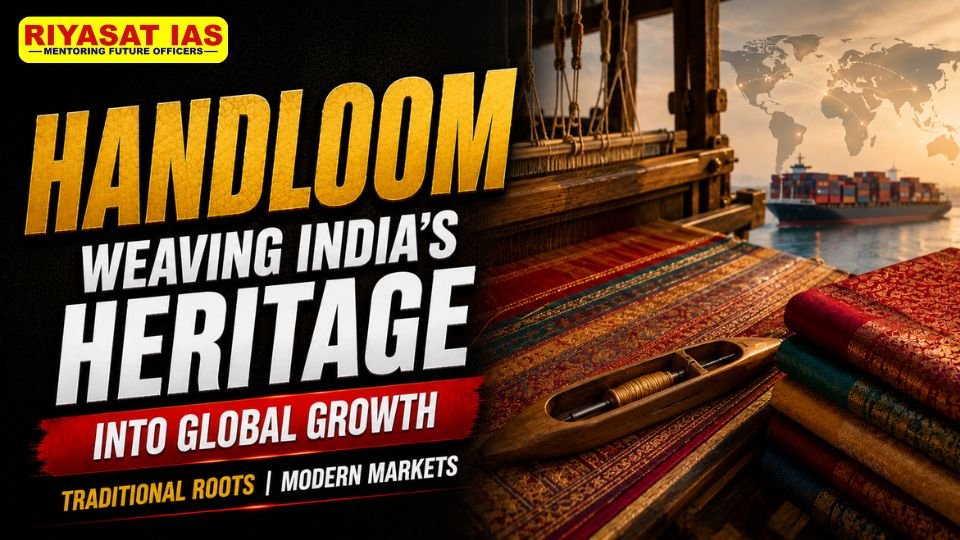
GS-III: Economy | MSMEs | Textile Sector | Inclusive Growth | Cultural Economy
Context
- India celebrated the 12th National Handloom Day on August 7, highlighting the need to recognize the handloom sector not merely as a traditional craft but as a strategic industry for achieving Viksit Bharat 2047.
- Handloom aligns with global trends of sustainability and authenticity: As international markets increasingly value eco-friendly, handcrafted and ethically produced goods, India’s handloom sector has an opportunity to strengthen its global position.
It represents India’s civilisational strength and cultural identity
- India possesses one of the world’s oldest weaving traditions: From the Indus Valley Civilization, where cotton cultivation and weaving first flourished, India has maintained a rich textile heritage.
- Indian textiles once dominated global trade: Products such as Bengal Muslin, Banarasi Silk, Kanchipuram Silk, Pochampally Ikat, and numerous regional weaves earned worldwide recognition for their quality and craftsmanship.
- Handloom preserves traditional knowledge: Every handwoven fabric reflects generations of inherited skills, cultural values and artisanal excellence.
- The sector strengthens India’s soft power: Every product serves as an ambassador of Brand India, promoting India’s heritage across global markets.
Handloom supports the vision of Viksit Bharat 2047
- The sector combines heritage with innovation: It demonstrates that traditional industries can coexist with modern technology and global competitiveness.
- It promotes women-led development: Around 72% of India’s handloom workforce comprises women, making the sector an important instrument of gender-inclusive growth.
- It strengthens rural entrepreneurship: Handloom provides employment opportunities in villages while reducing rural distress and migration.
- It contributes to self-reliance: The sector supports the vision of Atmanirbhar Bharat by promoting indigenous production and local value addition.
Government initiatives have strengthened the handloom ecosystem
- Handloom is India’s largest cottage industry: The sector supports the livelihoods of over 35 lakh weavers and allied workers.
- Raw Material Supply Scheme improves access to inputs: The scheme ensures timely availability of quality yarn and raw materials.
- Handloom clusters enhance productivity: Around 797 handloom clusters have been developed to improve production, infrastructure and market access.
- Modernisation initiatives have improved efficiency: More than 1.24 lakh improved looms have been distributed to increase productivity.
- Skill development has expanded: Nearly 97,000 artisans have received training and upskilling support.
- Branding and certification initiatives improve market credibility: Measures include GI-tagged products, Handloom Mark, India Handmade certification, Urban Haats, Producer Companies, and Design Resource Centres.
- Institutional support has been strengthened: 29 Weavers’ Service Centres provide training, design support, raw material assistance and marketing linkages, while 11 Indian Institutes of Handloom Technology are being upgraded.
The National Handloom and Handicraft Programme aims to scale the sector
- The programme will strengthen around 1,800 clusters across more than 500 districts.
- Nearly 65 lakh weavers and artisans are expected to benefit through improved infrastructure, training and market access.
- The initiative seeks to establish ‘Handmade in India’ as a globally recognised brand, enhancing India’s export competitiveness.
Technology is transforming traditional weaving
- Innovation has always complemented handloom: Earlier examples include Mahatma Gandhi’s Ambar Charkha, which improved spinning efficiency.
- Recent indigenous innovations include Assam’s Maina Loom and the Chitranjan Handloom, which reduce physical effort and improve productivity.
- The Centre of Excellence for Handloom Technology, established in collaboration with Indian Institutes of Technology (IITs), is developing lighter, stronger and more ergonomic looms, including designs suitable for persons with disabilities.
- Handloom 4.0 integrates digital technologies: Artificial Intelligence is being used to monitor productivity, quality control and predictive maintenance, with pilot implementation on 100 looms.
- Technology is intended to empower artisans rather than replace them, improving productivity while preserving craftsmanship.
Digital platforms can expand global market access
- Platforms such as VisioNXT help forecast fashion trends and identify changing consumer preferences.
- Digital authentication strengthens consumer confidence by distinguishing genuine handloom products from imitations.
- Direct market linkages reduce intermediaries, allowing artisans to receive better prices.
- Product diversification into premium silk, natural fibres, sustainable fibres and innovative blends can create higher-value products and expand export markets.
- The long-term vision is to enhance weavers’ incomes, with an aspirational target of ₹50,000 per month.
Handloom can become a major creative industry
- Weavers should be recognised as entrepreneurs and innovators, not merely traditional artisans.
- Moving up the value chain through branding and design innovation can increase competitiveness.
- Youth participation can integrate technology, design and entrepreneurship, ensuring the long-term sustainability of the sector.
- The handloom industry has the potential to become one of India’s leading creative industries, generating employment while preserving cultural heritage.
Significance
- Promotes sustainable and environmentally friendly production through low-carbon, handmade textiles.
- Supports rural employment and women-led development, contributing to inclusive growth.
- Strengthens India’s cultural diplomacy and Brand India in global markets.
- Enhances export potential by meeting growing international demand for authentic handcrafted products.
- Aligns with the vision of Viksit Bharat 2047 through self-reliance, innovation and inclusive development.
Challenges
- Competition from powerloom and machine-made textiles reduces market share for handloom products.
- Low and irregular incomes discourage younger generations from entering the profession.
- Limited branding, marketing and export penetration constrain global competitiveness.
- Dependence on intermediaries often reduces artisans’ earnings.
- Technological adoption remains uneven, particularly among small and remote weaving communities.
Way Forward
- Strengthen technology adoption while preserving traditional craftsmanship.
- Expand branding, GI protection and international marketing initiatives for Indian handloom products.
- Improve digital market access through e-commerce and direct-to-consumer platforms.
- Enhance skill development, design innovation and entrepreneurship among weavers.
- Promote sustainable fibres and premium product diversification to capture high-value global markets.
Conclusion
India’s handloom sector is far more than a traditional craft—it is a powerful instrument of inclusive growth, cultural preservation and economic transformation. By combining heritage with innovation, technology and global market access, handloom can emerge as a key pillar of Viksit Bharat 2047, strengthening livelihoods while showcasing India’s civilisational identity to the world.
UPSC Mains Practice Question
Q. Discuss the role of India’s handloom sector in achieving the vision of Viksit Bharat 2047. Examine how technology, innovation and policy support can transform handloom into a globally competitive creative industry while preserving its cultural heritage.

 Ravi Raaz
 Hassan Khan
 Shadab Ali