
GS-II: Governance | Health | Medical Education | Human Resource Development
Context
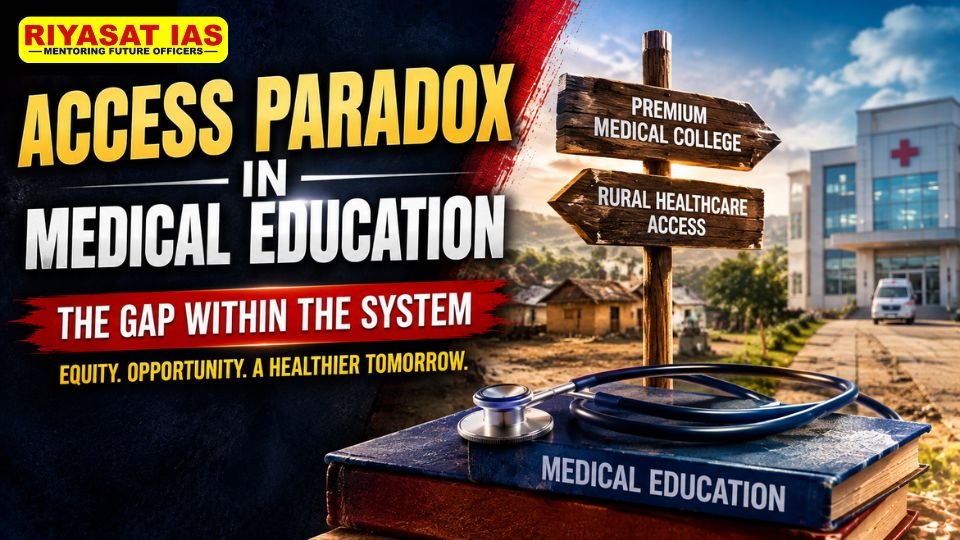
- India has witnessed a rapid expansion in medical education: The number of MBBS seats has nearly tripled in the last 12 years due to the government’s efforts to improve healthcare access through infrastructure upgrades and simplified regulations.
- Private medical colleges are driving this expansion: For the first time, private institutions now host more than half of all MBBS seats, raising concerns about equitable access to medical education.
Expansion of MBBS seats aims to improve healthcare capacity
- The number of MBBS seats has nearly tripled over the past 12 years: This expansion is part of the government’s effort to improve healthcare access.
- New government medical colleges have also been established: Many are attached to district hospitals to expand medical education.
- Expanding domestic capacity addresses intense competition: Indian students continue to compete fiercely for limited MBBS seats.
- Higher domestic capacity can reduce dependence on foreign medical education: Thousands of Indian students seek medical education abroad due to limited opportunities at home.
Private sector has become the main driver of expansion
- Private institutions now host more than half of all MBBS seats: This marks a significant shift in India’s medical education landscape.
- Nearly 79% of the approximately 10,000 new MBBS seats are in private institutions: Future growth is likely to remain concentrated in the private sector.
High cost of private medical education affects accessibility
- Government medical colleges remain relatively affordable: An MBBS course generally costs less than ₹5 lakh for the full duration.
- Private medical colleges are significantly more expensive: A seat may cost around ten times more.
- High demand for medical education sustains these higher fees: The cost difference creates unequal access to medical education.



Geographical concentration creates unequal healthcare distribution
- Private medical colleges are concentrated in Tier-I and Tier-II cities: They are largely located in more prosperous States where higher incomes support their commercial viability.
- Graduates often remain in these regions after completing their education: Unless they deliberately move elsewhere, medical professionals remain concentrated in urban areas.
- Rural areas continue to face shortages of healthcare providers: The scarcity of doctors is felt more acutely in remote regions.
Rapid expansion raises quality concerns
- Institutions may focus on securing NMC accreditation with minimum facilities: Rapid growth increases the risk of uneven quality.
- Medical colleges may not adequately address local healthcare needs: The emphasis may remain on meeting minimum regulatory requirements.
Capitation fees and poor service conditions influence career choices
- Capitation fees continue despite government bans: These increase students’ financial burden.
- Educational debt may influence graduates’ career decisions: Many prefer higher-paying opportunities after graduation.
- Lack of competitive salaries, housing, schools and career progression discourages public service: Graduates often choose private practice or migrate abroad.
Government continues to have a major role in expanding affordable education
- Growth of private capacity requires continued government expansion: The government needs to keep opening AIIMS-like institutions and expanding affordable public medical colleges.
- Affordable government seats remain essential: They ensure wider access to medical education.
Editorial recommends stronger regulation and better rural incentives
- The NMC’s rule requiring 50% of seats in private institutions to be charged at government rates should be enforced.
- The NMC should adopt stronger regulatory mechanisms: These include surprise inspections and the ability to inspect institutional records without prior permission.
- Governments should reward rural service rather than only compel it: Better incentives and improved facilities should be provided for healthcare workers and their families.
Way Forward
- Strictly enforce the NMC rule requiring 50% of private medical seats to be charged at government rates.
- Strengthen regulatory oversight through surprise inspections and independent record verification.
- Continue expanding affordable government medical colleges, including AIIMS-like institutions.
- Reward rural service by improving salaries, housing, schools and career progression.
Conclusion
- Expanding medical education capacity is essential, but access, affordability and quality must improve simultaneously. According to the editorial, equitable medical education requires affordable public institutions, effective regulation and stronger incentives for rural healthcare so that increased capacity translates into better healthcare access across the country.
UPSC Mains Practice Question
Q. India’s rapid expansion of medical education has increased capacity but also raised concerns regarding affordability, quality and equitable access. Critically examine.




 Ravi Raaz
 Hassan Khan
 Shadab Ali