
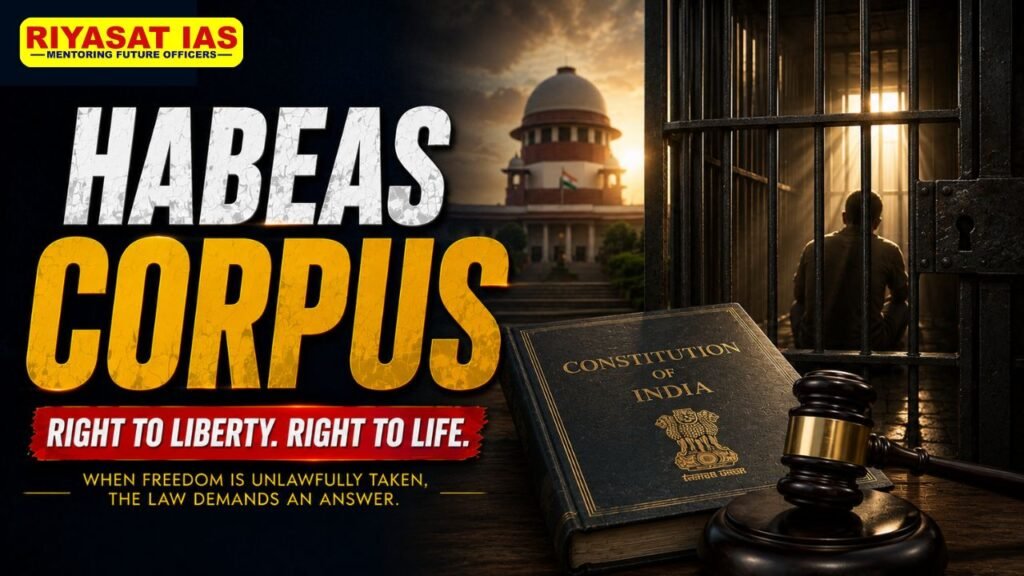
- Meaning: Habeas Corpus literally means “to have the body of.”
- Purpose: It is a writ against unlawful detention and seeks the release of a person who has been illegally detained.
- Constitutional Basis:
- Article 32 → Supreme Court
- Article 226 → High Courts
- Issued by: Both the Supreme Court and High Courts can issue Habeas Corpus.
- Against whom: It can be issued against public authorities and, in appropriate cases, private individuals who illegally detain a person.
- Key point: It protects the Right to Life and Personal Liberty under Article 21.
- Emergency: After the 44th Constitutional Amendment Act, 1978, the right to move courts for enforcement of Articles 20 and 21 cannot be suspended under Article 359.
Prelims MCQ — English



Q. With reference to the writ of Habeas Corpus, consider the following statements:
- It can be issued only by the Supreme Court.
- It can be issued against a private person in cases of unlawful detention.
- It is primarily aimed at securing release from illegal detention.
Which of the statements given above is/are correct?
(a) 1 and 2 only
(b) 2 and 3 only
(c) 1 and 3 only
(d) 1, 2 and 3
Answer: (b) 2 and 3 only
Explanation: Habeas Corpus can be issued by both the Supreme Court under Article 32 and High Courts under Article 226. It is primarily used to protect personal liberty against unlawful detention.





 Ravi Raaz
 Hassan Khan
 Shadab Ali