
GS-II: Governance | Government Policies & Interventions | Inclusive Growth | Financial Inclusion | Digital Public Infrastructure
Context
- 12 Years of PMJDY: The Pradhan Mantri Jan Dhan Yojana (PMJDY), launched on August 28, 2014, completes 12 years in 2026 and represents a major step towards financial inclusion and Antyodaya.
- Ideology and governance: PMJDY reflects the idea that governance should ensure that the most deprived sections receive priority in accessing the benefits of development.
- From political to economic freedom: Political independence does not automatically ensure economic liberty. Lack of access to banking, formal credit, insurance and government benefits can limit citizens’ ability to exercise meaningful economic freedom.
- Financial exclusion: Before PMJDY, large sections of the population remained outside the formal financial system, while leakages in welfare delivery weakened the effectiveness of government expenditure.
- State responsibility: Financial inclusion can be viewed as a means of enabling citizens to participate in the formal economy and access economic opportunities.
Vision Behind PMJDY
- Financial inclusion: PMJDY sought to provide universal access to basic banking facilities, particularly for economically vulnerable sections.
- Account as an entry point: A bank account was envisaged not merely as a welfare benefit but as an entry point into the formal financial system.
- Antyodaya: The scheme embodies the principle that the last person in the queue should not remain outside the development process.
- Economic empowerment: Access to savings, payments, credit, insurance and government transfers can enhance the economic agency of citizens.
- Chanakya’s principle: The scheme’s philosophy can be linked to the idea that economic means are fundamental to human welfare, making access to economic resources an important responsibility of the state.
Key Features of PMJDY
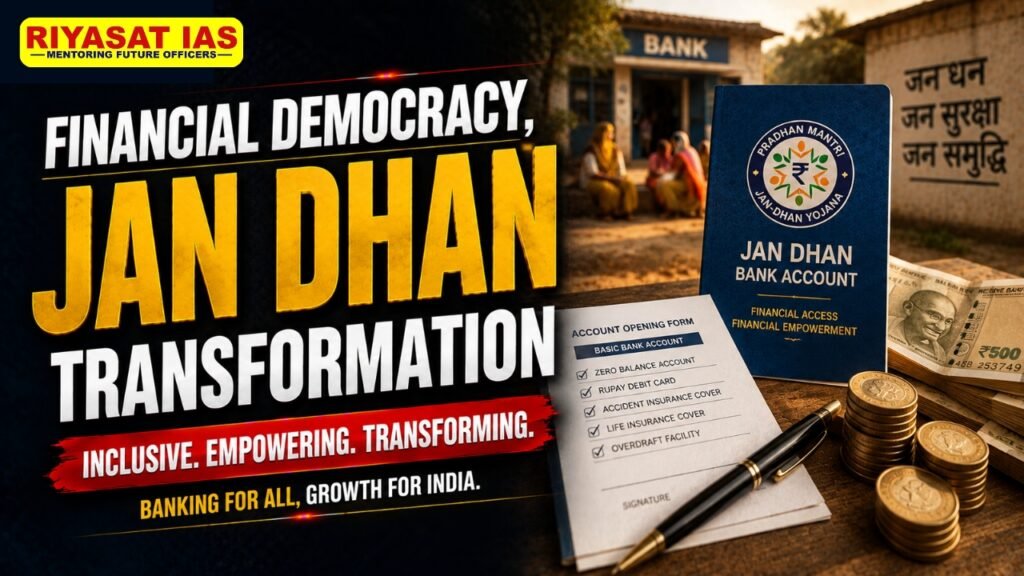
- Zero-balance accounts: Enables economically weaker citizens to enter the banking system without the requirement of maintaining a minimum balance.
- RuPay debit card: Provides access to formal digital and banking transactions.
- Overdraft facility: Intended to provide limited access to formal credit to eligible account holders.
- Insurance component: Provides access to specified insurance benefits subject to applicable conditions.
- Universal banking access: Seeks to connect previously unbanked households with the formal financial system.
- Women-centric impact: A significant proportion of PMJDY accounts are held by women, strengthening their financial agency and inclusion.



The Numbers Tell a Story
- Scale: By July 2026, PMJDY had crossed 58 crore accounts, with deposits of around ₹3 lakh crore.
- Women: More than half of the accounts are held by women.
- Rural inclusion: Roughly three-fourths of the accounts are located in rural and semi-urban areas.
- Beyond account opening: The real significance lies in connecting citizens with savings, payments, credit, insurance and welfare delivery.
- Financial deepening: PMJDY has helped expand the reach of formal financial institutions beyond traditional urban and economically better-off populations.
PMJDY and JAM Architecture
- JAM Trinity: PMJDY became the bank-account layer of the broader Jan Dhan–Aadhaar–Mobile (JAM) architecture.
- Direct Benefit Transfer: Linking bank accounts with identity and mobile infrastructure strengthened the government’s capacity to transfer benefits directly to beneficiaries.
- Reduction in leakages: Direct transfers can reduce intermediaries and improve the traceability of welfare payments.
- Digital financial ecosystem: PMJDY subsequently became part of India’s expanding Digital Public Infrastructure (DPI) ecosystem.
- UPI linkage: The growth of digital payments through platforms such as UPI demonstrates how basic bank-account access can evolve into participation in a wider digital economy.
PMJDY and Antyodaya
- Last-mile inclusion: PMJDY attempts to ensure that the poorest citizen is not excluded from formal finance.
- Recognition: A bank account provides not only financial access but also a formal institutional connection between the citizen and the state.
- Dignity and agency: Financial inclusion can strengthen individual autonomy, economic decision-making and social dignity.
- Women empowerment: Independent access to financial accounts can enhance women’s control over household resources and government benefits.
- Inclusive governance: The scheme illustrates how welfare policy can move from passive benefit distribution towards active economic participation.
From Political Freedom to Economic Freedom
- First independence: Independence in 1947 primarily meant liberation from colonial rule.
- Second challenge: The post-independence challenge is to create conditions in which citizens can meaningfully exercise their freedom.
- Economic capability: Without access to formal finance, savings, secure payments and economic opportunities, political rights may not translate into substantive empowerment.
- Financial democracy: PMJDY seeks to bridge part of this gap by bringing excluded citizens into the formal economic system.
- Governance implication: The scheme demonstrates that institutional access is an important dimension of substantive freedom.
Significance
- Inclusive growth: Expands participation in formal economic activity.
- Welfare efficiency: Strengthens the infrastructure for targeted government transfers.
- Women empowerment: Enhances women’s access to formal financial institutions.
- Rural transformation: Brings rural and semi-urban populations into the formal banking ecosystem.
- Digital transformation: Provides a foundation for wider digital financial services.
- Financial resilience: Formal savings and access to financial services can improve households’ capacity to manage economic shocks.
- State–citizen relationship: Creates a more direct institutional connection between citizens and the government.
Challenges
- Dormant accounts: Opening an account does not automatically ensure regular and meaningful usage.
- Financial literacy: Beneficiaries may lack adequate understanding of digital banking, insurance and formal credit.
- Digital divide: Unequal access to smartphones, internet connectivity and digital skills can limit the benefits of financial inclusion.
- Last-mile banking: Remote areas may continue to face difficulties in accessing banking infrastructure.
- Cybersecurity risks: Increasing digital financial participation also exposes vulnerable users to fraud and cybercrime.
- Quality of inclusion: The focus must shift from merely counting accounts to measuring actual usage and economic outcomes.
Way Forward
- From access to usage: Measure financial inclusion through active accounts, savings, credit access, insurance coverage and digital transactions.
- Strengthen financial literacy: Expand financial and digital literacy programmes, particularly among women and rural populations.
- Improve last-mile connectivity: Strengthen banking correspondents, digital infrastructure and assisted banking services.
- Enhance cybersecurity: Provide stronger consumer protection and awareness against digital financial fraud.
- Women-centric financial inclusion: Use PMJDY accounts to deepen women’s access to credit, insurance, entrepreneurship and government schemes.
- Integrate DPI: Further integrate bank accounts with India’s wider digital public infrastructure while ensuring privacy, security and inclusion.
- Outcome-based governance: Evaluate PMJDY not merely by the number of accounts opened but by its contribution to economic empowerment and poverty reduction.
Conclusion
PMJDY demonstrates that financial inclusion is not merely a banking reform but an instrument of inclusive governance and economic freedom. By connecting citizens to formal finance and subsequently to the JAM and wider digital public infrastructure ecosystem, it has helped bring the previously excluded closer to the formal economy. The next phase must move from “account ownership” to “meaningful financial participation”, ensuring that Antyodaya translates into genuine economic empowerment.
UPSC Mains Practice Question
Q. “Financial inclusion is an important bridge between political freedom and economic freedom.” Discuss how the Pradhan Mantri Jan Dhan Yojana has contributed to inclusive governance and the empowerment of vulnerable sections in India.





 Ravi Raaz
 Hassan Khan
 Shadab Ali