
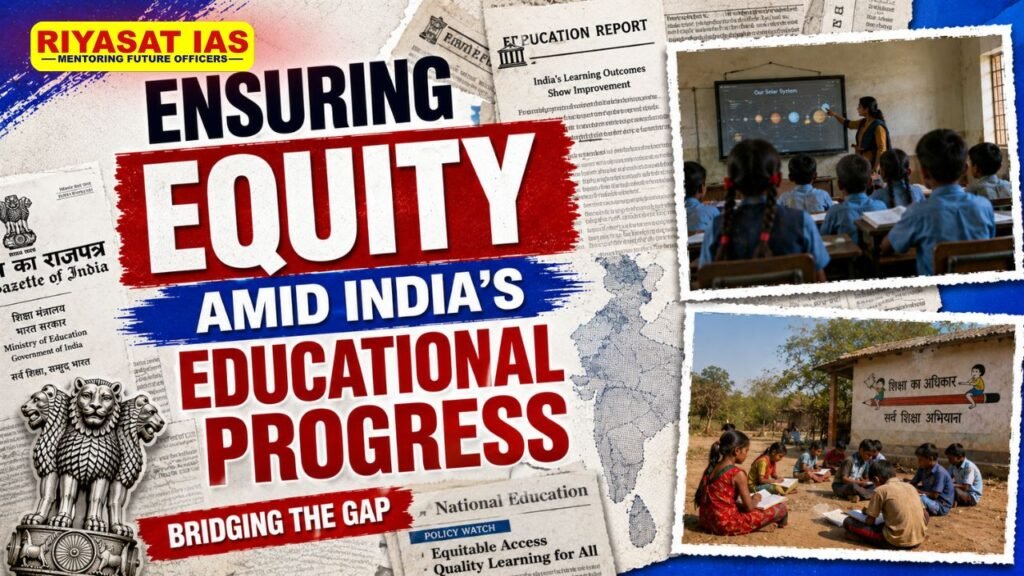
GS-II: Education | Social Justice | Human Resource Development | Inclusive Growth
Context
- UDISE+ 2025–26 Report: Covers 1.47 million schools, 240 million students and 10.2 million teachers.
- Progress: Improvements have been recorded in gross enrolment, student retention, dropout reduction, teacher availability and educational infrastructure.
- Persistent Gaps: Regional and social disparities remain in access, resources, learning opportunities and educational outcomes.
- Core Concern: Wide variations in GER, dropout rates, Pupil-Teacher Ratio (PTR) and infrastructure continue to challenge the goal of equitable, inclusive and quality education.
Regional and Social Imbalances
- Aadhaar Seeding: Andhra Pradesh leads with 99.6%, followed by Chandigarh at 99%, while Meghalaya records only 35%, against the national average of 90.2%.
- School-Enrolment Imbalance: Uttar Pradesh accounts for the highest share of schools and student enrolment, while Meghalaya and Himachal Pradesh have lower shares of schools relative to enrolment, indicating higher student-school ratios.
- School Structure: West Bengal has the highest proportion of foundational and preparatory schools (79%) and among the lowest secondary schools (11%), while Chandigarh has the highest secondary schools (83%) and the lowest foundational and preparatory schools (5%).
Social Composition and Participation
- General Category: Chandigarh and Delhi have the highest proportions of General category students.
- ST Enrolment: Lakshadweep, Mizoram, Meghalaya and Ladakh have high proportions of ST enrolment.
- SC Enrolment: Punjab records one of the highest shares of SC enrolment.
- OBC Enrolment: OBC representation is particularly high in Tamil Nadu and Gujarat.
- National GER: OBCs account for the highest GER (49%), followed by General (27%), SC (17%) and ST (10%).
- Gender Parity: Girls’ enrolment and participation are higher than boys across most States/UTs.
- Minority Participation: Minority communities account for more than 20% of enrolment, with Muslims and Parsis among the major minority groups.
School Size and Regional Variation
- Highest Average Enrolment: Chandigarh — 1,194 students per school.
- Delhi: 788 students per school.
- Lowest Average Enrolment: Ladakh — 64 students per school.
- Significance: Wide variations indicate differences in population density, school size and geographical accessibility.



Pupil-Teacher Ratio: Quality Challenge
- Importance: PTR directly influences the extent of individual attention and classroom effectiveness.
- Regional Variation: PTR is generally lower in Union Territories and higher in densely populated States.
- Stage-wise Variation: Foundational, preparatory and middle PTRs are generally lower than secondary PTRs.
- Highest Secondary PTR: Jharkhand — 43, followed by Uttar Pradesh.
- Lowest Secondary PTR: Sikkim — 6, followed by Ladakh.
- Concern: High PTR, particularly in densely populated States, can increase teacher workload and reduce personalised learning.
Gross Enrolment Ratio: Uneven Educational Participation
- Foundational: Meghalaya — 131; Bihar — 24.
- Preparatory: Meghalaya — 171; Gujarat — 74.
- Middle: Chandigarh and Meghalaya — 118; Bihar — 70.
- Secondary: Chandigarh — 109; Bihar — 48.
- Implication: Wide variations in GER point towards differences in access, retention and transition across educational stages.
Dropout: The Transition Challenge
- Preparatory: Bihar records the highest dropout rate at 7.9%, followed by Meghalaya.
- Middle: Bihar records the highest dropout at 9%, followed by Uttar Pradesh.
- Secondary: Ladakh records the highest dropout at 14.8%, followed by Karnataka.
- Lowest Secondary Dropout: West Bengal — 1.5%, preceded by Telangana.
- Core Concern: Persistent dropout, particularly at higher stages, indicates weaknesses in retention and transition from one educational stage to another.
Persistent Geographical Gaps
- Remote and Difficult Areas: Hilly, tribal, border and remote regions continue to face inadequate schools and transport facilities.
- Examples: Bageshwar, Ganjam, Kandhamal, Kathua and Palghar.
- Access Challenge: Physical distance and inadequate connectivity can discourage regular school attendance.
- Rural-Urban Divide: Educationally backward districts continue to face difficulties in creating comparable learning environments in rural schools.
Persistent Social Gaps
- Vulnerable Groups: Children belonging to SCs, STs, minority communities and economically poor families face greater barriers to enrolment, attendance and completion.
- Multiple Deprivations: Social disadvantage can interact with poverty, geographical isolation and inadequate infrastructure.
- Disability Inclusion: Lack of sufficient and suitable facilities for children with disabilities remains a challenge.
- Gender: Despite significant progress in girls’ education, reducing dropout and improving transition to secondary education remain important concerns.
Infrastructure and Teacher Gaps
- Infrastructure Progress: Access to drinking water and electricity has improved.
- Regional Disparity: Infrastructure availability remains uneven across States and districts.
- Teacher Shortage: Several regions continue to face shortages despite recruitment of qualified teachers.
- Rural Burden: Teachers in rural and remote schools often handle multiple classes and subjects.
- Non-Teaching Duties: Government-assigned non-teaching responsibilities further increase teacher workload.
- Learning Outcome: High student-teacher ratios and teacher shortages can adversely affect individual attention and learning.
Way Forward
- Targeted Investment: Direct greater resources towards educationally deprived regions, remote areas and vulnerable communities.
- Equitable Teacher Deployment: Ensure rational and need-based deployment of teachers to reduce regional disparities in PTR.
- Strengthen Digital Infrastructure: Expand digital connectivity and learning resources in underserved regions.
- Improve Retention: Focus on reducing dropout and strengthening transition from primary to secondary education.
- Inclusive Infrastructure: Develop accessible classrooms and suitable facilities for children with disabilities.
- Social Support: Strengthen interventions for SCs, STs, minorities and economically disadvantaged children.
- NEP 2020: Align interventions with the National Education Policy 2020 to promote equity, inclusion and quality.
- Evidence-Based Governance: Use UDISE+ data for district-specific planning, resource allocation and monitoring.
- Balanced Approach: Combine accessibility, infrastructure, teacher availability, digital resources and social inclusion rather than addressing them in isolation.
Conclusion
The UDISE+ 2025–26 Report presents a paradox of progress: India has expanded access to schooling and improved several educational indicators, yet deep regional and social inequalities continue to influence who gets access to quality learning and who is able to complete schooling.
The next phase of educational reform must therefore move from “schooling for all” to “quality and equitable learning for all.” A regionally and socially balanced approach, aligned with NEP 2020, is essential to convert improvements in enrolment and infrastructure into genuine educational equity, social mobility and inclusive development.
UPSC Mains Practice Question
Q. “India’s school education system has achieved significant expansion, but the challenge has now shifted from access to equitable quality.” Discuss in the light of the UDISE+ 2025–26 Report.





 Ravi Raaz
 Hassan Khan
 Shadab Ali