
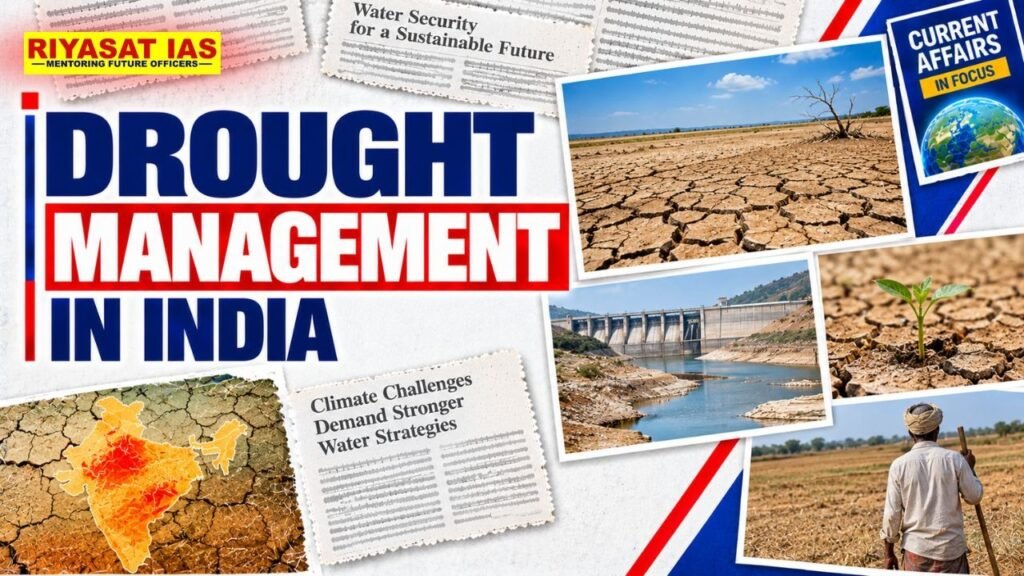
- Drought: A prolonged period of deficient rainfall that leads to water scarcity and adversely affects agriculture, ecosystems and human activities.
- Drought is a slow-onset disaster, unlike earthquakes or cyclones.
- Drought-prone regions: Rajasthan, Gujarat, Maharashtra, Karnataka, Andhra Pradesh, Telangana and parts of Tamil Nadu and Madhya Pradesh.
- Types of drought:
- Meteorological drought: Rainfall is significantly below the long-term average.
- Agricultural drought: Soil moisture becomes insufficient to meet crop-water requirements.
- Hydrological drought: Reduced water levels in rivers, reservoirs, lakes and groundwater.
- Socio-economic drought: Water scarcity affects the supply of goods and services, livelihoods and economic activities.
Drought Management in India
- Ministry of Agriculture and Farmers Welfare: Plays an important role in agricultural drought assessment and relief measures.
- Department of Agriculture and Farmers Welfare: Issues the Manual for Drought Management, which guides drought assessment, declaration and response.
- State governments: Have the primary responsibility for assessing and declaring drought in their respective states.
- NDMA: Provides the national framework and guidelines for disaster management, including drought.
- IMD: Provides rainfall observations, forecasts and meteorological drought-related information.
- Central Water Commission (CWC): Monitors water levels and storage in important reservoirs.
- ISRO: Satellite-based remote sensing helps monitor vegetation conditions, agricultural stress and drought impacts.
Drought Assessment and Declaration
- Drought Manual 2020: Provides a scientific framework for drought assessment using rainfall, agricultural conditions, soil moisture and remote-sensing indicators. Revision discussions were initiated in 2025.
- State government: The final authority for declaring a region drought-affected; India does not have one universally applicable legal definition of drought.
- Rainfall deficiency: Seasonal rainfall deficiency of more than 10% from the long-period average is one important indicator, but drought declaration requires assessment of additional indicators.
- Remote sensing: Satellite-based indicators help assess vegetation health and agricultural stress.
- NDMA Guidelines on Management of Drought: Released in September 2010.



Major Schemes and Initiatives
| Scheme / Initiative | Key objective |
| PMKSY — Pradhan Mantri Krishi Sinchayee Yojana | Expand irrigation coverage and improve water-use efficiency. |
| MGNREGA | Create rural employment through water conservation, ponds and other drought-proofing works. |
| Atal Bhujal Yojana | Community-led sustainable groundwater management in selected areas. |
| Jal Shakti Abhiyan: Catch the Rain | Rainwater harvesting and water conservation. |
| Watershed Development Component of PMKSY (WDC-PMKSY) | Soil and water conservation, rainfed-area development and restoration of degraded land. |
| National Rainfed Area Authority (NRAA) | Supports planning and coordination for rainfed and dryland agriculture. |
| Drought Mitigation Project | A project launched in March 2026 to support drought mitigation in 12 drought-prone states through resilient landscapes and sustainable natural-resource management. |
UPSC Prelims Practice Questions
Q.Consider the following statements about drought management in India:
1. NDMA issued national drought-management guidelines in 2010.
2. Drought can occur even in regions receiving high annual rainfall.
3. El Niño invariably causes drought in India.
Which statements are correct?
A. 1 only
B. 1 and 2 only
C. 2 and 3 only
D. 1, 2 and 3
Answer: B
Statements 1 and 2 are correct. El Niño can increase drought risk, but its effect on India’s monsoon is not inevitable.
Build a Strong Foundation for UPSC CSE 2027–2028! Start your preparation with the Riyasat IAS Foundation Mentorship Program in English Medium. Strengthen your GS concepts, develop effective study habits, and prepare for Prelims and Mains with structured mentorship.


 Ravi Raaz
 Hassan Khan
 Shadab Ali