
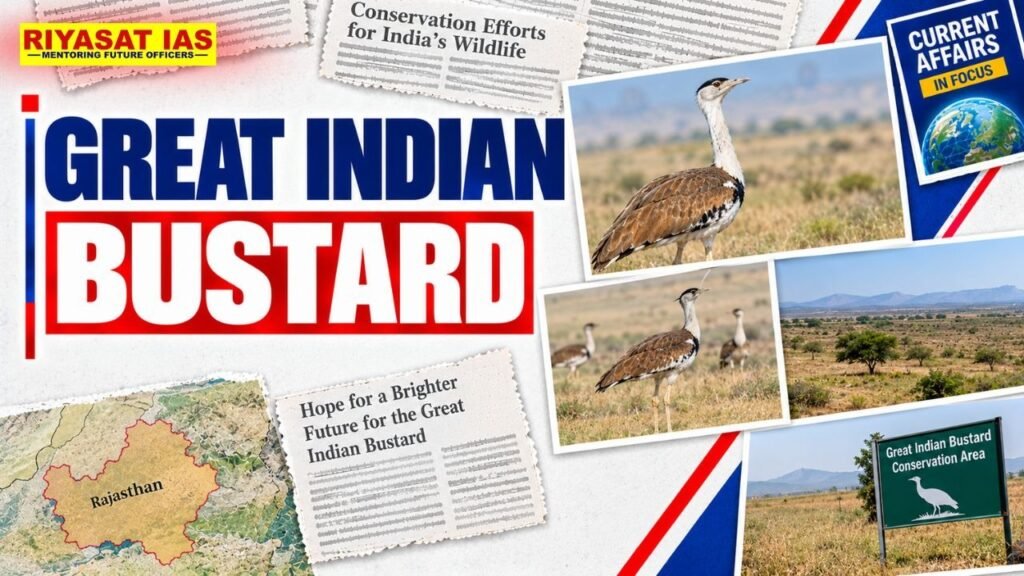
- Scientific name: Ardeotis nigriceps
- Common name: Godawan.
- Conservation status: Critically Endangered on the IUCN Red List.
- Habitat: Grasslands and open, arid and semi-arid landscapes.
- Distribution: Mainly Rajasthan, with small populations in Gujarat and other parts of its historical range.
- State bird: Rajasthan.
- Major habitat: Desert National Park, Rajasthan.
- Ecological importance: A flagship species of India’s grassland ecosystems.
- Major threats: Habitat loss and fragmentation, collisions with overhead power lines, disturbance and low reproductive rates.
Environmental Programmes for Conservation
1. Project Great Indian Bustard
- Launched by the Rajasthan Government on 5 June 2013.
- Aims to protect the remaining population and its habitat.
2. Bustard Recovery Programme
- Implemented by the Wildlife Institute of India (WII) with support from MoEFCC and state forest departments.
- Focuses on conservation breeding, applied research, habitat restoration, threat mitigation and monitoring.
- Covers the Great Indian Bustard and Lesser Florican.
3. Habitat Improvement and Conservation Breeding — Integrated Approach
- Supported by the National CAMPA Authority.
- Conservation-breeding facilities are located at Sam and Ramdevra, Jaisalmer, Rajasthan.
- Includes captive breeding, scientific research, habitat improvement and preparation for release into the wild.
4. Conservation Action Plan for GIB and Lesser Florican
- The National CAMPA Authority approved ₹77.05 crore for five years in 2024.
- Includes surveys, artificial insemination research, habitat improvement, predator management, community participation and telemetry-based monitoring.



Important Conservation Developments
- Jumpstart Approach: A captive-laid fertile egg is placed in a wild nest, where a wild female incubates it. In March 2026, this approach helped a chick hatch in Gujarat after a decade.
- Power-line mitigation: Overhead power-line collisions are a major threat. Conservation efforts include identifying dangerous stretches and measures to reduce collision risks.
- Recent milestone: On 4 October 2026, two captive-bred male Great Indian Bustards were released into the wild at Desert National Park, Jaisalmer, marking a major step towards rewilding.
Prelims Practice Questions
Q1. Consider the following statements about the Great Indian Bustard:
- It is classified as Critically Endangered by the IUCN.
- It is a grassland species.
- Rajasthan is an important stronghold of the species.
- Its major threat includes collisions with overhead power lines.
Which of the statements given above are correct?
(a) 1 and 2 only
(b) 1, 2 and 3 only
(c) 2, 3 and 4 only
(d) 1, 2, 3 and 4
Answer: (d) 1, 2, 3 and 4
Write Better Answers. Prepare with Greater Clarity.
Improve your answer structure, analytical depth, presentation, and use of examples through focused answer-writing practice and constructive feedback.
👉 Strengthen Your UPSC Mains Answer Writing with Riyasat IAS!




 Ravi Raaz
 Hassan Khan
 Shadab Ali