
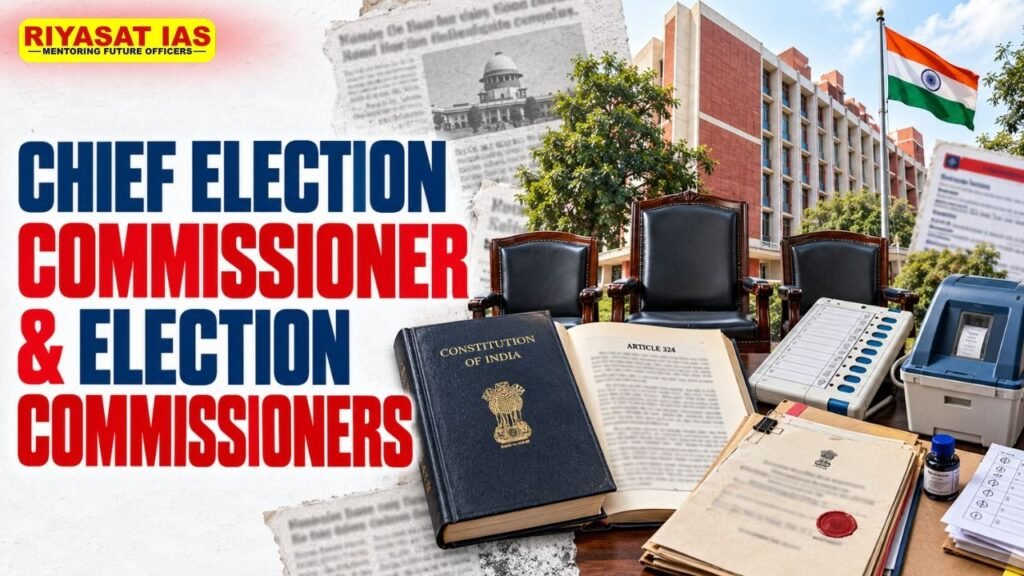
- Constitutional Provision: Article 324(2) of the Constitution provides for the appointment of the CEC and other ECs by the President, subject to any law made by Parliament.
- Governing Law: Chief Election Commissioner and Other Election Commissioners (Appointment, Conditions of Service and Term of Office) Act, 2023.
- Appointment:
- Appointed by the President on the recommendation of a Selection Committee.
- Selection Committee: Prime Minister (Chairperson), Leader of Opposition in the Lok Sabha (Member), and a Union Cabinet Minister nominated by the Prime Minister (Member).
- Search Committee: Headed by the Union Minister of Law and Justice; prepares a panel of five persons for consideration by the Selection Committee.
- Eligibility: Persons who hold or have held a post equivalent to the rank of Secretary to the Government of India, with integrity and knowledge of, and experience in, the management and conduct of elections.
- Term of Office: Six years from the date of assuming office or until attaining 65 years of age, whichever is earlier. No reappointment.
- Removal of CEC: Removed in the same manner and on the same grounds as a Judge of the Supreme Court.
- Removal of ECs: Cannot be removed except on the recommendation of the CEC.
- Supreme Court Judgment: Anoop Baranwal v. Union of India (2023) directed that appointments be recommended by a committee comprising the Prime Minister, Leader of Opposition in the Lok Sabha and Chief Justice of India, until Parliament made a law.
Prelims Practice Questions
Q1. With reference to the appointment of the Chief Election Commissioner (CEC) and other Election Commissioners (ECs), consider the following statements:
- The Constitution provides for their appointment by the President.
- The Selection Committee includes the Prime Minister, the Leader of Opposition in the Lok Sabha, and a Union Cabinet Minister nominated by the Prime Minister.
- The Chief Justice of India is a member of the Selection Committee under the 2023 Act.



Which of the statements given above is/are correct?
(a) 1 only
(b) 1 and 2 only
(c) 2 and 3 only
(d) 1, 2 and 3
Answer: (b) 1 and 2 only. The CJI was part of the interim committee directed by the Supreme Court in Anoop Baranwal (2023), but is not included in the Selection Committee under the 2023 Act.
Q2. the following statements:
- The CEC can be removed in the same manner and on the same grounds as a Judge of the Supreme Court.
- Other Election Commissioners can be removed only on the recommendation of the CEC.
- The President can remove the CEC at their discretion.
Which of the statements given above is/are correct?
(a) 1 only
(b) 1 and 2 only
(c) 2 and 3 only
(d) 1, 2 and 3
Answer: (b) 1 and 2 only. The CEC has removal protection comparable to a Supreme Court Judge, while other ECs cannot be removed except on the CEC’s recommendation.





 Ravi Raaz
 Hassan Khan
 Shadab Ali