
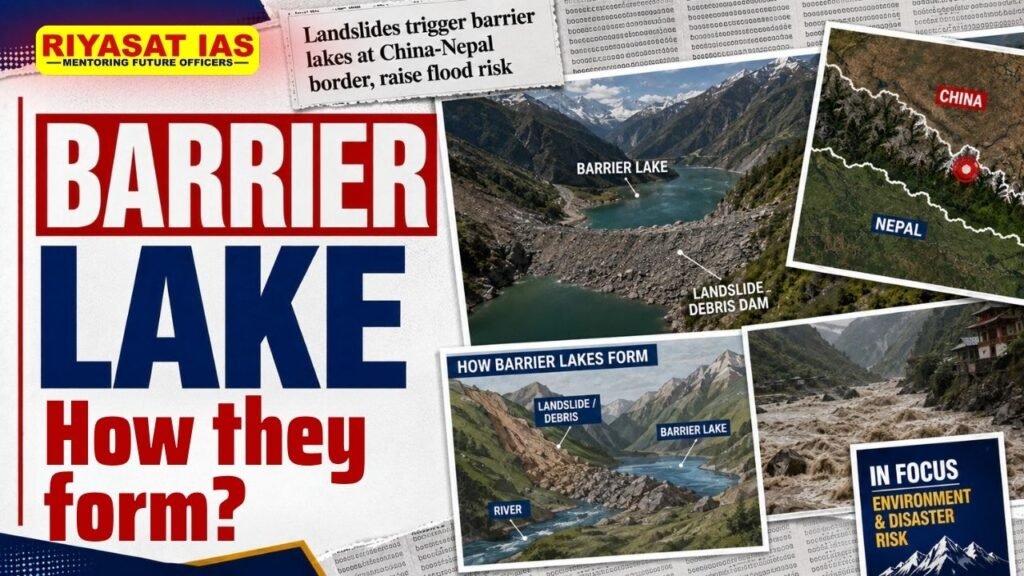
- Meaning: A barrier lake is formed when a natural or artificial barrier blocks the flow of a river/stream, causing water to accumulate upstream.
- Natural Barriers: Common natural barriers include landslides, rockfalls, volcanic lava flows, moraines and glacial debris.
- Landslide-Dammed Lake: When a landslide blocks a river valley, the resulting lake is called a landslide-dammed or barrier lake.
- Hazard: Such lakes can be unstable. Failure or overtopping of the natural barrier can cause a sudden release of water, producing a flash flood.
- Himalayan Relevance: In the Himalayas, earthquakes, landslides and glacial processes can create temporary barriers and lakes, increasing the risk of downstream flooding.
- Difference from GLOF: A GLOF specifically involves the sudden release of water from a glacial lake, whereas a barrier lake may form due to several types of barriers.
Prelims Question — English
Q. With reference to a Barrier Lake, consider the following statements:
- It can form when a landslide blocks the course of a river.
- Failure of the natural barrier can cause a flash flood downstream.
- Every barrier lake is necessarily a glacial lake.



Which of the statements given above are correct?
A. 1 and 2 only
B. 2 and 3 only
C. 1 and 3 only
D. 1, 2 and 3
Answer: A
Explanation: A barrier lake forms when a natural or artificial barrier obstructs drainage. Landslides are a common natural cause. If the barrier fails, accumulated water can be released suddenly, causing a flash flood. However, a barrier lake is not necessarily a glacial lake; it can result from landslides, volcanic activity, moraines or other barriers.




 Ravi Raaz
 Hassan Khan
 Shadab Ali