
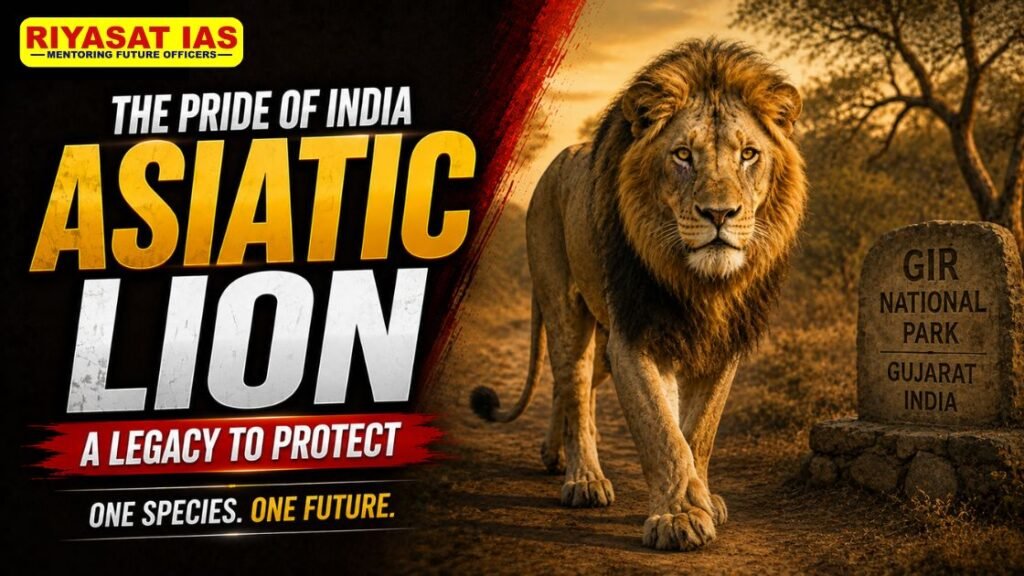
- Scientific Name: Panthera leo persica
- IUCN Red List Status: Endangered, indicating that the species faces a very high risk of extinction in the wild if conservation efforts are not sustained.
- CITES: Appendix I, which provides the highest degree of international protection by prohibiting commercial international trade in the species.
- Wildlife (Protection) Act, 1972: Schedule I, providing the highest level of legal protection in India.
- Endemic to India: The Asiatic Lion is the only wild lion population found in India and the last surviving population of Asiatic lions in the world.
- Distribution: Its natural habitat is confined to the Gir Landscape of Gujarat, which includes:
- Gir National Park and Wildlife Sanctuary
- Girnar Wildlife Sanctuary
- Pania Wildlife Sanctuary
- Mitiyala Wildlife Sanctuary
- Surrounding reserved forests and revenue areas
- State Animal: The Asiatic Lion is the State Animal of Gujarat.
- Habitat: It inhabits dry deciduous forests, thorn scrub forests, savannah grasslands and open woodland ecosystems, where sufficient prey and water are available.
- Diet: It is a carnivore, feeding mainly on Chital, Sambar, Nilgai, Wild Boar, Four-horned Antelope and livestock in some areas.
- Distinctive Features:
- Comparatively smaller and less developed mane than the African lion.
- A prominent longitudinal fold of skin along the belly, which helps distinguish it from African lions.
- Generally lives in smaller prides than African lions.
- Major Threats:
- Entire wild population concentrated in a single geographical region, making it vulnerable to epidemics and natural disasters.
- Human–wildlife conflict.
- Habitat fragmentation.
- Disease outbreaks and genetic bottlenecks due to limited population distribution.
- Conservation Measures:
- Project Lion launched by the Government of India for habitat improvement, disease management and long-term conservation.
- Continuous habitat expansion within the Gir landscape.
- Wildlife health monitoring and disease surveillance.
- Strengthening wildlife corridors and prey-base management.



UPSC Prelims Question (English)
Q. With reference to the Asiatic Lion, consider the following statements:
- It is the only wild lion population found in India.
- It is listed as Endangered under the IUCN Red List.
- It is included in Appendix I of CITES.
- It is naturally found in more than one Indian State.
Which of the statements given above is/are correct?
(a) 1 and 2 only
(b) 2, 3 and 4 only
(c) 1, 2 and 3 only
(d) 1, 2, 3 and 4
Answer: (c)
Explanation:
- Statement 1 is correct: The Asiatic Lion is the only wild lion population surviving in India.
- Statement 2 is correct: It is classified as Endangered by the IUCN.
- Statement 3 is correct: It is listed in CITES Appendix I, ensuring the highest level of international trade protection.
- Statement 4 is incorrect: Its natural wild population is confined to the Gir landscape of Gujarat.





 Ravi Raaz
 Hassan Khan
 Shadab Ali