
GS-II | International Relations | India–ASEAN Relations | Regional Security
GS-III | Defence | Security | Defence Technology
Why in News?
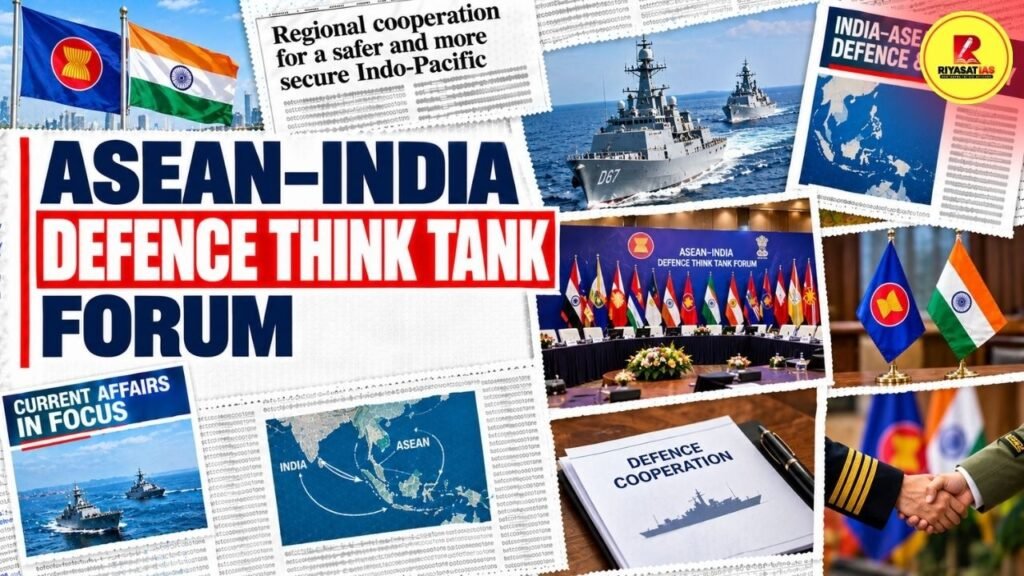
- The first ASEAN-India Defense Think Tank Forum was held at the Manohar Parrikar Institute for Defense Studies and Analyses in New Delhi, India, during October 14th-15th, 2026.
- The event brought together delegates representing India and each of the eleven member nations of the Association of Southeast Asian Nations (ASEAN) in order to improve both strategic communication and defense collaboration.
- The project met a promise made by Defense Minister Rajnath Singh during the second ASEAN–India Defense Ministers’ Informal Meeting held in Kuala Lumpur in October 2025.
Key Issues and Developments
1. Significance of the Forum
- Institutional Dialogues: This is an exclusive avenue for security professionals, researchers and experts in defense to discuss their views about regional security.
- Beyond government interaction: It increases the level of non-governmental participation in addition to the other types of non-governmental participation that are already available through existing programs like the Delhi Dialogue and the ASEAN-India Network of Think Tanks.
- Strategic Insight: It allows us to view the way in which ASEAN states perceive the issues related to regional safety and the strategic rivalry among nations.
- Sustained Engagement: In addition to building a level of trust with regular interactions, a consistent engagement of this type will also develop India’s long-term relationship with Southeast Asia.
2. India’s Indo-Pacific Vision and ASEAN Outlook
- India’s Vision: Defense Minister Rajnath Singh expressed India’s vision of an Indo-Pacific in which every nation has the ability to safeguard its own interests, choose freely what it wants to do, and work towards developing itself in peace.
- ASEAN Outlook on the Indo-Pacific (AOIP): India seeks to complement ASEAN’s approach rather than create competing regional frameworks.
- Core Principles: The basic principles are to respect the independence of other nations, to follow international laws, to use communication and trust as well as work together peacefully.
- Strategic Autonomy: ASEAN countries are working to maintain their independence in a time of increasing strategic competition between the world’s most powerful nations.
- Challenge: India’s strategic priorities are not always emphasized equally throughout ASEAN, due to differences in national interest and sensitivities.



3. Major Areas of Cooperation
- Strategic Stability: The global system for peace and security based on rules. Maritime security. Regional geopolitics.
- Maritime Cooperation: The maritime cooperation includes:
- Awareness of maritime domains
- Coast guard cooperation
- Joint exercises and interoperability
- HADR (Humanitarian Assistance & Disaster Relief): better prepare for disasters, share information with other organizations and coordinate emergencies.
- Emerging Technologies: Cybersecurity, Counter-Drone Technologies, Defense Innovation, and Joint Research.
- Critical Infrastructure: Strengthening the security and resilience of essential infrastructure and supply chains.
4. Defence-Industrial Cooperation
- Beyond arms sales: ASEAN countries wish to develop long-term relationships with India as opposed to simply buying its military hardware.
- Maintenance, Repair and Overhaul (MRO): Reliable maintenance and technical support help build strong defense relationships over time.
- Technology Transfer: Cooperation can be sustained over time by transferring technology and building local industry capacity.
- Co-development & co-production: Partnerships between Indian and Southeast Asian businesses can lead to collaborative production and innovation.
- Resilient Supply Chain: A diverse and reliable supply chain may decrease strategic risks.
5. Challenges in India–ASEAN Defence Relations
- Different Strategic Views: Some ASEAN states would likely be hesitant to publicly address some of the more sensitive issues like the Quad and the Code of Conduct for the South China Sea.
- Competition for Influence: In addition to the above mentioned types of investment, other dialogue partners make similar investments in exchange programs, fellowship opportunities, and joint research projects with ASEAN institutions.
- Technology Transfer: Conference-based engagement is limited to a single event and will not be enough to create long-term relationships of trust with participants if there are no other interactions between the institutions involved.
- Need for Local Participation: Defense cooperation must meet the individual needs of each ASEAN country and build up their internal capacity.
- Institutional Coordination: India should coordinate more closely with the existing ASEAN-led and broader Indo-Pacific platforms.
Way Forward
- Regularise the Forum: Hold meetings periodically, preferably biennially, with continuous work between meetings.
- Promote Research Collaboration: Establish common research areas, fellowships, and exchanges for early-career scholars and military personnel.
- Conducting Tabletop Exercises: To improve coordination and preparation for maritime emergencies, cyber security incidents, and humanitarian assistance.
- Strengthen Institutional Networks: The institutional networks should be strengthened: collaborate more closely with the Network of ASEAN Defence and Security Institutions (NADI).
- Integrate regional platforms: Establish relationships/synergy with ASEAN, IORA (Indian Ocean Rim Association), BIMSTEC and India’s IPOI (Indo-Pacific Oceans Initiative).
- Focus on real-world results: Prefer to work on projects together with others, establish relationships based upon technology, exchange data related to the ocean, and measure success through periodic reviews.
- Respect the Centrality of ASEAN: Align India’s actions with those of ASEAN, while recognizing that each member state has their own strategic independence and different interests.
Conclusion
- The ASEAN–India Defence Think Tank Forum provides a critical vehicle to expand strategic confidence through the use of non-governmental means in addition to governmental interactions.
- The effectiveness of the Forum is dependent upon developing dialogue into sustained research programs, practical defense collaborations, and strengthened institutional partnerships.
- To date, India has focused on conducting regional events, but now needs to focus on establishing long-term strategic relationships with the countries of Southeast Asia.
UPSC Mains Practice Question
Q. Examine the significance of the ASEAN–India Defence Think Tank Forum in strengthening India’s Act East Policy and its Indo-Pacific engagement. What challenges must be addressed to deepen defence cooperation with ASEAN?
Master International Relations with Riyasat IAS! Prepare for UPSC Current Affairs 2026 with expert guidance, comprehensive GS coverage, and answer-writing practice.
Join our UPSC Mentorship Program 2027 to strengthen your preparation for the UPSC Civil Services Examination.




 Ravi Raaz
 Hassan Khan
 Shadab Ali