
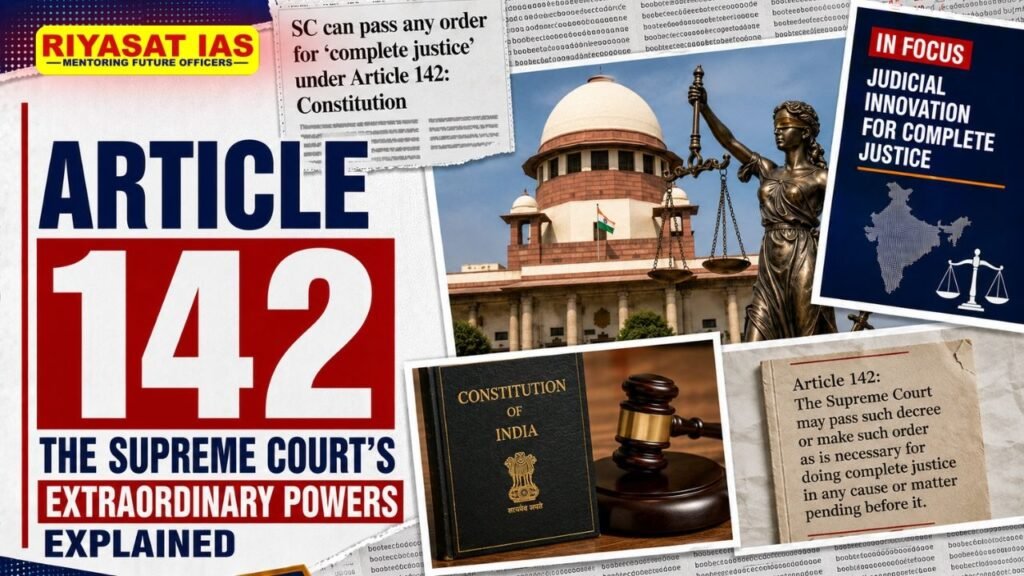
Constitutional Provision: Article 142 empowers the Supreme Court to pass any decree or order necessary for doing “complete justice” in any cause or matter pending before it.
- Exclusive Power: The power under Article 142 is vested only in the Supreme Court, not in High Courts.
- Enforceability: Any decree or order made under Article 142 is enforceable throughout the territory of India.
- Purpose: It enables the Supreme Court to provide an effective remedy when existing legal provisions or procedural limitations are insufficient to achieve complete justice.
- Discretionary Power: Article 142 gives the Court wide discretionary powers to mould relief according to the circumstances of a case.
- Constitutional Limitation: The power is not unlimited. It cannot be exercised in a manner that violates the Constitution or defeats substantive statutory law.
- Supplementary Character: Article 142 is intended to supplement the law, not become a substitute for legislation.
Article 142 vs Article 141
- Article 141: Law declared by the Supreme Court is binding on all courts within India.
- Article 142: Supreme Court can pass orders to ensure “complete justice” in matters before it.



Prelims Question
Q. With reference to Article 142 of the Constitution of India, consider the following statements:
- It empowers the Supreme Court to do complete justice in any cause or matter pending before it.
- Orders passed under Article 142 are enforceable throughout India.
- High Courts also possess the same power under Article 142.
Which of the statements given above is/are correct?
Answer: A. 1 and 2 only
Explanation: Article 142 is a special constitutional power of the Supreme Court. It allows the Court to pass necessary orders for doing complete justice, and such orders are enforceable throughout India. High Courts do not derive this power from Article 142.





 Ravi Raaz
 Hassan Khan
 Shadab Ali