
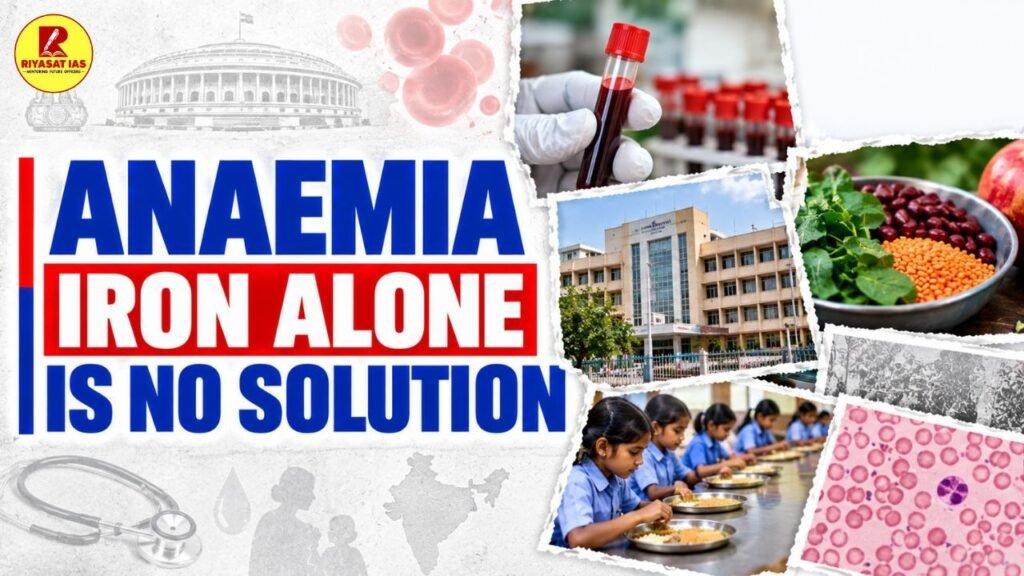
GS-II | Health | Nutrition | Government Policies and Interventions | Social Justice | Human Resource Development
Introduction
- Anaemia Burden: There is no doubt about India’s anaemia burden. More than half of all women and almost two-thirds of young children were found to be anaemic by the fifth National Family Health Survey (NFHS-5).
- Double-Fortified Salt (DFS): DFS has been suggested as a possible game changer since it contains both iodine and iron, and virtually every person uses salt.
- Convenience vs. Effectiveness: The effectiveness of a policy is different from its convenience; therefore, a policy which requires the public to continue to consume salt to provide them with iron should be evaluated more carefully.
Concerns Regarding Double-Fortified Salt (DFS)
- Conflict with Public Health Objectives: It is generally accepted that the average Indian consumes about twice as much as the five grams per day of salt that the World Health Organization (WHO) recommends.
- One out of every three adults is affected by hypertension, and India’s Non-Communicable Disease (NCD) Action Plan includes a goal of reducing salt consumption by 30% in relative terms.
- On the other hand, DFS goes against this because its logic relies on people continuing to eat large amounts of salt.
- Impact of Salt Reduction on Iron Consumption: Salt reduction has implications for household iron consumption, and the use of the term “double fortified” suggests that it is acceptable to consume higher amounts of DFS.
- To suggest that DFS is consistent with sodium reduction is merely a way of saying so, rather than being part of the design.
- Unequal Iron Intake: Iron intake is dependent upon a person’s age, gender and where they live.
- Adults (particularly males) tend to eat more than any other group, while children and females eat less than all other groups.
- Because of this, the groups who require iron the most may also have the lowest intake of iron, whereas the groups who are least likely to suffer from anaemia will have the highest intake of iron.
Health Risks Associated with Iron Fortification
- Iron Accumulation: The body does not have a formal mechanism to rid itself of iron. As such, it can build up over time and create oxidative stress. This buildup of iron has also been associated with metabolic disorders.
- Evidence from Pemba Trial (2006): The use of iron and folic acid supplements by children who live in an area of Tanzania where malaria is prevalent led to higher rates of hospitalisation and death.
- Evidence from Kenyan Trial (2015): Iron-fortified food led to a shift in infant gut microbiomes towards potentially harmful bacteria and increased levels of diarrhoea.
- Indian Context: India has large malaria-endemic and poorly sanitised areas.
- Haemoglobinopathies: Beta-thalassaemia affects millions of people in India. Sickle cell disease affects people who live primarily in tribal areas. Those who receive blood transfusions for thalassaemia may develop too much iron in their bodies.
- Limitations of Screening: Screening isn’t an effective means of safeguarding, nor is it feasible to screen the number of people who use the Public Distribution System (PDS) to purchase salt, which totals approximately 800 million.
Risk of Excessive Iron Intake Through Multiple Government Programmes
- Current Fortification Initiatives: Fortified rice is currently being made available via several delivery channels, which include the Public Distribution System (PDS), the Pradhan Mantri Poshan Shakti Nirman (PM POSHAN) initiative and the Integrated Child Development Services (ICDS) initiative.
- Iron Supplementation: Iron-folic acid tablets are also being distributed to multiple populations.
- Cumulative Iron Exposure: Children and young adults may receive iron from multiple government programmes (up to 4) when DFS is added.
- Lack of Assessment: There is no published evaluation of cumulative iron intake across these programmes. Therefore, it would be premature to begin a “central flagship” roll-out without an evaluation.



Factors Affecting Iron Absorption
- Non-Haem Iron: The iron contained within DFS is referred to as non-haem iron. As such, the absorption of this type of iron is significantly influenced by the other foods consumed during that particular meal.
- Inhibited Absorption: A typical Indian diet of grains (cereals), small grains (millets), and legumes (pulses) contains high amounts of phytate that can bind iron.
- Additionally, tea and coffee contain polyphenols that can interfere with the body’s ability to absorb iron, while milk contains calcium that may also decrease iron absorption.
- Low Absorption: Non-haem iron absorption in these cases can be low compared to the high absorption of haem iron, or iron taken with vitamin C while you have nothing in your system.
- Food Interaction: Since salt is used both in cooking and as a condiment on the plate, DFS will always be consumed with food.
- Many of the iron fortificants that are added to DFS will remain unabsorbed and travel into the colon; once there, they may provide sustenance for harmful microorganisms.
- Limitations of Efficacy Trials: The trial (with a supervised delivery) does not show how household cooking losses will affect the results, how much variability there will be in the doses received by each individual participating in the trial, and what kind of effect the different diets consumed by those participating in the trial will have on the results.
- Effect of Infection and Inflammation on Absorption: The effect of an infection and/or inflammatory process on the absorption of iron will be affected by the production of the hormone hepcidin.
- Hepcidin will prevent the body from absorbing iron.
- Therefore, the use of fortification to help individuals who have low levels of iron will not be as effective in areas where there is a high number of individuals experiencing infections.
Anaemia Is Not the Same as Iron Deficiency
- Iron Deficiency and Anaemia: Globally, approximately 50% of all cases of anaemia result from a lack of iron.
- The Comprehensive National Nutrition Survey conducted in India from 2016-2018 used biological markers to determine how much of the anaemia observed among children and adolescents could be explained by a deficiency in iron.
- The results indicated that only some of the anaemia in these age groups was caused by a lack of iron.
- Nutritional Deficiencies: The remaining causes of anaemia are due to nutritional deficiencies, such as folate and vitamin B12, both of which are very prevalent in individuals who follow a vegetarian diet, as well as an overall lack of proper nutrition, including too little protein and too little vitamin A.
- Infections and Other Factors: Chronic inflammatory states, recurrent infections, hookworm infestations, malarial infections, inadequate sanitation practices, and haemoglobinopathies are all other contributing factors to anaemia.
- Social and Biological Factors: Early marriage, early pregnancy, adolescent undernutrition, and menstrual loss contribute to the overall issue.
- Measurement Issues: Capillary haemoglobin measurements and cut-off points applied to the data used for establishing prevalence rates have been in question as to which one provides accurate results.
- Multi-Causal Aspect: The Indian diet has little variety and contains very little haem iron; however, diet is only one possible solution to this problem.
- If a single-nutrient solution is attempted to be used to solve a multi-causal problem, then you are going to get less than what you expected out of it.
- Also, you could end up taking away focus from finding out why people are getting sick (diagnostic) and spending money on improving their hygiene (sanitation), which are things that would actually help solve the problem.
Limitations of India’s Existing Anaemia Control Strategy
- 7x7x7 Approach: India’s new approach to addressing anaemia, which includes a 7x7x7 approach, has received some praise for including other approaches than what it is currently doing.
- Dependence on Iron-Folic Acid Tablets: Despite having documented compliance problems and GI side-effects, the programme continues to rely on iron-folic acid tablets.
- Inadequate Diagnostics: Testing of haemoglobin alone cannot determine what is causing the anaemia; however, routine testing for ferritin, vitamin B12, and inflammation markers is primarily non-existent.
- Affordability of Healthy Food: The ‘Eating Right’ concept is on its way to being just another advertising slogan if it does not address the affordability of foods that are good for you, such as eggs, milk products, green leafy vegetables and millet.
- Weak Outcome Monitoring: Digital tracking usually records tests and tablets, but does not measure health outcomes.
- Neglect of Other Interventions: Deworming, malaria control, water and sanitation hygiene (WASH) are currently on the fringe.
- One-Solution Thinking: If we were to make DFS our primary method, we’d simply go back into that same type of thinking that we are trying to get away from with the use of the 7x7x7 framework.
International Experiences in Anaemia Reduction
- Peru’s Approach: Peru has been able to significantly decrease the number of children with anaemia over the past ten years.
- This reduction was achieved through a variety of measures, including making anaemia a top priority for politics, tracking each child individually through health contacts, providing both iron supplements and micronutrient powders to low-income families via cash transfers, and holding regional governments responsible for decreasing rates of anaemia within their jurisdictions.
- Lessons from Peru: When the COVID-19 pandemic disrupted service delivery, progress was reversed. This demonstrates that sustaining service delivery determines outcomes, not products.
- Vietnam’s Approach: Weekly iron-folic acid supplements, deworming, and fish sauce containing NaFeEDTA, a form of iron that can be absorbed more efficiently than other forms of iron in phytate-rich diets, were used by Vietnam to lower the levels of anaemia in women.
- Supporting Factors: These efforts were coupled with increased household income and a more varied diet. Vietnam’s fortification programme was specifically designed for the local diet and implemented alongside other measures.
- Key Learning: Neither of these cases demonstrates that a single fortified food item will be able to resolve anaemia alone.
Way Forward
- District-Level Pilot Programmes: India should not scale up its national DFS programme until it conducts some district-level pilot programmes.
- Scientific Assessment: Pilots must determine ferritin, haemoglobin, and inflammatory markers, evaluate the amount of iron people have been exposed to through different programmes, and assess if they are at risk of being harmed in areas where malaria is prevalent and/or there is a high incidence of haemoglobin disorders.
- Targeted Fortification: Fortification is most effective when it is targeted, as opposed to universal, and utilises iron that has been shown to be more easily absorbed.
- Better Diagnosis: Increased funding is needed for diagnosis of the cause of anaemia.
- Strengthening Public Health Initiatives: Greater resources should be allocated to enhancing public health initiatives through improved sanitation, affordable access to a variety of foods, and increased funding for deworming programmes.
Conclusion
- Anaemia can result from many different things and cannot be cured with just a simple addition to the salt shaker.
- A single-nutrient solution is unlikely to address the diverse causes of anaemia.
- In addition to focusing on targeted fortification, improved diagnosis of conditions requiring fortification, deworming, improved sanitation and providing access to a wide variety of affordable food options.
UPSC Mains Practice Question
Q. Critically examine the concerns associated with Double-Fortified Salt (DFS) as a strategy to address anaemia in India. Discuss the need for a comprehensive approach to tackle the multi-causal nature of anaemia.




 Ravi Raaz
 Hassan Khan
 Shadab Ali